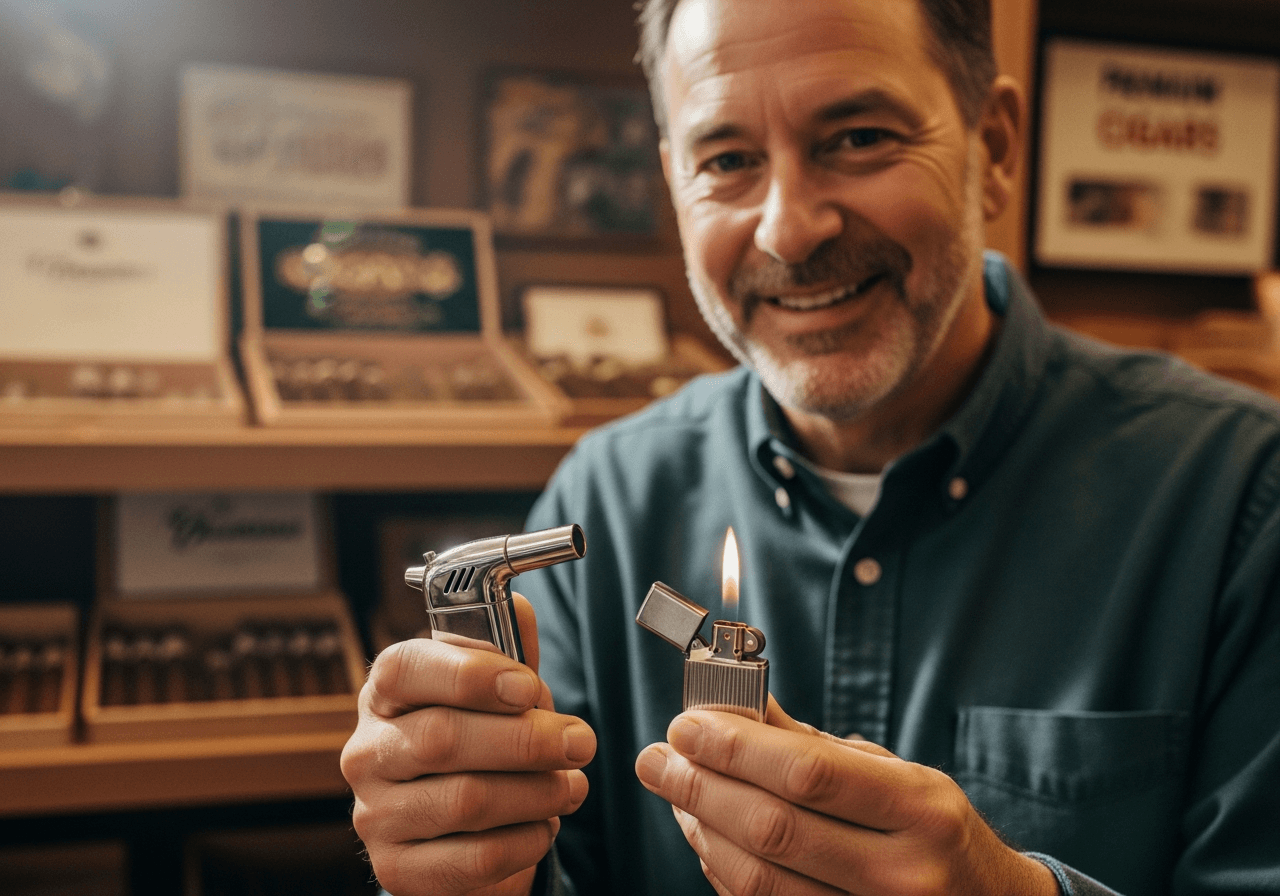
At the old shop on Seventh Avenue in Ybor, we kept a little tray by the register: a box of long matches, a glass jar of Spanish cedar spills, two soft-flame lighters, and a triple-torch we used when somebody walked in with a 60 ring gauge and ten minutes to kill. The tray was there because the question I got most often, after which cigar, was what should I light it with. After fifty years around tobacco, I can tell you the honest answer: it depends on the cigar, the room, and the kind of smoker you are.
So let's walk through it the way I would have at the counter, with no rush.
Start with what a cigar actually needs
A premium cigar is a different animal from a cigarette. It is hand-bunched, it holds more moisture, and the foot you are about to light is a bundled face of filler, binder, and wrapper that all want to catch evenly. If one side lights and the other does not, you get a canoe, and a canoe is a slow miserable smoke.
That means whatever you light with has to do three things: deliver enough heat to char the whole foot, last long enough for you to toast it properly, and add nothing of its own to the taste. Everything below is just different ways of meeting those three requirements.
Matches and the trouble with them
I like matches. My father lit cigars with them at la fabrica when I was a boy. But the little paper matches you grab at a bar are not what you want. The sulfur tip burns hot and fast and dumps an off note right into the wrapper. By the time you have toasted half the foot, you are reaching for a second match, then a third.
If you are going to use matches, get the long wooden cigar matches, the ones around four inches. Light the match, let the sulfur burn off for a full two or three seconds, then bring it to the cigar. You will still need two or three of them for anything above a 50 ring gauge, but the smoke will taste clean.
Cedar spills, the old way
Spanish cedar spills are a thin slat of the same wood your humidor is lined with. You light the spill from a candle or a soft flame, then use the spill itself to toast the cigar. There has been a quiet revival of this method the last few years, and I am glad to see it. Klaro and a few other brands now sell pre-cut spills by the hundred, and you can also peel your own from a cedar humidor sheet.
The spill burns slow, gives you a wide soft flame, and adds nothing but a faint cedar note that actually flatters most wrappers. It is the most ritualistic way to light a cigar, and at this point in my life, I find the ritual is half the reason I sit down with one. If you ever get the chance to light a Padron Anniversario with a cedar spill on a back porch in January, you will understand.
Soft-flame butane lighters
A soft-flame lighter is what most of the old-timers I knew used day to day. Think of a refillable lighter with a normal yellow flame, fueled by clean butane. Brands like S.T. Dupont built their reputation on these, and there are plenty of more affordable options now from Xikar, Colibri, and others.
The soft flame is taller and gentler than a torch. It cannot fight wind worth a dime, so it lives indoors or on a sheltered porch. But it does not scorch the wrapper, and it gives you the same forgiving toast as a cedar spill with a little more convenience. For a Connecticut shade or any delicate wrapper, I would pick a soft flame every time.
Torch lighters and when you actually need them
The jet torch, with its blue cone of flame, is what most newer smokers reach for. It is windproof, it is fast, and it solves the canoe problem on a big ring gauge cigar in about fifteen seconds. The downside is that the flame is roughly 2,500 degrees, hot enough to caramelize the wrapper and bake a bitter edge into the first inch if you are careless.
A few honest guidelines:
- Single jet: good for cigars up to about a 50 ring gauge and excellent for touch-ups. Less fuel use, easier to control.
- Double jet: the all-around choice for most modern cigars in the 52 to 56 range.
- Triple jet: the right tool for the big 60-plus ring gauges that are everywhere now. The wide flame pattern lights the whole foot at once.
Whichever you choose, hold the cigar an inch or so above the flame, not in it. You are toasting, not branding.
What to look for when you buy
You do not need to spend a fortune. A good torch from Xikar, Colibri, Vector, or Lotus will last years if you treat it right. A few features genuinely matter:
- A clear fuel window. Running dry mid-smoke is its own small tragedy.
- An adjustable flame. Outdoor wind and indoor calm are not the same job.
- A flip-top or hinged lid that stays out of your way and keeps lint out of the jet.
- A built-in punch or cutter if you travel light. Two tools, one pocket.
- Solid construction. Pick it up. If it feels like a toy, it is.
A word on butane and care
This is where most lighters die before their time. Cheap butane is full of impurities that gum up the valve. Buy butane refined five times or better, which any decent tobacconist sells. Bleed your lighter of the old gas every few refills by pressing the valve with a small screwdriver until it stops hissing, then refill. If the flame goes weak, it is almost always either a clogged jet or trapped air, not a dead lighter.
What about USB and electric arc lighters
The plasma arc lighters are clever little things, and I understand the appeal of never buying butane. For pipes they can work fine. For cigars I would say wait. The arc gap is small, and you cannot toast a 54 ring gauge foot evenly with a tool that lights a half-inch slice at a time. If the technology catches up, fine. For now, it is a gadget.
What I would tell a new smoker
If you are just starting and want one lighter that does everything, get a double-jet torch with a clear fuel window from a known brand and a can of five-times refined butane. That kit will run you well under a hundred dollars and last a decade.
Once you settle in, pick up a soft-flame lighter or a jar of cedar spills for the cigars you really want to taste. There is no shame in owning two lighters. La fabrica had a tool for every job; your smoking corner can too.
The cigar is the point. The lighter is just how you get there. Pick one that gets out of the way, and enjoy the smoke.