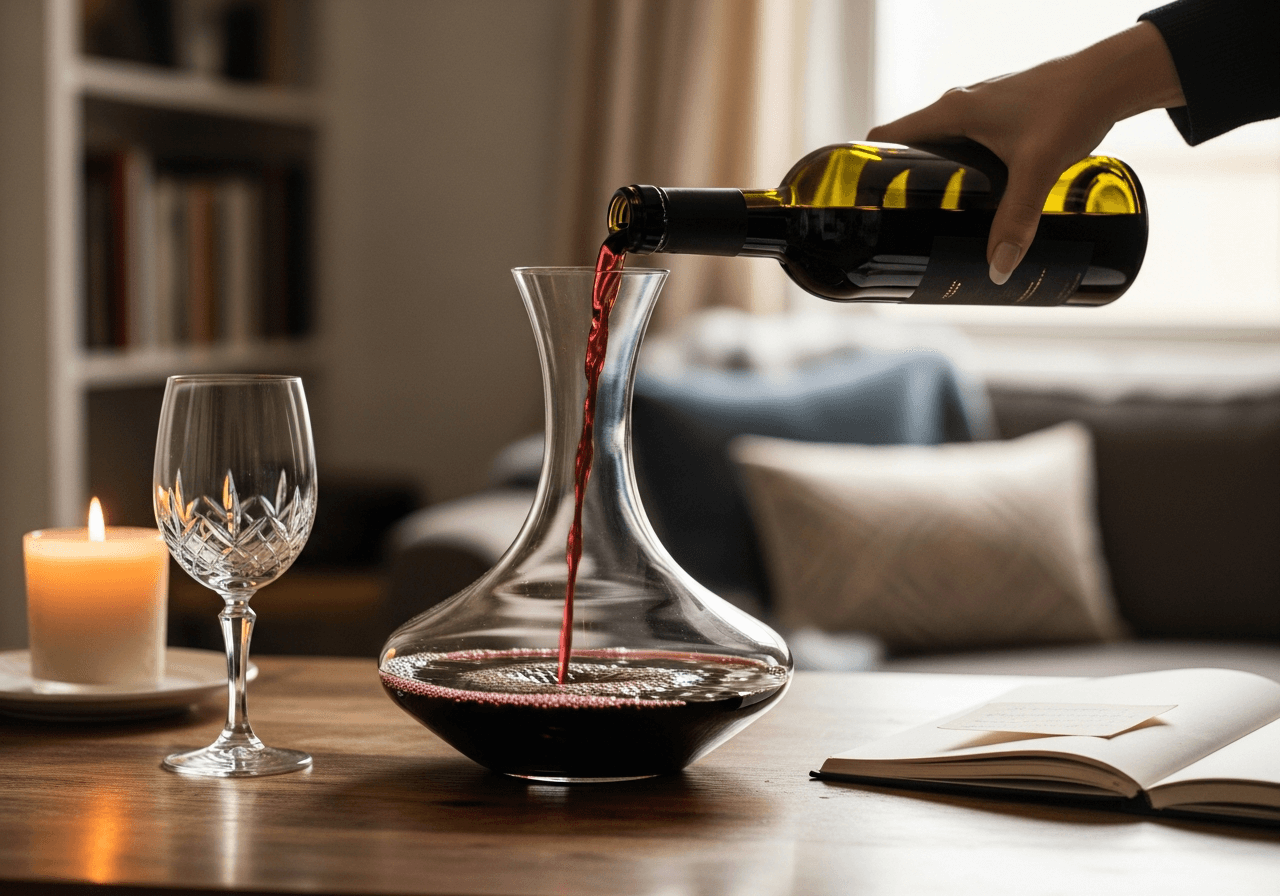
The decanter on my sideboard is a plain glass duck Susan bought me at a flea market in Healdsburg the year we moved up to the barn. Nothing fancy. It has held a 1997 Vega Sicilia that a friend pulled the cork on for our anniversary, and it has held a twelve-dollar Cotes du Rhone from the grocery store down the road. It does the same job in both cases, which is most of what I want to tell you about decanting.
People treat decanting like a parlor trick reserved for the cellar set. It is not. It is a small, useful habit that makes ordinary wine better and great wine more honest. If you have stayed away from it because it felt fussy, I would gently suggest you stop staying away.
Two reasons we decant, not one
There are really only two things a decanter does, and it helps to keep them separate in your head.
The first is sediment. Older reds, particularly mature Bordeaux, traditional-method Barolo, vintage Port, and any well-aged Rhone, drop a fine grit at the bottom of the bottle over time. That sediment is harmless but unpleasant on the tongue. Pouring the bottle slowly into a separate vessel lets you leave the dregs behind.
The second is air. Young red wine, freshly uncorked, is often tight, a little surly, a little closed. A producer I visit in the Rhone calls it “stretching its legs.” Twenty minutes to an hour in a wide-bottomed decanter, and the same pour smells and tastes more like itself. The tannins soften. The fruit comes forward. It is not magic; it is just oxygen doing what oxygen does.
Those two purposes pull in opposite directions, which is the whole reason this gets confusing. Old wine wants gentleness and a quick transfer to leave the sediment behind. Young wine wants a vigorous splash to wake it up. Same vessel, opposite techniques.
Which wines actually benefit
You do not need to decant every bottle. Most weeknight pours, in my house, go straight from bottle to glass and nobody complains. But here is roughly how I think about it.
- Young, full-bodied reds (under five or six years old). Cabernet Sauvignon, Nebbiolo, Syrah, Malbec, Tempranillo from Ribera del Duero, big Zinfandel. These almost always benefit from sixty minutes or more in a decanter. Pour them in with a splash.
- Young, medium-bodied reds. Merlot, Sangiovese, Grenache, Cotes du Rhone, lighter Tempranillos. Thirty to sixty minutes is plenty.
- Light-bodied reds. Pinot Noir, Gamay, Beaujolais cru. Twenty minutes, maybe thirty, and only if the wine seems shy in the glass.
- Mature reds (fifteen-plus years). Decant gently and serve soon. Fifteen, maybe twenty minutes. Older wines have delicate aromatics that can blow off if you give them too much air. The point here is sediment, not aeration.
- Whites. Most don’t need it. But a serious white Burgundy or a fine German Riesling can open up nicely with twenty minutes in a small decanter at cool temperature. This used to be heresy. It isn’t anymore.
- Vintage Port and unfiltered natural wines. Always decant for sediment. Always.
How to actually do it
Forget the candle for a moment. The first time I decanted in front of my father-in-law, I dripped wax on his tablecloth and never lived it down. Here is the simple version, the one I have used for forty years.
- Stand the bottle up for a day or two before you open it, if it is an older wine with sediment. This lets the grit settle to the bottom. If you grabbed the bottle off the rack two hours ago, stand it up now and do the best you can.
- Cut the foil cleanly below the lip and wipe the bottle mouth with a clean damp cloth. Pull the cork without yanking.
- Set a small light source behind the shoulder of the bottle as you pour. A candle is traditional and pleasant. A penlight or the flashlight on your phone, propped up against a saltshaker, works just as well. The point is to watch for the first wisps of sediment moving toward the neck.
- For an old wine, pour slowly and steadily, one continuous motion, into the decanter. When you see sediment approaching the neck, stop. There will be an ounce or two left in the bottle. That is fine. Leave it.
- For a young wine, pour with a little verve. Splash it in. You want it to slosh against the wide bottom of the decanter and pick up air. Then let it rest, uncovered, on the counter.
That is the whole production. It takes ninety seconds.
The vessel itself
A good decanter has a wide base and a narrower neck. The wide base maximizes the wine’s surface area against air. The narrow neck keeps the bouquet from dissipating into the room.
You do not need to spend two hundred dollars. A plain glass decanter from any kitchen store will do the job. Riedel makes lovely ones; so does Schott Zwiesel; so does the thrift store on Healdsburg Avenue. If you have a clean glass pitcher with a decent shape, use that until you get something better. Wine doesn’t know what it’s sitting in.
Clean it with hot water and a bottle brush, not soap. Soap residue will turn your next pour into something it should not be. Dry it upside down on a clean towel.
What people get wrong
Two small things I’d gently correct, having sat through a lot of dinners where the host meant well.
First, simply pulling the cork and letting the bottle sit on the counter does almost nothing. The opening at the top of the bottle is the diameter of a pencil. You are aerating about a thumbnail’s worth of surface area. If you want air on the wine, you need to move it.
Second, those plastic in-pour aerators that whistle and gurgle have their moment, but they cannot do what a decanter does for a stubborn young wine. They give the first pour a quick lift; they don’t give the whole bottle thirty quiet minutes of evolution. Use them in a pinch, not as a habit.
A small habit, a real return
At our age, the pleasure of a wine is less about acquiring it and more about taking proper care of what we already have. A bottle pulled from the rack tonight, decanted while you set the table, poured to whoever is sitting with you — that is a complete thing. It does not require a cellar, a cave in Burgundy, or a hundred-dollar bottle. It requires a glass vessel, a few minutes of attention, and the willingness to slow down.
Pour one this week. Decant it, even if it is a Tuesday and the wine cost fifteen dollars. You will notice. That is the point.