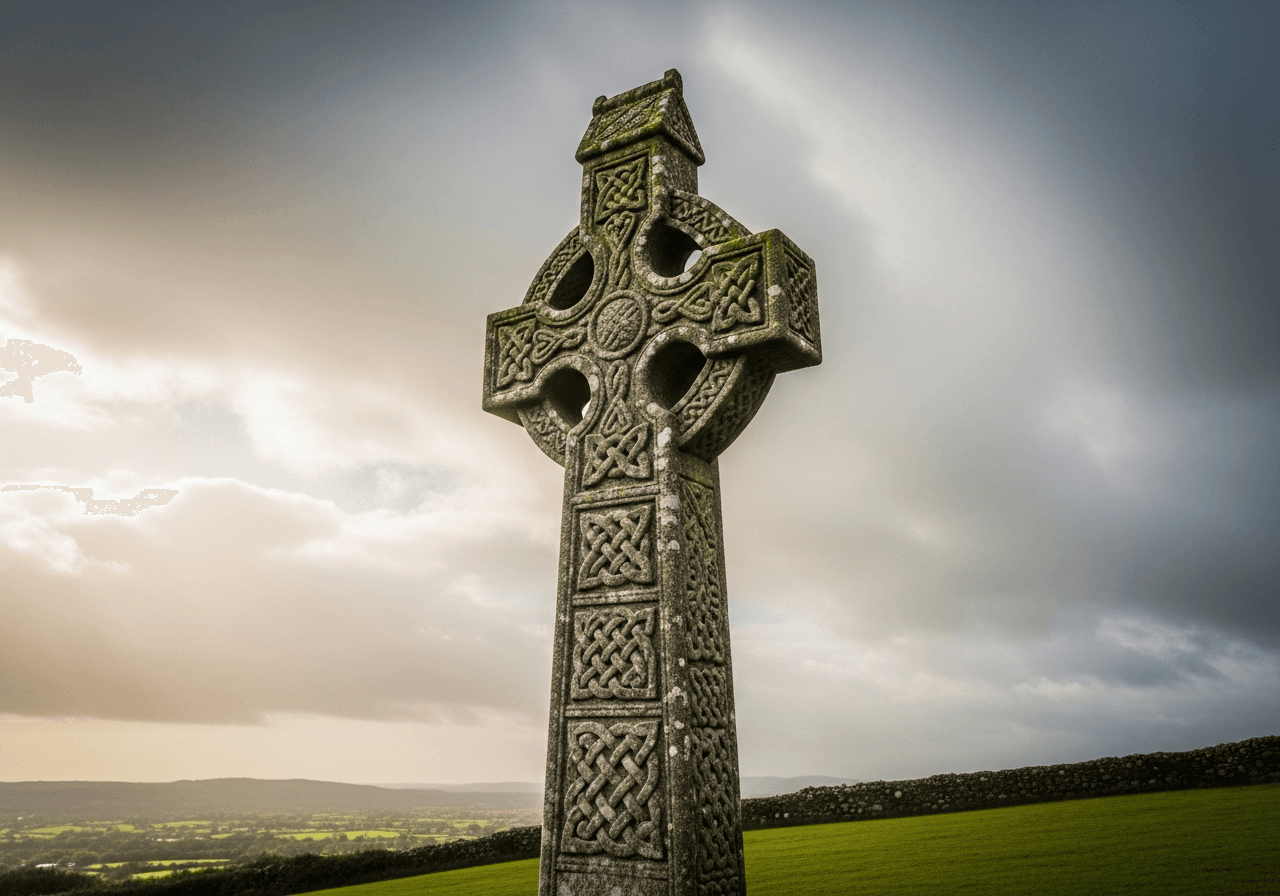
Of all the questions that came across the reference desk during my years at the library, the ones about family symbols were the most charming and the most prone to legend. The Celtic cross was a regular. Someone would bring in a photograph of a headstone from a trip to County Kerry, or a small silver pendant inherited from a grandmother, and ask where the design came from. The honest answer is that nobody knows for certain, and that the most popular story, the one about Saint Patrick drawing a circle through a Latin cross, is almost certainly a much later invention. That is not a disappointment. The real history, as best as scholars can reconstruct it, is more interesting than the legend.
What the Celtic cross actually is
When art historians use the term, they usually mean a cross with a ring or nimbus around the intersection of the arms, often carved in stone and decorated with interlace, spirals, and biblical scenes. According to the entry in Wikipedia, which draws on standard reference works in the field, the form emerged in Ireland and Britain in the Early Middle Ages and reached its most ambitious expression in the great stone high crosses erected from roughly the ninth through the twelfth centuries. The earliest surviving examples cluster in two places: Ahenny in County Tipperary, Ireland, and the island of Iona, off the coast of Scotland, which was a daughter house of the Irish monastic tradition.
That is a narrower window than most popular accounts suggest. It is worth noting that the high crosses are firmly Christian objects, made by monks for monastic settlements. The idea that the form is pre-Christian, or that it preserves a Druidic sun symbol absorbed by missionaries, is a much later interpretation. There is no archaeological evidence for it.
Where the ring came from
The ring around the intersection is the feature everyone notices, and it is the feature scholars argue about. Heritage Ireland, which oversees the state's care of these monuments, summarizes the main competing theories. There are roughly four:
- A practical, structural origin. Earlier wooden crosses may have used struts at the joint to support the crossarms, and the ring on stone crosses preserves the memory of those struts.
- A borrowing from earlier Christian art. The art historians Michael W. Herren and Shirley Ann Brown have argued that ringed crosses already existed in Christian iconography and that the Irish form is a regional development, not an invention from scratch.
- A connection to the Coptic ankh, the looped cross of Egyptian Christianity, brought into Ireland through wider contact with the Eastern Mediterranean.
- An adaptation of indigenous Bronze Age imagery in which a wheel or disc surrounds a head, repurposed for Christian use.
None of these has been proven. They are not mutually exclusive, either. A monastic carver working in the ninth century could have inherited several visual habits at once and combined them. The honest summary is that the ring is old, its origins are debated, and the Saint Patrick story belongs to folklore rather than history.
The high crosses themselves
If you have ever stood in front of one, you understand why scholars treat them as a class of their own. The cross at Muiredach's monastery at Monasterboice in County Louth stands roughly eighteen feet tall and is carved on every face with biblical scenes: the Fall, Cain and Abel, Moses, the Crucifixion, the Last Judgment. The Cross of the Scriptures at Clonmacnoise is similar in ambition. These were not grave markers in the modern sense. They were public catechism, set up where ordinary people would walk past them, in an age when most could not read.
The carving tradition tapered off after the arrival of the Anglo-Normans in the late twelfth century, as monastic patronage shifted and the political landscape changed. Many of the surviving crosses spent centuries weathered in fields. Several have now been moved indoors for protection, with weatherproof replicas left in their original spots, a conservation choice that has been quietly underway across Ireland over the past few decades.
Folklore, faith, and the Saint Patrick story
The story that Patrick combined a Christian cross with a pagan sun symbol to ease conversion is appealing and tidy. It also dates to no early source. It appears to be a much later piece of folk explanation, the kind of origin story communities attach to symbols they care about. There is no fifth-century document that records it. That does not strip the story of meaning, but it should be labeled for what it is: tradition, not history.
Within Christian interpretation, the ring has been read as a symbol of eternity, of God's unending love, and of the halo of light around the risen Christ. These readings developed over centuries and are part of the lived devotional life of the symbol. They are theology rather than archaeology, and they sit comfortably alongside the historical questions about origin.
One important note about modern usage
If you are researching the symbol today, you will run into a complication that did not exist when these crosses were carved. The Anti-Defamation League notes that a particular variant of the Celtic cross, a square cross set inside a circle, has been adopted by neo-Nazi and white supremacist groups, going back to use by Norwegian fascists in the 1930s. The ADL is careful to distinguish that variant from the traditional elongated form with knotwork, which remains overwhelmingly a religious and heritage symbol used by ordinary people of Irish, Scottish, and Welsh background. Context, as the ADL puts it, matters. The grandmother's pendant and the headstone in Kerry are not what the hate group is appropriating, but it is worth being aware of the distinction if you see the squared variant in an unfamiliar setting.
What it means now
For most people who wear or display a Celtic cross today, the symbol does several things at once. It signals heritage, often Irish but sometimes Scottish, Welsh, or Breton. It expresses Christian faith, particularly within Catholic and Anglican traditions. It marks a connection to a place, a family, or a parish. None of those uses requires a single tidy origin story. The symbol has carried different meanings in different centuries, which is precisely what gives it staying power.
If you are curious to see one in person, the originals at Monasterboice and Clonmacnoise in Ireland, and the Iona crosses on display at the abbey museum in Scotland, are still the canonical examples. For closer-to-home study, several American Catholic cathedrals have nineteenth-century Celtic cross monuments in their churchyards, often erected by Irish immigrant communities. A walk through an older Catholic cemetery in Boston, Pittsburgh, or Chicago will turn up dozens of them, many with the donor families' names still legible. That, more than any pendant or print, is where the long story of the Celtic cross is still being written.