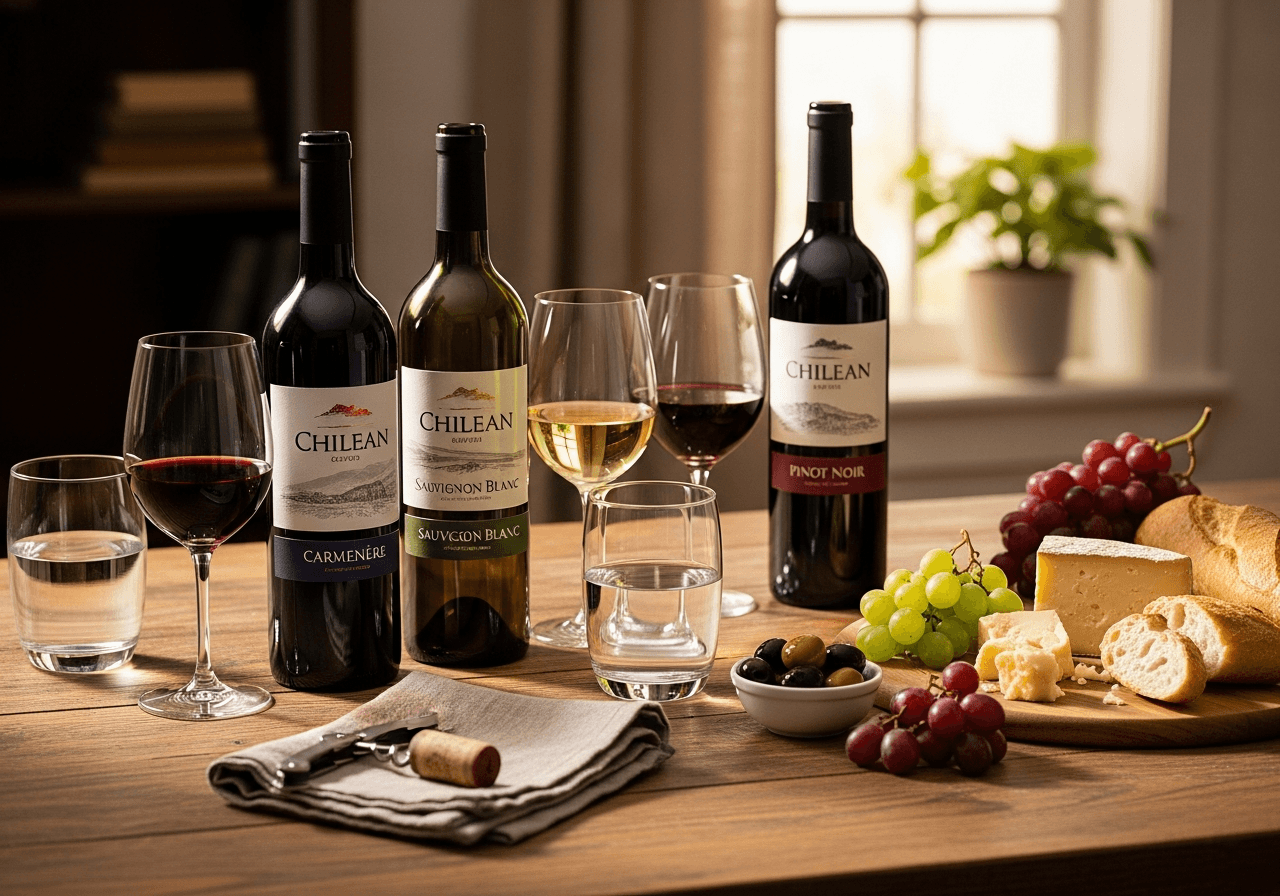
The first Chilean bottle I ever sold was a Cabernet from Maipo, around 1986, and I remember the buyer pulling a face when I told him where it was from. Chilean wine in those years was shorthand for cheap and acceptable, the kind of pour you took to a potluck. Susan and I were down in Santa Rosa last spring with one of my old accounts, and he opened a Carmenere from Apalta that would have embarrassed a few Bordeaux producers I used to call on. The country has moved a great distance in forty years, and most American drinkers haven't quite caught up.
What follows is a plain accounting of where Chilean wine actually stands now, which producers are worth your time, and how to spend an honest twenty-dollar bill without being talked into a thirty-dollar one.
A short geography lesson
Chile's wine country is a long, narrow strip squeezed between the Andes on one side and the Pacific on the other. The Spanish brought vines in the 1500s, and unlike Peru and Mexico, the cuttings actually took. The combination of rainy winters, dry summers, and the cold Humboldt Current offshore created what producers down there will tell you is the only viticultural climate of its kind in the new world.
You can ignore most of the place names if you want, but a handful are worth knowing because they'll appear on the back label:
- Maipo Valley, just south of Santiago. The old guard. This is where the famous Cabernets come from, particularly the Puente Alto sub-zone.
- Colchagua and Apalta, in the Rapel region. Warmer, generous reds, including the country's best Carmenere.
- Casablanca and San Antonio, near the coast. Cool, foggy mornings. This is the white-wine country: Sauvignon Blanc, Chardonnay, more recently some lovely Pinot Noir.
- Maule, Itata, and Bio-Bio, further south. Old vines, dry farming, the country's most interesting story right now.
- Limari and Elqui, in the far north. Cool desert, some surprisingly elegant Syrah.
That's the whole map in five bullets. You can spend a lifetime inside it.
Where Chile is in 2026
A few honest observations on what's changed since most of the older guides were written.
Chile is now the world's fourth-largest wine exporter. Roughly 80 percent of the bottled exports come from producers certified for sustainable practice, which is a higher figure than you'll find in most other producing countries. That's worth a moment of reflection if sustainability matters to you.
The recent harvests have not been easy. The 2023 wildfires in the centre-south burned through more than 400,000 hectares and destroyed vineyards in Itata, Bio-Bio, and Maule. A great many small growers lost their fruit or couldn't sell it because of smoke taint. The 2024 vintage came in cool and rainy in the central valley, producing wines of lower alcohol and good acidity, which the better producers will tell you is closer to the style they want to make anyway. The 2025 growing season brought heat and water concerns back to Limari and Casablanca. Climate is no longer a footnote in any wine country, Chile included.
Vineyard area has been quietly shrinking. Some producers down there estimate it could contract by as much as forty percent before this decade is out, driven by falling consumption worldwide and by years of selling fruit at prices that don't pay for the labor. This is not unique to Chile, but it is more visible there because the country has so much old-vine inheritance to lose.
What to drink: the reds
Cabernet Sauvignon is still the flagship, and Maipo Cabernet from Puente Alto is the genuine article. Concha y Toro's Don Melchor 2021 was named Wine Spectator's wine of the year for 2024, which is not a small thing for a Chilean producer. You don't need to buy the top bottling to get the picture; the same house's Marques de Casa Concha or Terrunyo will give you most of the story for a third of the money. Almaviva, the joint venture with the Rothschilds, is the famous prestige bottle and worth tasting once if someone else is buying.
Carmenere is the grape Chile decided to make its own after a researcher figured out in 1994 that most of what was being sold as Merlot was actually Carmenere, a variety nearly extinct in Bordeaux. The best modern Carmenere has shed the green-pepper note that used to plague it. Look at producers in Apalta and Peumo. Vina Montes, De Martino, and Errazuriz all make honest, well-priced versions.
Pinot Noir from Casablanca and the cooler coastal stretches has gotten quietly good. It will not displace Burgundy, and it shouldn't try to. But for $18, a Cono Sur or Casa Marin Pinot will out-perform most California Pinots at the same price.
The thing I'd most urge you to try is something from the far south, made from old Pais or Cinsault vines. These are 150-year-old bush vines, dry-farmed on granite, that for decades sold their fruit cheap to the bulk market. A new generation of small producers in Itata and Maule, names like Pedro Parra, Roberto Henriquez, and De Martino's old-vine series, are bottling these wines under their own labels. They are the real Chilean wines, in the sense that they have nowhere else they could possibly come from.
What to drink: the whites
Sauvignon Blanc from Casablanca and Leyda is the workhorse white. Crisp, citrusy, less aggressive than New Zealand, less leesy than the Loire. Casa Silva, Matetic, and Veramonte are reliable. Drink them young, with a fish.
Chardonnay in Chile has split into two camps: the warm, tropical, oaky style that used to dominate, and a leaner Burgundian style coming out of Limari and the coastal cool spots. The latter is what I'd seek out. Tabali and Casa Marin do the cooler style honestly.
Riesling and Gewurztraminer from Bio-Bio exist and are improving. They are not yet world-class, but they are a pleasant surprise at $15.
How to buy without getting fleeced
A few practical notes for anyone walking into a wine shop:
- The Chilean sweet spot remains $14 to $22. Above that you start paying for prestige and oak, both of which are easier to find elsewhere.
- Pay attention to vintage if you can. 2024 will be a good central-valley year. 2023 wines from Itata and Bio-Bio may have smoke issues, depending on the producer.
- If the back label says "Reserva," understand that the term is not legally protected in Chile the way it is in Rioja. It indicates the producer's intent, not a regulatory minimum.
- For a casual weeknight pour, a $14 Cabernet from a serious producer (Cousino-Macul, Santa Rita, San Pedro) will outperform a great many $40 California Cabernets. I will keep saying this until people stop spending money to be unhappy.
The last thing I'd say is that Chile has earned its quiet ascent. The wines are not faddish, the producers are not chasing scores, and the country has done the harder thing of investing in old-vine recovery and sustainable practice while the rest of the trade chased the next novelty. That deserves a place on your table this week.