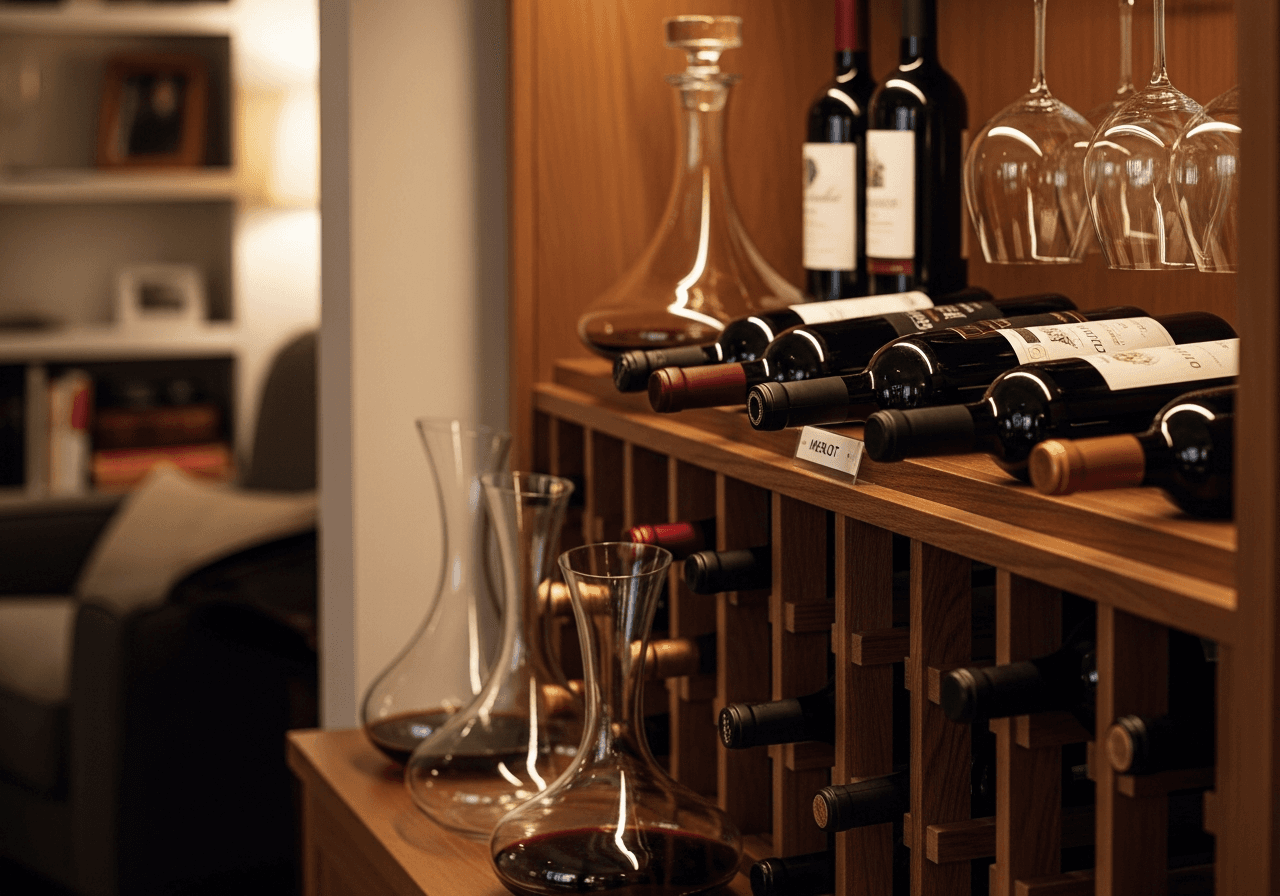
The barn we converted out here in Sonoma has a north-facing corner that stays around 56 degrees year round, and that is where most of my pours live. Susan calls it the cellar. It is really just a closet with the right wall against earth and a curtain in front of the door. That is the whole secret, in a sentence: wine wants steady, cool, dark, and still. Everything else in this piece is footnotes.
People ask me how to store wine properly all the time, usually after they have bought a case of something they like at a tasting and suddenly have nowhere sensible to put it. I spent thirty-some years selling small European producers to East Coast restaurants, and I watched a lot of beautiful bottles get cooked in a hot dining room or a garage in July. So let me walk you through what actually matters at home, and what does not.
Temperature is the one thing you cannot fudge
The numbers most cellar people will give you are 55 to 59 degrees Fahrenheit, with around 57 being the resting spot. That is the ideal. But here is the part that gets understated: a bottle held at a steady 65 degrees will outlast a bottle that swings from 55 to 75 and back every week. Fluctuation is what wears wine out. The cork breathes a little with every swing, and the wine ages in fits and starts instead of slowly.
If you keep your wine in a kitchen cabinet near the oven, or above the refrigerator where the compressor heat rises, you are cooking it slowly. The same goes for an attached garage in any state with real summer. A friend in New Jersey lost a case of '15 Brunello to a July heat wave one year, and the wines that survived tasted stewed. Heat is permanent. You cannot walk it back.
An interior closet on the cool side of the house, a north-wall pantry, a basement if you have one, the bottom of a hall coat closet that nobody opens much. Any of those beats a wine rack on top of the fridge. If your home has central air that runs through summer, you have more options than you think.
Humidity matters less than people pretend
The textbook says 50 to 70 percent relative humidity, with 60 as the sweet spot. The reason is the cork. A bone-dry environment can shrink a natural cork over years, and a soaked one invites mold on the label and the rack. But unless you are putting bottles down for a decade or more, the humidity in a normal interior room is fine. The folks selling cellar equipment lean on humidity because it sells humidifiers. For a case of wine you plan to drink in the next two or three years, do not lose sleep over it.
One real exception: if you live somewhere bone-dry, like Phoenix or the high desert, and you are aging Bordeaux or Barolo for the long haul, a small cellar unit with a humidity setting earns its keep.
The cork question, and why screw caps changed the rules
The old advice to store every bottle on its side comes from one fact: a natural cork dries out if it is not in contact with wine, and a dry cork lets air in. Air turns wine to vinegar. So horizontal is right for anything sealed with natural cork.
But a lot of what you buy now is not under natural cork. Screw caps are something like a third of global wine sales as of the last few years. DIAM, a technical cork made from cleaned cork particles, has taken over much of Burgundy and a good slice of the Loire. Both seal more tightly and more consistently than natural cork. For screw caps and most synthetic closures, upright storage is perfectly fine. For DIAM, horizontal is still the convention, but you have more margin for error than with a traditional cork.
So look at your bottles. If you have a mixed cellar like most people do now, store the natural-cork bottles on their sides and put the screw-tops wherever they fit.
Light, vibration, and the things that quietly ruin a bottle
Sunlight will age a wine fast and give it off-flavors. The fancy term is light-strike. Even fluorescent light will do it over time, and clear bottles and pale rosés are the most vulnerable. Dark glass helps, but it does not block UV. A pantry door or a curtain is plenty of cover.
Vibration is the one I would not lose sleep over in a typical home. The serious cellars I have walked through in Burgundy keep bottles still because they sit for thirty years. If your case is on a rack in a hall closet and someone walks past it twice a day, the wine is fine. Do not store wine on top of a clothes dryer or against a wall that shares a furnace, and you have done enough.
Practical setups for a small home
Most readers are not building out a temperature-controlled room. You probably want one of these:
- A countertop or under-counter wine fridge. Twenty to forty bottles, dual-zone if you keep both reds and whites. These are the workhorses now. Look for one with a real compressor, not a thermoelectric unit, if you live anywhere with a warm summer. Thermoelectrics struggle once the room hits the mid-80s.
- A passive closet or pantry rack. Good for short-term storage, six months to two years. Pick the coolest interior wall in the house.
- A purpose-built cellar. If you have a basement corner and are putting away bottles for the long term, a split cooling unit and a proper insulated room is the right answer. But it is real money and real planning.
One more thing worth saying as you get older: keep your everyday-drinking wines somewhere easy to reach. I keep the weeknight Cotes du Rhone and Chianti on a low rack in the pantry, eye level, no bending. The serious bottles go in the cool closet. Your back will thank you in ten years.
What not to worry about
Most of the wine made in the world is meant to be drunk within two to four years of release. Nearly all whites, most rosés, the bulk of every-night reds. They do not need a cellar. They need a cool, dark spot and your attention before they hit the back wall and get forgotten. The bottles that actually reward long storage are a small slice: serious Bordeaux, Brunello, Barolo, top-tier Rhone, vintage Champagne, certain Rieslings. If you are not buying those, the closet is plenty.
The practical takeaway, if you are 60-plus and tidying up how you live with wine: pick one cool, dark spot in your home, put your bottles there on their sides if they are corked and upright if they are not, and drink them within a few years. That is the whole job. Anything more elaborate is for collectors, and most of us are not collectors. We are drinkers, and that is the better thing to be.