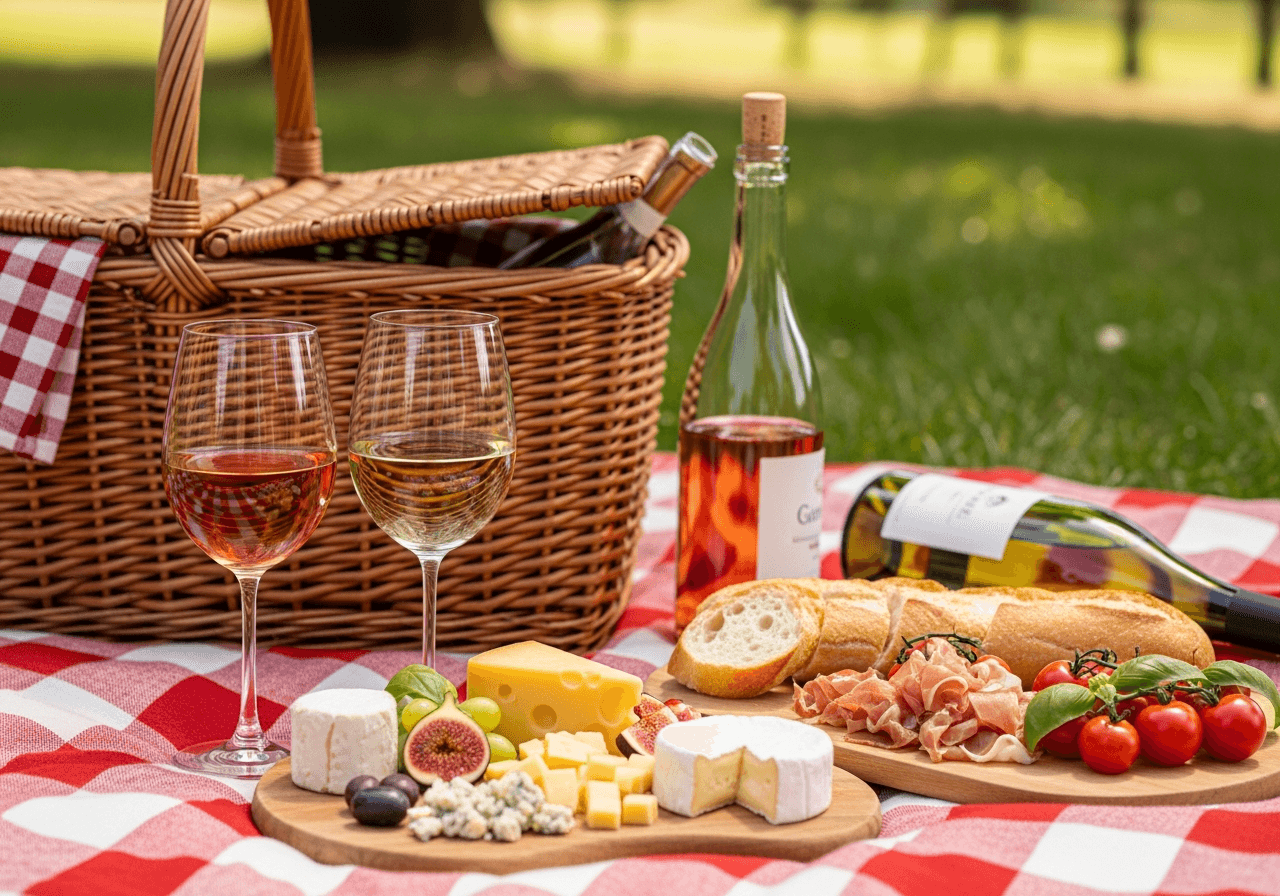
The first warm Saturday in May, Susan packs a basket and tells me to stop overthinking the wine. After forty-four years she has my number. We live on the dry side of Sonoma County now, in a barn we converted in 2019, and the picnic spots on the back roads up toward Glen Ellen are the kind of thing you mostly stop noticing until a grandkid points them out. So this is a pairing guide written from a folding chair under an oak, not from a tasting room. Take the suggestions loosely. In summer, the rules get shorter.
I spent thirty-some years importing small-production wines from southern France, Piedmont, and the Rhone for a Mid-Atlantic distributor. What I learned, more than anything, is that the right summer bottle is usually cheaper, lighter, and colder than people expect. The fancy stuff stays in the cellar until the leaves turn.
Bread, cheese, and a bottle of something honest
Start with the easiest picnic on earth: a crusty loaf, a wedge or two of cheese, some olives, maybe a small jar of cornichons. The wine to chase that is rarely Cabernet, no matter what people remember from the 1990s. Cabernet in a hot meadow is hard work. Bring a chillable red instead. A Beaujolais-Villages from a producer like Foillard or Lapierre, served at around 55 degrees, will partner a sharp aged cheddar or a young Gorgonzola without making you sweat through your shirt.
If you want white, a Sauvignon Blanc from the Loire (Sancerre if the budget is there, a Touraine Sauvignon if it isn't, and the Touraine is often the smarter pour) handles soft goat cheese like Bucheron or a young chevre beautifully. For provolone, Gouda, or a mild Manchego, I'd reach for a dry rose from Bandol or Cotes de Provence. The 2024 roses are showing well as I write this, and the better producers are still moving toward leaner, drier styles after a stretch where everything seemed to be drifting pink and confectionary.
Fruit, and what not to do with it
Summer fruit is its own course. Berries, stone fruit, melon with a little prosciutto, maybe a few figs if you can find decent ones. The temptation is to reach for something sweet, and the temptation is wrong. Sweet on sweet flattens both. What you want is a wine that's dry but generous: a lightly oaked Chardonnay from the Macon, or a Vermentino from the Tuscan coast or Sardinia. Cantina Santadi makes one that I keep buying. The wine pulls the fruit forward instead of competing with it.
The exception, and it's a real one, is a true late-harvest dessert wine with cheese and fruit at the very end of the meal. A small pour of Sauternes or a Vouvray moelleux with a wedge of Roquefort and a few halved fresh figs is one of the better things a summer afternoon can produce. Just remember the operative word is small. Two ounces, not a tumbler.
Salads, sandwiches, and the case for sparkling
If your picnic runs to chicken salad with grapes and almonds, a salmon salad with dill and lemon, or grain salads with herbs and vinaigrette, you're in the sweet spot for sparkling wine. A grower Champagne (anything from Egly-Ouriet, Chartogne-Taillet, or Pierre Peters if you're celebrating something; a Pol Roger or Bollinger if you want the safe move) does the work. So does a Cremant de Bourgogne or a Franciacorta from Lombardy, and either runs maybe a third the cost of a serious Champagne while drinking like a much more expensive bottle.
The thing people miss with sparkling and picnics is temperature. Warm Champagne is a small tragedy. Pack it in a hard cooler with ice and a wet kitchen towel wrapped around the bottle, and pull it out twenty minutes before you pour. If you must compromise on storage, compromise on the wine, not the chill.
Spicier food and the sangria question
Grilled, spice-rubbed meats served cold, chimichurri vegetables, a tomato salad with chiles and good olive oil. This is where I'll part ways with the old wine-snob orthodoxy. A well-made sangria, built from a sturdy Spanish red (a Garnacha from Calatayud or a young Tempranillo), a splash of brandy, some orange and lemon, and not too much sugar, is the right call. Sangria has been getting a quiet second life the last couple of years, along with wine spritzes, and the better versions have shed the cloying sweetness that gave the category a bad name in the early 2000s.
If sangria isn't your thing, a Spanish rose from Navarra or a Cotes-du-Rhone Villages served lightly chilled handles spicy fare without raising its voice. The Rhone bottle on my kitchen counter as I write this cost fourteen dollars at the local market and would embarrass plenty of bottles three times its price.
A few practical notes from the basket
- Bring a screw-cap or two. Cork or no cork is settled science by now. A well-made screw-cap closure protects a young, fresh wine for a picnic better than a cork does, and you don't end up hunting for the corkscrew at the bottom of the basket.
- Plastic stems are fine. Susan likes the unbreakable Govino-style glasses. The wine doesn't know the difference outdoors. Don't bring your crystal to a meadow.
- Canned wine has gotten honest. A few of the smaller California and Oregon producers are now putting real wine in cans, not the cooler-aisle stuff. Useful for kayak trips and grandkid-heavy gatherings. Don't dismiss it.
- One bottle per two adults, plus a backup. Heat moves wine faster than you'd think. Better to bring back an unopened bottle than to run dry at four in the afternoon.
The point, really
If you remember one thing from this guide, make it the temperature rule. Most picnic wines (whites, roses, even the lighter reds) drink best between 50 and 60 degrees. Warmer than that and the alcohol starts to shout, the fruit goes flat, and you wonder why the bottle was a disappointment when it was really the meadow that did it in.
Beyond that, follow your own palate. Summer is short, the grandkids grow fast, and the bottle you brought last picnic doesn't have to be the bottle you bring next time. A pairing guide is a starting point, not a verdict. Pour what's cold, sit in the shade, and let the wine do its job, which is mostly to keep good company.