I have a small lacquered box on my dressing table that holds, among other things, a pair of my grandmother's screw-back earrings, a thin gold bangle from my late husband, and a Robert Lee Morris cuff I bought myself the year I left Better Homes & Gardens. None of it is what an appraiser would call important. All of it is, to me, exactly that. A good jewelry catalog, when one still arrives in the mail, is a quiet invitation to think about the next piece that might earn its place in such a box.
What follows is not a ranking. Rankings are for sporting events. It is, instead, an appraisal of the catalogs and house brands a discerning shopper, particularly one of a certain age, can still rely on in 2026. Some of the names below print proper catalogs; others have moved chiefly to digital lookbooks and television. I have noted the difference where it matters.
Houses That Still Mail a Real Catalog
Ross-Simons
Ross-Simons, headquartered in Cranston, Rhode Island, remains one of the few traditional fine-jewelry catalogs that arrives, reliably, with the seasons. Their catalog request page is still active, and a free copy will be sent without charge for postage. The merchandise is broad: Italian gold chains, freshwater pearl strands, sterling cocktail rings, and a respectable selection of estate-style pieces. Prices sit comfortably between costume and grand. For the reader who likes to consider a piece on paper before committing, Ross-Simons remains the workhorse it has always been.
Honora
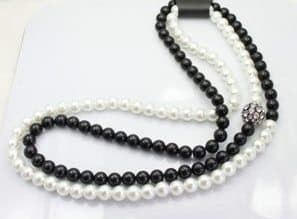
Honora made its name in cultured freshwater pearls and, since the late 1990s, has been a fixture on QVC. The brand was acquired some years ago by Richline Group, the jewelry arm of Berkshire Hathaway, and continues to release new collections through QVC's site and broadcasts. Honora no longer mails a standalone catalog of any size that I have seen, but the brand's pearl ropes, button studs, and silver-and-pearl combinations are easy to study online. For the woman who wants a strand that will outlast the trend cycle, this is a sensible house.
Heidi Daus
Miss Daus is the closest thing American costume jewelry has to a contemporary Kenneth Jay Lane. Her crystal-encrusted brooches, animal pins, and statement necklaces are sold primarily through HSN, with her own site, heididaus.com, supplementing the broadcasts. She has been at it for more than thirty-five years, and one suspects she will be at it for thirty-five more. These are pieces that announce themselves. Worn with restraint elsewhere in the outfit, they read as confident rather than costumey.
Designers Who Have Moved Beyond the Catalog
Robert Lee Morris
Mr. Morris closed his retail storefront some time ago and now keeps a virtual gallery, robertleemorrisgallery.com, where he sells from a deep archive built over more than fifty years. His sculptural, almost goldsmith-of-antiquity work for Donna Karan, Calvin Klein, Geoffrey Beene, and Karl Lagerfeld is part of American fashion history; the Council of Fashion Designers of America gave him the Geoffrey Beene Lifetime Achievement Award in 2007, the first to a jeweler. There is no print catalog to request, and one wonders if there ever will be again, but the gallery is worth a slow afternoon's browse.
Judith Ripka
The Ripka brand has changed hands more than once in recent years. Xcel Brands sold it in 2025, in a transaction reported at roughly three million dollars, to Fuzion Creations, a wholesale fine-jewelry manufacturer; the brand now operates under that ownership while Mrs. Ripka herself, by all reports, remains involved in design at an emeritus level. The aesthetic, layered cuffs, oversized cocktail rings, and pavé-edged earrings, has not materially shifted. Pieces are available on judithripka.com and through QVC and JTV.
Jean Dousset
A great-great-grandson of Louis Cartier, Mr. Dousset rebranded his lab-grown line, formerly Oui by Jean Dousset, under his own name and now sells exclusively GIA-certified lab-grown diamonds. The flagship in West Hollywood opened in recent years and the work, particularly the engagement rings, is noteworthy for proportion and clean shoulder-and-shank treatments. There is no traditional catalog; the lookbooks live on jeandousset.com. For a granddaughter's engagement gift, or a self-purchased stone that one can finally justify, the brand merits serious attention.
Tacori
Tacori, the Berberian family's California house, continues to design bridal and dress jewelry distinguished by its crescent silhouette and intricate side detailing. The pieces are sold through authorized jewelers rather than a consumer catalog. Their site, tacori.com, includes a store locator that I have found useful when traveling.
R. J. Graziano
R. J. Graziano, the New York costume house long beloved of stylists and First Ladies, continues to sell wholesale and through its own site. As of early 2026 I cannot point you to a printed consumer catalog, but the necklaces, particularly the bib styles, remain among the most photographed costume pieces in editorial fashion.
The Two Names One Cannot Reasonably Omit
Tiffany & Co.
Now part of LVMH, Tiffany continues to publish its annual Blue Book of high jewelry and the seasonal lookbooks one expects of a house of that stature. The blue box endures because the contents, on the whole, deserve it. For an investment piece, Tiffany sets a standard against which other houses are honestly measured.
Rolex
Strictly speaking, Rolex is a watchmaker, not a jeweler. Strictly speaking is overrated. A Datejust on the wrist of a woman who has earned it is a piece of jewelry by any reasonable definition, and Rolex remains, in 2026, what it was in 1956: a maker of objects that hold their value and their dignity.
How to Read a Jewelry Catalog Well
A few habits I learned from years of editing shopping pages and have not let go.
- Read the metal first, the design second. Sterling, vermeil, gold-filled, 14k, 18k. The word vermeil is doing a lot of work in many catalogs; know what it means before you spend.
- Mind the carat-total-weight footnotes. A piece described as ten carats of color may be ten very small stones. There is nothing dishonest about this; one simply needs to know.
- Photograph for scale. Most catalog photography enlarges. A pair of earrings shown the size of a quarter may be the size of a pencil eraser in life.
- Keep the receipts. Estates and insurance riders are easier with paperwork.
A Final Thought
The jewelry box, as I think of it, is less a hoard than a record. Each piece in mine corresponds to a year, a person, a small private occasion. The catalogs above will not all suit every reader, and some have changed hands or formats since the last time you may have ordered from them. But each, in its way, is still publishing. That, in 2026, is its own quiet kind of endorsement.