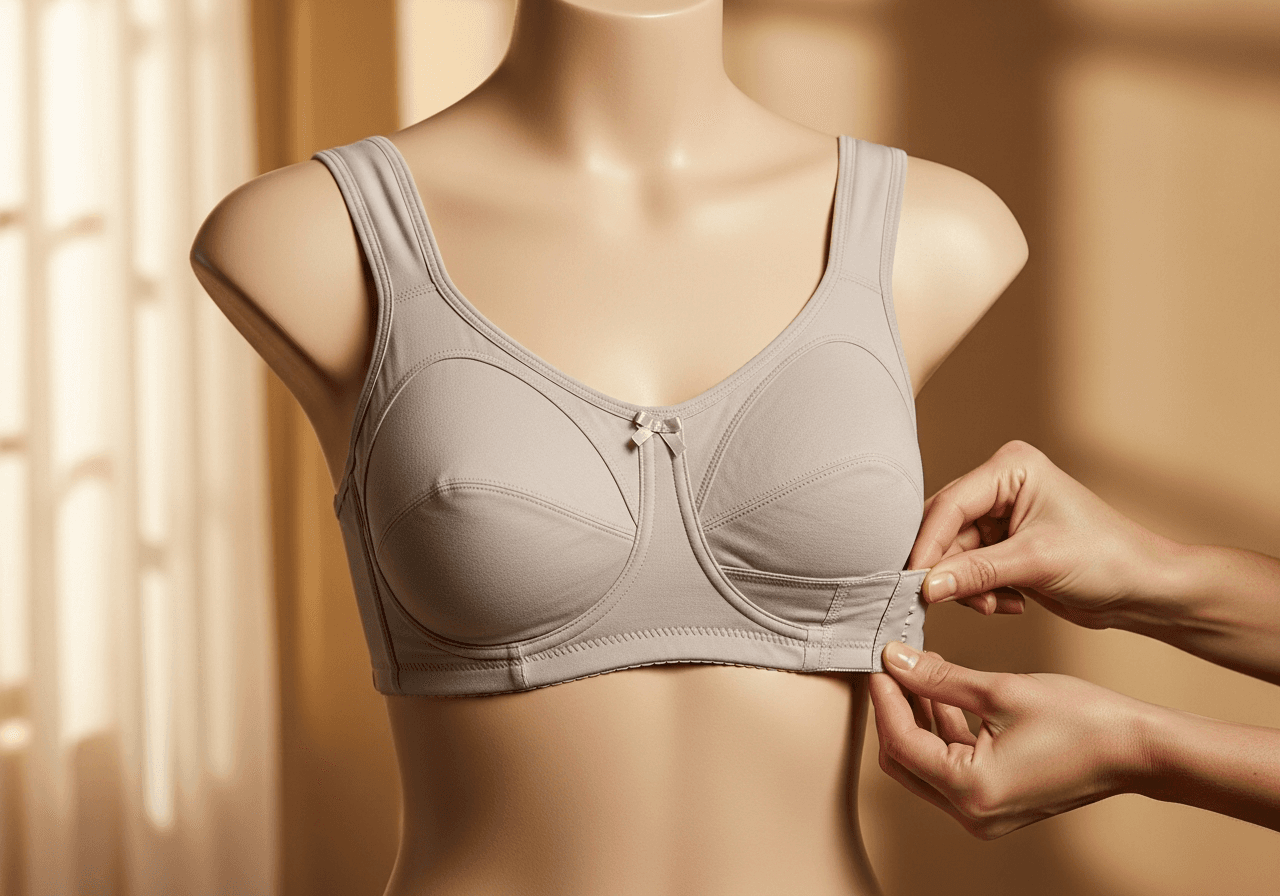
I spent thirty-five years on the fitting-room floor at Bloomingdale's, and the question I heard most often from women coming back after surgery was some version of this one. The bra climbs. The pocket shifts. The form drifts up under the collarbone by lunchtime. It is not a small thing. A bra that won't stay put steals your attention all day, and after a mastectomy the last thing you need is one more thing on your mind.
So let me walk you through what I tell women in the fitting room, in the order I tell them. Riding up is almost always a band problem first, a strap problem second, and a prosthesis problem third. Sort those in that order and most of the trouble goes away.
Start With the Band, Not the Cup
The band does ninety percent of the work in any bra. After a mastectomy that share goes higher, because the band is what anchors the pocket and the form. If the band rides up in back, the front rides up too, and the pocket lifts the form right with it.
The test is simple. Stand in front of a mirror with the bra on, both straps off your shoulders for a second, and look at the back. The band should sit parallel to the floor and stay there. If it is climbing up your shoulder blades, the band is too big. Most women coming through after surgery are wearing a band one size larger than they need because they sized up for swelling and never sized back down once the swelling settled.
The fix is to drop a band size and add a cup size. A 38B that is loose becomes a 36C. Same cup volume, tighter anchor. That single change ends most ride-up problems before we ever talk about the pocket.
One note for women six months or more post-surgery: tissue changes keep happening. Radiation, weight shifts, hormone therapy, simple time. The bra that fit at the eight-week follow-up may not fit at the one-year mark. Re-measure yourself, or have it done, at least once a year. It is free at most department-store lingerie counters and at specialty mastectomy shops, and it takes ten minutes.
The Straps Are the Second Pass
After the band, look at the straps. They should be snug enough that you can slide two fingers underneath at the shoulder but not three. Loose straps let the cup gap and the form ride.
Pay particular attention to the strap on the surgery side. After a mastectomy, especially a unilateral one, the affected side often sits a touch differently. The shoulder may be a hair lower or the muscle a hair tighter from lymph-node work. You may need to tighten that strap a quarter-inch more than the other one. That is normal and it is fine. The two straps were never required to be at identical lengths. They are required to hold each cup at the right height.
If the straps slip off your shoulders no matter how tight you set them, that is a different issue, usually narrow or sloped shoulders, and the answer is a bra with leotard-back or J-hook straps that bring the back of the strap closer to the spine. Many of the post-surgery brands carry this style now.
Now We Talk About the Pocket
A properly built mastectomy bra has a pocket sewn into the cup that opens at the top or the side, holds the form, and lies flat against your chest. If your bra has a pocket and the form is still climbing, three things are usually going on.
- The form is too light for the cup. A soft foam form weighs almost nothing. Inside a roomy cup it floats. If you swim or move around a lot, a weighted silicone form will hold position better.
- The form is too small for the cup. A C-cup form in a D-cup pocket is going to swim no matter what. The form has to fill the pocket.
- The cup itself is too big. Back to band-and-cup math. Drop the band, raise the cup.
If the form is the right size and weight and it still walks, there are good adhesive options now that did not exist when I started in this work. Skin-safe form adhesives and double-sided fabric tape (you'll see it sold as boob tape or fashion tape) both work. Tape goes on the back of the form, sticks to your skin, and holds the form steady inside the pocket. It is single use and you replace it every day. For women with skin still healing or with radiation-thinned skin, ask your surgeon or oncology nurse before using anything adhesive on the chest wall.
Brands Worth Trying in 2026
The post-surgery bra market has changed a lot in the last five years, mostly for the better. A few names that come up consistently with my customers and on the breast cancer forums I read.
- Amoena. Forty-plus years of post-mastectomy specialty work. Wide range of cup sizes, pocketed everyday and sports styles, and good band construction.
- Anita Care. German-made, wireless options, generous pocket coverage. Their bands are firmer than most, which helps with ride-up.
- AnaOno. Founded by a survivor. Soft, no underwire, larger armhole openings for women with lymphedema or sensitivity near the scar. Their lightweight F(oo)B form is a useful option if a heavy silicone prosthesis is uncomfortable.
- Wacoal Embrace. Their pocketed line uses the same underband engineering as their regular bras, which is the gold standard for staying in place.
Medicare Part B covers post-mastectomy bras under code L8000, generally four to six bras a year, with a prescription. Most private insurance follows the same pattern. The specialty shops are used to handling the paperwork. Ask before you pay out of pocket.
A Few Quiet Tips From the Fitting Room
Things that are not in any catalog but that women told me worked for them.
- For short trips, a safety pin through the bottom of the pocket into a soft form will stop it walking. Not for silicone, not near a fresh scar, and never through skin. Just through the bra fabric.
- If the band rides up only when you raise your arms (reaching for a top shelf, dressing, hugging a grandchild), a longline mastectomy bra with a band that extends two or three inches below the bust solves it. The extra real estate keeps the band anchored.
- If you wear a prosthesis only sometimes, keep two bras going: a pocketed one for the days you wear the form, a soft wireless one for the days you don't. Trying to make one bra do both jobs is what wears it out.
- Hand wash and lay flat to dry. Mastectomy bras are not cheap and the band elastic is what holds the whole system together. The dryer kills it.
What I Want You to Take Away
A bra that rides up is not a personal failing and it is not the bra company's fault either. It is almost always a fit conversation that nobody walked you through. Drop a band size if the back is climbing. Tighten the strap on the affected side a quarter-inch. Make sure the form fills the pocket. Get re-measured once a year because your body keeps changing, and that is fine, that is what bodies do.
You went through a great deal to get here. You deserve a bra that holds still and lets you forget about it. That is the whole job of a bra, and it is very much within reach.