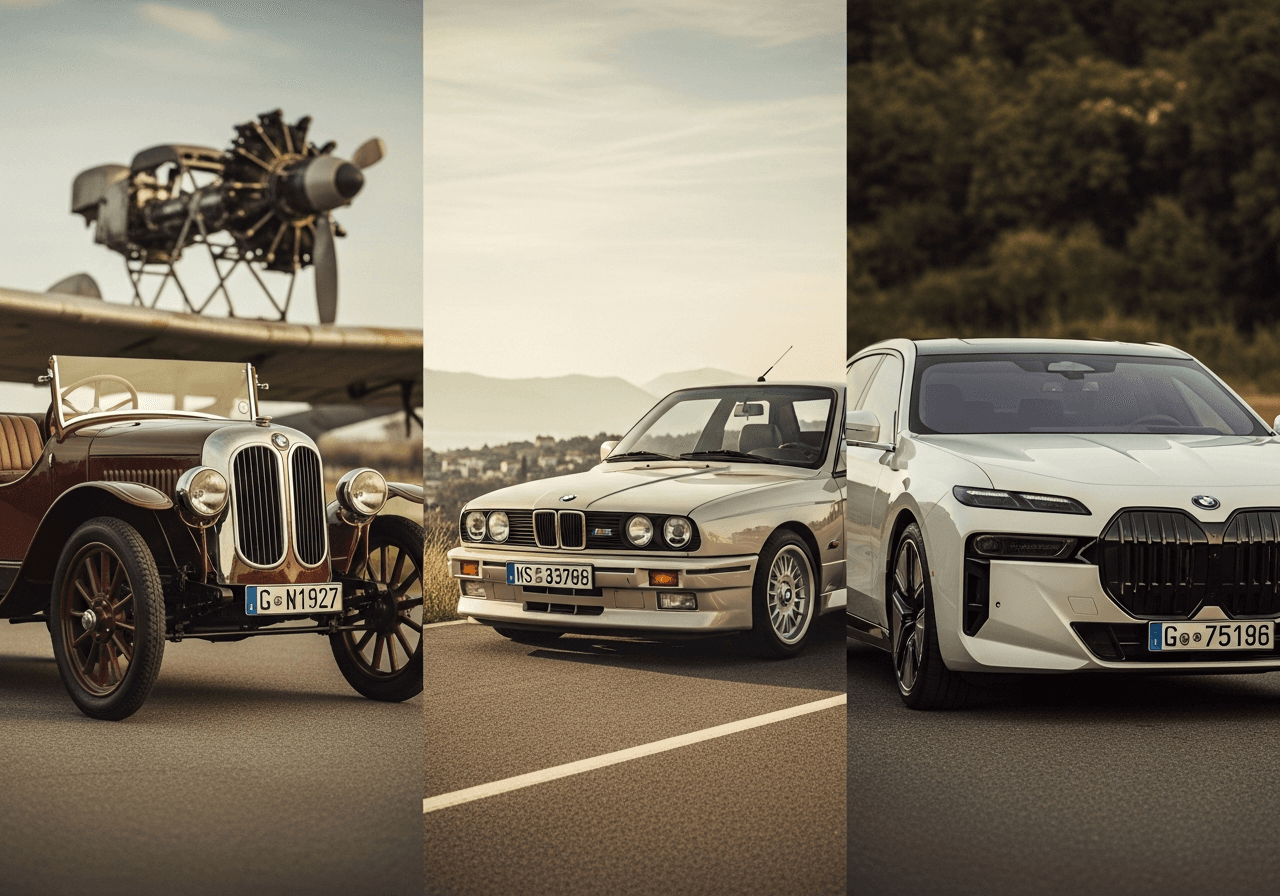
Here is a fact that always stops people at parish coffee hour: the company we now know as BMW did not begin by building cars. It began by building airplane engines, in Munich, during the First World War. The white-and-blue roundel that decorates the hood of every 3 Series and X5 is often described as a stylized spinning propeller against a Bavarian sky. The propeller story is partly marketing legend, as the BMW Group itself has acknowledged, but the aviation roots are entirely real, and they explain a great deal about how this Bavarian firm came to be one of the most recognizable carmakers in the world.
I have always had a weakness for origin stories, and BMW's is unusually tidy in its dates. So let us begin where the records do.
1916: A Wartime Birth in Munich
The official founding date of BMW is March 7, 1916. On that day a firm called Bayerische Flugzeugwerke, or Bavarian Aircraft Works, was registered in Munich. Its job was to build aircraft for the German military, and at first it had nothing to do with the name BMW at all.
The BMW name came from a separate company down the road. In 1913, an engineer named Karl Rapp had founded Rapp Motorenwerke to build aircraft engines. Rapp's company struggled with vibration problems in its early designs, and in 1917, after Rapp himself departed, the firm was renamed Bayerische Motoren Werke. That is the name that stuck. A few years later, in 1922, the engine-building assets and the BMW name were transferred over to the Bayerische Flugzeugwerke side of the family. The two strands were finally one company, and the modern BMW lineage was set.
It turns out that the very first product to wear the BMW badge was not a car or a motorcycle, but the BMW IIIa aircraft engine, prized by German pilots for its strong performance at high altitude. What most people don't realize is that BMW spent its first decade as an aviation firm.
From Treaty Restrictions to Two Wheels
After Germany's defeat in 1918, the Treaty of Versailles forbade the country from manufacturing aircraft engines for several years. A company built around airplane work suddenly had to find something else to do. BMW pivoted, first to railway brakes and industrial engines, and then in 1923 to motorcycles. The R 32, introduced that year, used a flat-twin boxer engine mounted lengthwise in the frame, with shaft drive to the rear wheel. That basic layout has carried through the BMW Motorrad line for more than a century, which is a remarkable run for any piece of engineering.
1928: BMW Builds Its First Car
It was not until 1928 that BMW entered the automobile business, and it did so by acquiring a small factory in Eisenach that was producing a license-built version of the British Austin Seven. That little car, sold in Germany as the Dixi, became the first BMW automobile. It was modest, affordable, and it helped the company survive the Depression years.
By the late 1930s BMW was building something altogether more glamorous. The Type 328 roadster, introduced in 1936, was a slim two-seater with a tuned six-cylinder engine and an aluminum body. It dominated European sports car racing in the years just before the Second World War, taking class wins at the Mille Miglia and at the Nürburgring. To this day, surviving 328s are among the most coveted prewar cars at any concours.
The Postwar Climb
BMW's wartime work, which included aircraft engines and forced labor at several of its plants, left the company in a deeply difficult position after 1945. Its Munich factory was heavily damaged. Its Eisenach plant ended up in the Soviet occupation zone and was lost to East Germany. For several years BMW was barred from making vehicles at all, and the company kept itself alive making pots, pans, and bicycles.
Recovery came slowly. The luxurious BMW 501 and 502 sedans of the early 1950s were handsome but expensive, and they did not sell in the numbers BMW needed. What actually saved the company was a tiny bubble-shaped car called the Isetta, licensed from an Italian firm and powered by a one-cylinder motorcycle engine. The Isetta was odd-looking and slow, but it was cheap, and it kept the lights on through some very lean years.
By 1959 BMW was on the verge of being sold to its much larger rival, Daimler-Benz. A group of shareholders, led by the Quandt family, intervened at the last minute. That decision, often overlooked in shorter histories, is the reason BMW continued to exist as an independent company.
The Modern BMW Takes Shape
The car that announced the new BMW was the 1500 sedan of 1962. It was sporty, well-engineered, and aimed at a customer who wanted something more interesting than the typical family car. From that one model grew the three-tier sedan range that BMW still uses today: the 3 Series, the 5 Series, and the 7 Series. The high-performance M division was founded in 1972, originally to support BMW's motorsport efforts.
BMW of North America was established in 1975 in New Jersey. By the 1980s the brand had become a fixture on American roads, and the slogan "the ultimate driving machine" had entered the language of car advertising. In 1992 BMW broke ground on its first American assembly plant, in Spartanburg, South Carolina. That plant has since grown into the largest BMW factory in the world. According to the BMW Group's own filings with the U.S. Department of Commerce, Spartanburg has been the single largest automotive exporter by value in the United States for more than a decade running, and in 2025 it shipped close to 200,000 SUVs to nearly 120 countries.
The BMW family also expanded. The company acquired the Rover Group in 1994, then divested most of it in 2000, keeping only the MINI brand, which it relaunched in 2001. BMW also took over the rights to Rolls-Royce passenger cars in 1998 and built a new factory at Goodwood in southern England, where Rolls-Royce models such as the Phantom, Ghost, Cullinan, and the all-electric Spectre are built today.
BMW in 2026: The Neue Klasse
The BMW story is, of course, still being written. The company is now in the middle of what it calls its Neue Klasse, or "new class," generation of electric vehicles, named in deliberate echo of the 1962 sedan that once saved the firm. The first Neue Klasse model, the iX3 sport-utility, entered production in late 2025 at a new plant in Debrecen, Hungary, and was named World Car of the Year for 2026. A second model, the i3 sedan, is scheduled to begin production at the home plant in Munich later in 2026.
So a company that started by building airplane engines for a wartime emperor is now, more than a hundred years later, building electric sedans named after one of its old gasoline cars. There is a kind of symmetry to that which I find quite satisfying.
A Practical Note for the Reader
If you happen to own a BMW of a certain age, the brand has cultivated an unusually devoted enthusiast network. Independent BMW specialists, often staffed by former dealer technicians, can keep an older 3 Series or 5 Series on the road for far less than the dealership will charge. And the X3 and X5 sold in the United States are very likely to have been built in South Carolina, which is a pleasant fact to keep in mind on a test drive.
It is worth remembering, when you next see that white-and-blue roundel in traffic, that you are looking at one of the longer continuous stories in modern industry. Wars, treaties, near-bankruptcies, and now a wholesale shift to electric power, and the badge is still there.