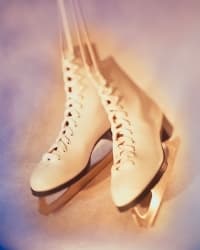
Most reference works trace the story of figure skating back at least a thousand years, to bone skates strapped to the feet of medieval Northern Europeans crossing frozen ponds and canals. Those early skaters were not performing; they were commuting. The transformation from useful winter footwear into the sequin-and-spotlight sport we now watch every four years took several centuries, and the cast of characters along the way is more interesting than the broad outlines usually suggest.
Skating Before It Was a Sport
Bone skates uncovered in places like York, England and Birka, Sweden have been dated by archaeologists to roughly the 10th and 11th centuries. The Dutch, who had every reason to perfect winter travel, are generally credited with the shift from bone to iron blades sometime in the 13th and 14th centuries. By the 17th century, paintings by Avercamp and other Dutch masters show ordinary people skating on the canals for both transport and recreation, which is when the line between “getting from one village to the next” and “having a good time” starts to blur.
The English, predictably, made it formal. The Edinburgh Skating Club, often cited as the world’s first, is generally dated to the 1740s. By the early 19th century, English skaters had developed what became known as the “English style,” an upright, stiff-armed manner of tracing precise figures on the ice. It was disciplined, geometric, and, by all accounts, not particularly fun to watch.
The American Who Changed Everything
It’s worth correcting a small but persistent error in older accounts: the man often credited as the father of modern figure skating was named Jackson Haines, not Jack. Born in the United States in 1838, Haines was a trained ballet dancer who simply put two ideas together that had not previously been combined. He skated to music, and he moved like a dancer rather than a draftsman.
According to the Britannica entry on Haines, his style found little welcome in the United States, where the English approach still ruled. He took his program to Europe in the 1860s and was a sensation in Vienna, where he is credited with helping inspire what came to be called the International Style and with influencing the founding of the Wiener Eislaufverein, one of the oldest skating clubs still in operation. Haines died young, in 1875, but the spin that bears his stylistic stamp—the sit spin—is still on every competitive program a century and a half later.
Building the Competitive Calendar
The institutional bones of the sport were laid down at the end of the 19th century. The International Skating Union, the ISU, was founded in 1892 in the Netherlands, making it one of the oldest international winter sport federations. The first European Championships were held in 1891, and the first World Championships followed in 1896 in St. Petersburg, Russia.
It is worth noting that those early championships were for men only. The rules did not explicitly prohibit women, which is how a British skater named Madge Syers entered the World Championships in 1902 and finished a clear second to Ulrich Salchow. The ISU promptly closed the loophole, then created a separate women’s event in 1906. Syers won the first two of those, and when figure skating made its Olympic debut at the 1908 Summer Games in London (yes, summer—there were no Winter Olympics until 1924), she took gold there as well.
Sonja Henie and the Shape of the Modern Sport
If you ask why a 1930s skating program looks something like what we still recognize today, the short answer is Sonja Henie. The Norwegian skater won three consecutive Olympic gold medals (1928, 1932, 1936), ten World titles, and six European titles—numbers that are unlikely to be approached again under modern judging.
Henie’s real influence, though, was visual. She skated in a short skirt and white boots when most women still wore long, dark dresses, and she choreographed her programs around the music rather than treating the music as background. She then took the whole package to Hollywood, starring in a series of films that introduced figure skating to audiences who had never thought of attending a competition. By the 1940s, every aspiring skater in North America had seen her on a movie screen.
1961: A Loss the Sport Has Not Forgotten
On February 15, 1961, Sabena Flight 548, a Boeing 707 bound from New York to Brussels, crashed on approach to Brussels Airport. All 72 people aboard were killed, along with one farmer on the ground. Among the dead were the entire 18-member United States figure skating team, plus six coaches, the team manager, judges, and family members—34 people connected to the U.S. delegation in all. They were on their way to the World Championships in Prague, which the ISU canceled out of respect.
It is hard to overstate what this did to American skating. A generation of competitors and coaches was simply gone in an afternoon. According to U.S. Figure Skating, the disaster prompted a rule still in force today: no team traveling to an international competition flies together on a single aircraft. The Memorial Fund established after the crash has supported skaters and their families for more than sixty years.
Cold War Powerhouses and Their Successors
Older articles often state that “a Soviet or Russian pair has won every Olympic gold in pairs from 1964 forward.” That was true for a remarkable run, but the streak ended some time ago. Chinese pairs won gold in 2010 (Shen Xue and Zhao Hongbo) and 2018 (Sui Wenjing and Han Cong). At the 2026 Games in Milano Cortina, gold in pairs went to Riku Miura and Ryuichi Kihara of Japan—the first Japanese pairs gold in Olympic history.
Russia’s presence in the sport has also changed considerably. Following the 2022 invasion of Ukraine, the ISU suspended Russian and Belarusian skaters from international competition. A small number competed at Milano Cortina under the “Individual Neutral Athlete” designation rather than under their national flag, and not in the team or pairs events. How long that arrangement persists is a question for diplomats rather than skating fans.
Where the Sport Stands Now
The 2026 Olympic results offer a snapshot of a sport that has continued to broaden. Ilia Malinin of the United States, known in the press as the “Quad God” for his command of all six quadruple jumps, won the men’s gold. Alysa Liu, also of the United States, took the women’s gold in a free skate that lifted her from third to first. Laurence Fournier Beaudry and Guillaume Cizeron of France won ice dance, with Madison Chock and Evan Bates of the United States in silver. The United States also retained its team gold from Beijing.
If you watched figure skating on a black-and-white television in the 1950s, the sport you see today is unrecognizable in execution—quadruple jumps were not landed in competition by a man until 1988 and by a woman only in this century—but the underlying appeal has not changed. People still glide across ice, and a few of them do it well enough to make the rest of us briefly forget gravity.
A Note for the Armchair Historian
For readers who want to go deeper, the Wikipedia entries on the ISU, Sonja Henie, and Sabena Flight 548 are well-sourced starting points. The U.S. Figure Skating Hall of Fame in Colorado Springs maintains records on American skaters going back more than a century. And if you have a public library nearby, ask the reference desk for back issues of the ISU’s Skating magazine; the long-form profiles there are far more careful with their dates than most of what you’ll find online.