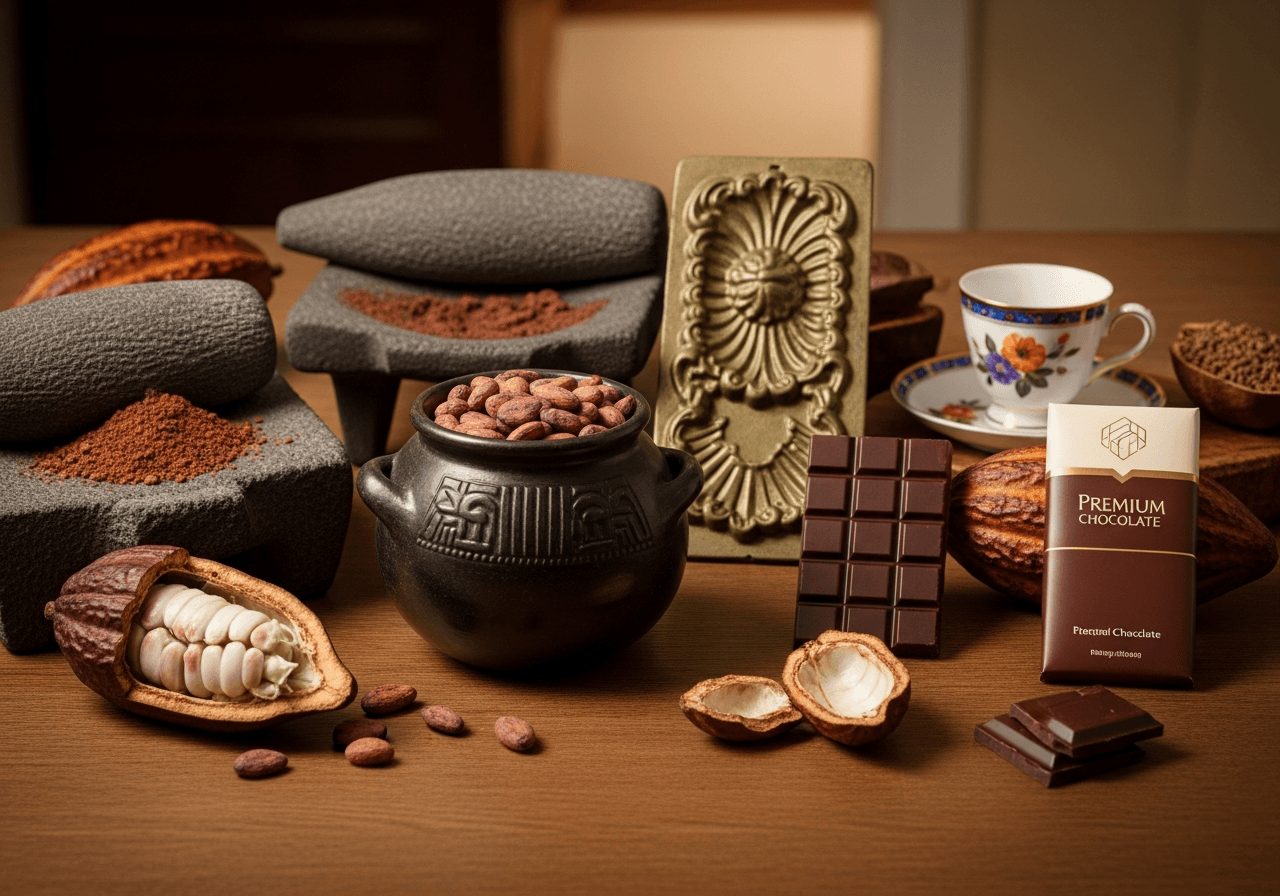
If you ask most folks where chocolate comes from, you will hear something about Switzerland, or perhaps Belgium, and a vague nod toward a candy bar in a vending machine. The actual answer is older, stranger, and a good deal more interesting. Chocolate began as a bitter drink, brewed from a fermented seed, in the rainforests of what we now call Mexico and Central America. According to the Smithsonian and a 2018 study published in the journal Nature Ecology & Evolution, the cacao plant has been used by humans for at least 5,300 years, with the earliest residues turning up not in Mesoamerica at all but at the Santa Ana-La Florida site in southeast Ecuador. So before we get to the foil-wrapped square in your pantry, it is worth pausing over how far this little seed has traveled.
The Olmec, Then the Maya
The Olmec, who lived along the Gulf Coast of Mexico from roughly 1500 BCE onward, are generally credited as the first Mesoamerican people to consume cacao in a recognizable form. Archaeologists have identified cacao residues on Olmec pottery from sites such as El Manatí and San Lorenzo Tenochtitlán, including the wide-mouthed jars called tecomates. We do not know exactly how they prepared it, only that they were doing so very early.
The Maya, picking up the practice and refining it, are the people most often associated with cacao in the popular imagination, and for good reason. By around 600 BCE they had developed a sophisticated cacao culture. They fermented the beans, dried them, roasted them, then ground the nibs on a heated stone metate until they had a paste. That paste was mixed with water, chile, achiote, vanilla, or honey, and poured back and forth between vessels at height to raise a thick foam. The foam was the prized part. The Maya word kakawa is the source of our word cacao; the Aztec word xocolatl, often translated as “bitter water,” is the source of chocolate.
It is worth noting that this drink was not a casual beverage. Cacao beans were used as currency among the Maya and later the Aztec. They appeared in marriage rites, in funerals, and in offerings to the gods. Hernán Cortés wrote that the Aztec emperor Moctezuma II was served cacao in golden goblets at court. Whether or not the more colorful versions of that story are accurate, the Spanish chroniclers were clearly impressed.
Crossing the Atlantic
The popular line that Christopher Columbus “discovered” chocolate is one of those tidy claims that does not quite hold up. Columbus and his son Ferdinand did encounter cacao beans on a 1502 voyage off the coast of Honduras, and noted that the local people treated them as something valuable, but there is no evidence the Columbus expedition actually drank chocolate or brought the practice home. Credit for that more properly belongs to Cortés and the later Spanish colonists who, by the mid-sixteenth century, were sending cacao back to Spain along with sugar and cinnamon.
Spain kept the new beverage to itself for the better part of a century, which sounds fanciful but is reasonably well documented. By the early 1600s, chocolate had reached the courts of France, Italy, and eventually England, where it was served hot and sweetened in dedicated chocolate houses. The first London chocolate house opened in 1657. For a time it was a drink of aristocrats and clerics, and in some periods, particularly in seventeenth-century France, the law tried to keep it that way.
From Drink to Bar
The original article on this page placed the invention of solid milk chocolate in England in 1847, and it is worth correcting that gently, because two separate inventions tend to get squashed together. In 1847 the Quaker firm J. S. Fry & Sons, of Bristol, England, produced what is generally recognized as the first solid eating chocolate, made by adding extra cocoa butter back to cocoa powder and sugar so the paste could be molded. That bar, however, was dark, not milk.
Milk chocolate came later, and from Switzerland. Daniel Peter, working in Vevey, spent years trying to combine milk and chocolate without the milk going rancid. He finally succeeded in 1875 by using condensed milk supplied by his neighbor Henri Nestlé. By 1887 his Gala Peter brand was on the market, and by the early twentieth century Swiss milk chocolate had set the standard for the world. A few other dates round out the timeline:
- 1828 — Coenraad van Houten of the Netherlands patents the cocoa press, which separates cocoa butter from cocoa solids and makes powdered cocoa possible.
- 1866 — Fry’s introduces the Chocolate Cream, often called the first mass-produced chocolate bar.
- 1879 — Rodolphe Lindt of Bern develops the conching process, giving milk chocolate the smooth texture we now take for granted.
- 1900 — Milton Hershey begins large-scale milk chocolate production in Pennsylvania, putting an affordable bar in the hands of ordinary Americans.
Where Cacao Grows Now
For most of its long history, cacao was grown in Mesoamerica and the northern reaches of South America. Today the picture is very different. According to the International Cocoa Organization, more than sixty percent of the world’s cocoa now comes from two West African countries, Côte d’Ivoire and Ghana, with Ecuador, Nigeria, Cameroon, and Indonesia making up most of the rest. The cacao tree itself, Theobroma cacao, still grows only in a narrow band roughly twenty degrees north and south of the equator.
That narrow band has been under stress lately. Cocoa prices climbed sharply through 2023 and 2024, hitting a record of roughly $11,500 per metric ton in the spring of 2024 before easing to about $4,000 in the fall of 2025. The reasons, as reported by the United Nations Trade and Development agency and by Climate Central, include heatwaves, heavy rains, and disease pressure on aging trees in West Africa. The Fairtrade Foundation has cautioned that parts of the region could become unsuitable for cacao within twenty-five years if temperatures continue to climb. None of that should come as a surprise to anyone who has noticed the price tag on a chocolate bar lately.
What to Take From All This
For a home cook or a casual reader, the practical lessons from chocolate’s long history are modest but real. First, the bitter little bean really is the same plant the Maya were grinding three thousand years ago, which is a quietly remarkable thing to consider while stirring a mug of cocoa on a January evening in the Midwest. Second, the words on the wrapper actually mean something. A bar labeled seventy percent cacao is closer in spirit to the Mesoamerican drink than the milky bar next to it; a bar labeled “single origin Ecuador” or “Ghana” tells you where the beans grew. Third, if you have grandchildren who like a good story, the history of chocolate is a generous one. There is the Olmec pot, the Maya foam, the Spanish galleon, the Quaker confectioner in Bristol, the Swiss neighbor with the condensed milk, and now the cacao farmer in Côte d’Ivoire dealing with a hotter dry season. It is a long line, and we are at the end of it for the moment, with a square of chocolate in our hand.