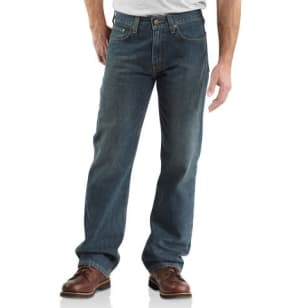
Most of what we think we know about blue jeans turns out to be partly legend and partly accurate, which is roughly the proportion the reference desk gets used to. The garment is genuinely old, the etymology is genuinely European, and the cultural identity is genuinely American. Sorting those three threads is the fun part.
Where the words come from
The fabric we now call denim takes its name from serge de Nîmes, a sturdy twill associated with the French town of Nîmes from at least the 17th century. The word jeans, by contrast, traces back to jene or Genoese, a cotton-and-wool blend produced in Genoa, Italy, and worn by the city's sailors. According to the entry in Wikipedia's denim article, which draws on textile-history sources, weavers in Nîmes were actually trying to imitate the Italian fabric and produced something different in the attempt. So the two textiles were cousins, not twins, and a great deal of denim historiography has been spent untangling the two.
It is worth noting that the popular line about Levi Strauss importing his cloth from Nîmes is, by most current accounts, a tidy story rather than a documented one. The Smithsonian's history of the garment notes that the denim used in the first American blue jeans was woven domestically, in mills in New England.
Who actually wore the early stuff
For most of the 18th and early 19th centuries, denim and jean cloth were workwear, worn by people who could not afford to be precious about a garment. Surviving examples from before the 1850s are rare for the simple reason that working clothes were worn until they fell apart, then cut down for rags. Museums have to piece the early record together from paintings, inventories, and a few stray garments held back by sentimental owners.
In the United States, cotton plantations of the late 18th and early 19th centuries supplied the raw material for a great deal of coarse domestic cloth, including the precursors of denim. That part of the history is sometimes glossed over in the romance of the cowboy era; it shouldn't be. The fabric's American story begins on plantations and in textile mills, not on a horse.
1873 and the rivet
The date most often cited as the birth of the modern blue jean is May 20, 1873, when Levi Strauss & Co. of San Francisco and a Reno tailor named Jacob Davis were granted U.S. Patent No. 139,121 for the use of copper rivets at the points of strain on men's work pants. Davis had been doing this for individual customers and wrote to Strauss, his cloth supplier, with the idea of patenting it. Strauss agreed, financed the patent, and the two went into business together.
The product they sold was called a “waist overall,” not a jean. Levi's archivists, working with the curators of the National Museum of American History at the Smithsonian, have used surviving early garments to reconstruct what the original 1873 model probably looked like. The model we now know as the 501 acquired its number around 1890, and the word jeans didn't displace overalls in Levi's own marketing until well into the 20th century.
Hollywood, then teenagers
Through the 1920s and 1930s, jeans were still primarily working clothes — ranch hands, miners, mechanics, dockworkers. What changed them into a national style was, in large part, the movies. The Western, by the 1930s, gave audiences a steady supply of cowboys whose uniform was denim, and the garment picked up a romantic vocabulary it had not had on the ranch. Dude ranches in the Southwest sold tourists the experience and the trousers together.
The next shift came after World War II. American servicemen wore denim off duty overseas, and the fabric crossed into European street fashion through that channel as much as any other. By the 1950s, jeans were a teenager's garment in a way they had never been before. Marlon Brando in The Wild One (1953) and James Dean in Rebel Without a Cause (1955) cemented the association with adolescent rebellion, and a number of American school districts responded by banning jeans — which, predictably, did nothing to slow them down.
From counterculture to designer label
Through the 1960s and 1970s, denim absorbed almost every subculture it touched: the embroidered and embellished jeans of the late '60s, the bell-bottoms and hip-huggers of the '70s, the patched and customized pairs of festivalgoers and protesters. By the late 1970s, designers had begun to notice the obvious commercial opportunity. Calvin Klein, Jordache, Sergio Valente, and Gloria Vanderbilt led what came to be called the “designer jean” era of the 1980s, in which the price of a pair of pants tracked the recognition of the name on the back pocket.
The 1990s, in some quarters, treated denim as too ordinary to bother with — flannel and cargo trousers had their moment — but the early 2000s brought premium denim back with a vengeance, this time from labels like 7 For All Mankind, Citizens of Humanity, and True Religion. Jeans that cost more than a week's groceries became a recognizable shelf in the department store.
Where denim sits in 2026
If you have not been buying jeans recently, you may be surprised at how the silhouette has moved. Skinny jeans, which dominated for roughly fifteen years, have receded; the prevailing cuts on the spring 2026 runways and in the trade press are wide-leg, baggy, barrel, and a slim-but-not-skinny straight cut sometimes called a “hybrid.” Refinery29's 2026 denim roundup and WWD's runway report both flag the return of looser legs and longer inseams.
For a 60-and-over reader who simply wants a pair of jeans that fit and last, the practical news is good. The wider, longer cuts are forgiving in ways skinny jeans were not, and well-made straight-leg denim has come back into stock at most mid-tier retailers. A few notes I'd offer from the sidelines:
- Weight matters. A 12 to 14 ounce denim will outlast a 9 ounce stretch denim by years. The lighter weights feel softer at first and pill faster.
- Stretch is a tradeoff. A small percentage of elastane (1 to 3 percent) makes jeans more comfortable for long days; more than that and the fabric loses shape after a few wears.
- Wash less. Denim historians and the Levi's archive both recommend washing jeans rarely — spot-cleaning between wears, machine-washing inside out in cold water when needed. The fabric was designed to age, not to be laundered weekly.
- The rise is back. Mid- and high-rise cuts are widely available again after years of low-rise dominance, which most of my friends consider a public service.
A footnote on water
One change worth flagging since the older version of this article was written: the environmental cost of denim has become a serious topic of trade conversation. Industry estimates put the lifetime water footprint of a single pair of jeans at somewhere between 2,000 and 5,000 liters, depending on the methodology, and there is still no agreed standard for measuring it. Several large mills, including Cone Denim, have published water-reduction targets and reported meaningful progress in the last few years. If sustainability matters to you, look for brands that disclose specific numbers rather than the vaguer “eco” language; the difference is usually telling.
The takeaway
The history of denim is one of those subjects that rewards a little patience. The fabric is European in origin, the garment is American in identity, and the cultural baggage is borrowed from at least three centuries of working people who needed clothes that wouldn't quit. Five hundred years on, the trousers have outlasted nearly every trend that tried to replace them — which is, perhaps, the most American thing about them.