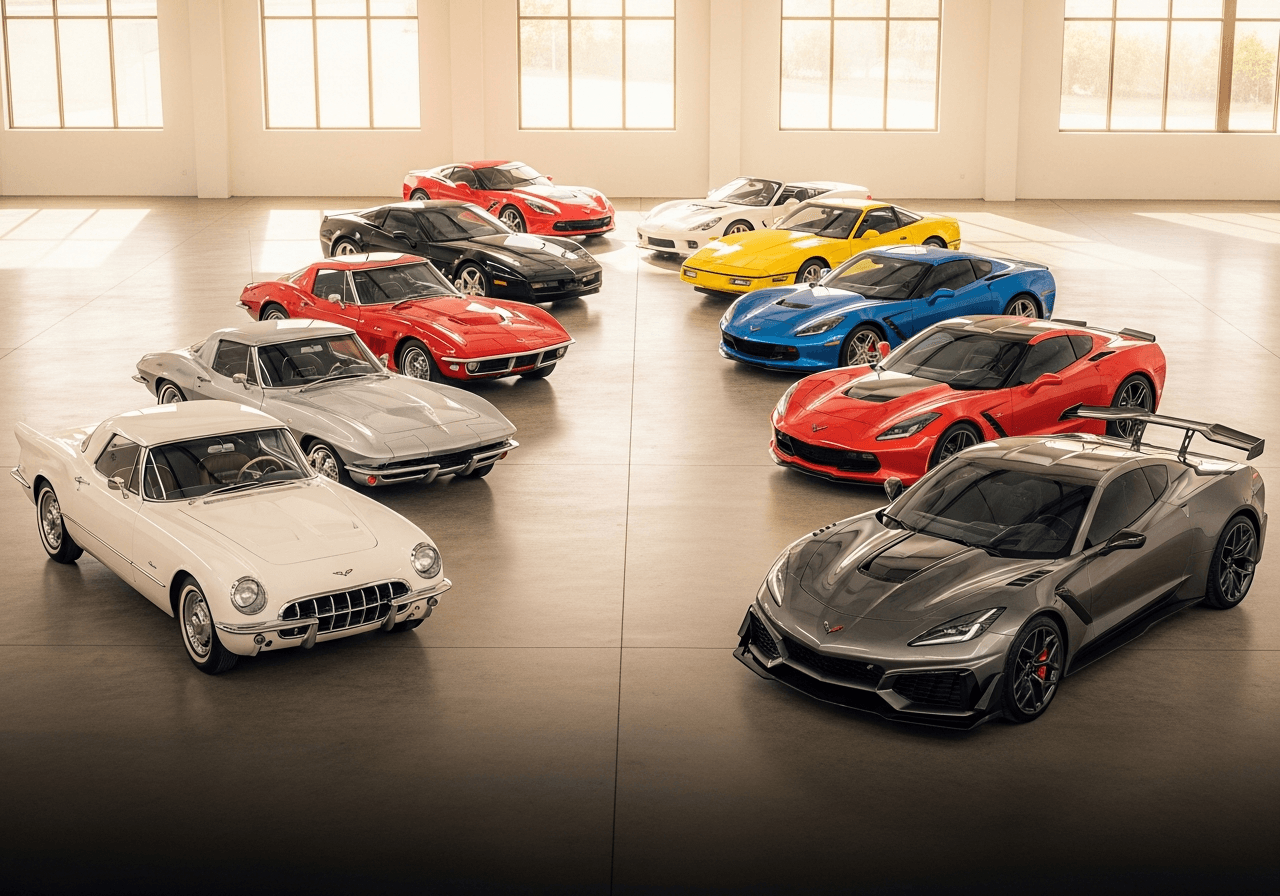
It turns out the Corvette almost wasn't called the Corvette. In the spring of 1953, a special naming committee at Chevrolet sat down with more than 300 candidates, all of which, for reasons no one ever quite explained, were supposed to begin with the letter C. The man who finally won the day was Myron Scott, then an assistant director in Chevrolet's public relations department, who pulled out a dictionary, found the word corvette — a small, fast warship the British had used to escort convoys through U-boat country during the Second World War — and put it on the table. He liked that it began with a C, rolled off the tongue, and carried the swagger of a fast little ship doing dangerous work. The committee agreed.
I came to the story sideways, the way I come to most things. I'd been helping a neighbor here in Pittsburgh document her late husband's car collection, and his 1965 Sting Ray was the centerpiece. One question led to another, and a few weeks later I had a stack of notes on seventy-plus years of one of the most American cars ever built. What follows is the short version — one a 60-and-up reader can take in over a cup of coffee — with the recent updates the older write-ups don't yet have.
1953: A show car that wouldn't stay on the show floor
The first Corvette was never meant to go into production. It was built as a concept for General Motors' Motorama exhibit at the Waldorf-Astoria in January 1953, the brainchild of GM design chief Harley Earl, who'd been watching American servicemen come home from Europe with a taste for small British and Italian roadsters. Crowds in New York reacted so strongly that GM rushed the car into production within six months, opening a hand-built assembly line in Flint, Michigan in late June. Only 300 were made that first year, every one of them Polo White with a red interior, every body panel made of fiberglass — a choice driven partly by post-Korea steel rationing, partly by speed of tooling.
What most people don't realize is that the 1953 Corvette wasn't really a sports car. It had a 150-horsepower inline six borrowed from Chevrolet's regular sedans and a two-speed Powerglide automatic. The price was $3,498 — nearly the cost of a small house in some parts of the country — and the early reviews were mixed. The car nearly died in its second year. It was the arrival of a small-block V8 in 1955 and Zora Arkus-Duntov's engineering hand on the wheel that turned the Corvette from a curiosity into the genuine article.
The generations, in brief
Corvette enthusiasts number the cars by generation, C1 through C8. The shorthand is useful, so here it is.
- C1 (1953–1962) — the solid-axle years. Fiberglass body, leaf-spring rear, the small-block V8 introduced in 1955. The 1957 fuel-injected 283 was the first American production engine to claim one horsepower per cubic inch, a milestone at the time.
- C2 (1963–1967) — the Sting Ray. Designed by Bill Mitchell with Larry Shinoda. The 1963 split-rear-window coupe is the one collectors chase. Independent rear suspension arrived this generation, along with the famous big-block 427.
- C3 (1968–1982) — the Mako Shark era. Long-running, sometimes maligned, with the first removable T-tops. The mid-'70s emissions rules took a hard bite out of horsepower, and the C3 carried that scar.
- C4 (1984–1996) — the digital reboot. Skipped the 1983 model year entirely; only one of the prototype '83s survives, on display at the museum in Bowling Green. The C4 brought the clamshell hood and the angular dashboard that defined a decade.
- C5 (1997–2004) — the “world beater.” All-new chassis, transaxle moved to the rear for better balance, the all-aluminum LS1 V8 up front. Chevrolet built a 50th Anniversary Edition for 2003.
- C6 (2005–2013). Refinement, fixed headlights for the first time since 1962, and the introduction of the ZR1 trim with a supercharged 638 horsepower — a properly serious car.
- C7 (2014–2019). The Stingray name returned. The last front-engine Corvette, and one many longtime owners still consider the sweet spot.
- C8 (2020–present) — mid-engine, finally. Zora Arkus-Duntov had pushed for a mid-engine Corvette in the 1960s. It took until 2019 for Chevrolet to actually do it.
Where the Corvette stands now
This is where the older versions of the article go quiet, so it's worth catching up. The current C8 has had an unusually busy few years.
The Corvette E-Ray, introduced as a 2024 model and built starting December 2023, is the first hybrid Corvette ever produced and also the first Corvette with all-wheel drive — a small electric motor on the front axle works alongside the 6.2-liter V8 in the back. The Z06 arrived a year earlier with a flat-plane-crank V8 that revs to 8,600 rpm. The ZR1 returned for 2025 with a twin-turbocharged version of that engine producing 1,064 horsepower.
And then, in June 2025, Chevrolet announced the 2026 Corvette ZR1X, which combines the twin-turbo ZR1 engine with the E-Ray's electric front motor for a total of roughly 1,250 horsepower. According to General Motors, the production ZR1X has run a 0–60 time of 1.68 seconds and a quarter mile of 8.675 seconds at 159 mph — numbers that would have been the stuff of pure fantasy when I was learning to drive in the early 1970s. Pricing starts at $207,395 for the coupe, and the first ZR1X bodies came down the line at the Bowling Green Assembly Plant in December 2025.
For 2026, the entire lineup — Stingray, E-Ray, Z06, ZR1, and ZR1X — received a redesigned interior with larger driver-facing displays, the first significant cabin refresh since the C8 launched. Every single one of them is still built in Bowling Green, Kentucky, where Corvette assembly has lived since the plant opened in 1981.
The museum, briefly
If you ever drive south on I-65 between Louisville and Nashville, the National Corvette Museum sits right off the highway in Bowling Green, across the road from the assembly plant. It opened to the public in September 1994, holds more than 100 cars and roughly 50,000 artifacts, and in October 2025 announced a 66,000-square-foot expansion scheduled to open in late 2026. Many longtime visitors still remember the morning of February 12, 2014, when a sinkhole opened under the museum's Skydome and swallowed eight Corvettes — a piece of history the museum has, somewhat charmingly, chosen to memorialize rather than hide.
What to take from all this
It's worth noting that the Corvette has now outlived nearly every other American sports car of its generation. The Mustang is younger by eleven years; the Camaro is in and out of production; the Pontiac Firebird is gone, the Plymouth Prowler is gone, the Dodge Viper is gone. The Corvette has kept going, in part because Chevrolet has been willing to reinvent it — from a polite fiberglass roadster to a hand-built carbon-fiber hypercar — without ever changing the badge on the nose.
If you're a reader of a certain age, my guess is you remember exactly which Corvette caught your eye first. For my neighbor's late husband, it was a 1965 Sting Ray glimpsed in a showroom on Liberty Avenue when he was twenty-two. For me — and I am not, by any stretch, a car person — it's the white '53 in the Smithsonian's collection, sitting quietly in its case the way most history does, waiting for someone to stop and read the placard.