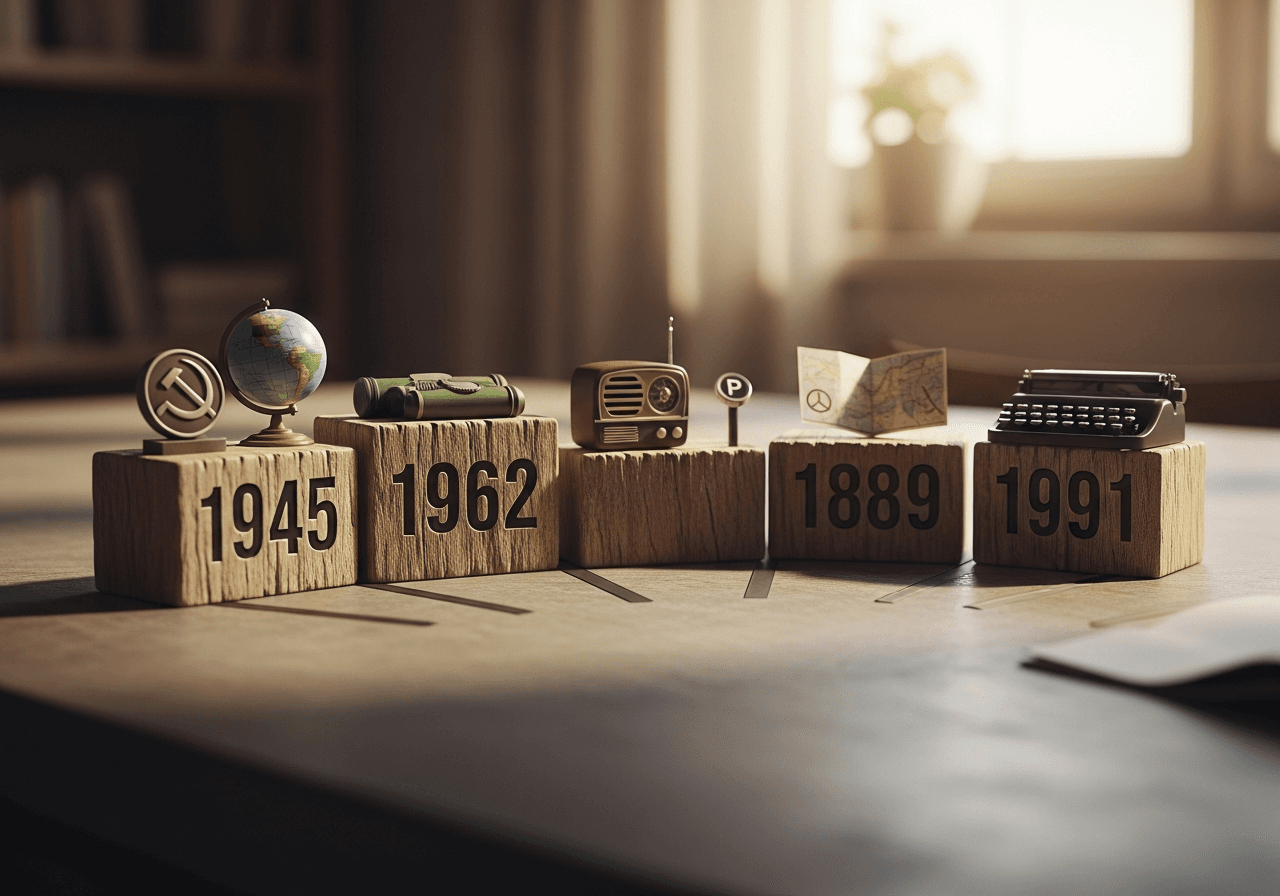
It turns out the Cold War never actually began on a single day. Historians like to argue about it, but most settle on the stretch between the Yalta Conference in February 1945 and Winston Churchill's “Iron Curtain” speech in Fulton, Missouri, in March 1946. By then the wartime alliance between Washington, London, and Moscow had cooled to something closer to a long, watchful stare. What followed lasted forty-five years and only ended in late 1991.
I grew up in Pittsburgh in the 1960s, and I can still picture the “duck and cover” drills at St. Bernard's. None of us understood the politics. We just knew the world had a hum to it. What follows is a walking-pace tour of the war that wasn't quite a war, with a few notes from the declassified record.
Where the Trouble Started
At Yalta, Roosevelt, Churchill, and Stalin agreed in broad strokes on what postwar Europe would look like. Germany would be divided into occupation zones. Eastern Europe would hold free elections. The first part happened. The second part, by and large, did not. By 1948, governments friendly to Moscow had taken hold across Poland, Hungary, Romania, Bulgaria, and Czechoslovakia. President Truman responded in 1947 with what became known as the Truman Doctrine, pledging American support to nations resisting Soviet pressure, followed by the Marshall Plan to rebuild Western Europe's economies.
Most historians date the Cold War proper from 1947 to 1991.
The Berlin Airlift, 1948 to 1949
Berlin sat deep inside the Soviet zone, but the city itself was carved into four sectors. In June 1948 the Soviets cut off road, rail, and canal access to the western sectors, hoping to starve the Allies out. Instead, the United States and Britain flew in food, coal, and medicine around the clock for nearly eleven months. Pilots became known as “Candy Bombers” for dropping handkerchief-parachuted sweets to children. The Soviets lifted the blockade in May 1949. It was the first real test of nerve, and the Allies passed it without firing a shot.
Mao, Korea, and the Cold War Goes Global
In October 1949, Mao Zedong's communist forces took control of mainland China and Chiang Kai-shek's Nationalists retreated to Taiwan, a split that, as of early 2026, has still not been resolved diplomatically.
Less than a year later, in June 1950, North Korean forces crossed the 38th parallel into South Korea. The Korean War, fought under a United Nations banner but largely by American troops, ground on until an armistice was signed at Panmunjom in July 1953. What most people don't realize is that no peace treaty was ever signed. The Korean Peninsula is still, technically, at war.
Hungary, 1956
For a brief autumn in 1956, Hungarians believed they could leave the Soviet sphere. Students marched in Budapest. A reform government took office. On November 4, Soviet tanks rolled in. Within weeks the rebellion was crushed and roughly 200,000 Hungarians fled west. Many ended up in places like Cleveland, Detroit, and yes, Pittsburgh. I went to school with two of their daughters.
Cuba, 1959 to 1962
Closer to home, in January 1959, Fidel Castro's revolutionaries overthrew the Batista government in Cuba. Castro openly aligned with Moscow soon after, and a wave of Cuban families fled to Miami and beyond. The 1961 Bay of Pigs invasion, planned under Eisenhower and authorized by President Kennedy, ended in a humiliating failure on the beach.
The bigger moment came in October 1962. American U-2 spy planes photographed Soviet nuclear missile sites under construction in Cuba. For thirteen days the world held its breath while Kennedy and Khrushchev negotiated. The crisis was resolved when the Soviets agreed to withdraw the missiles, and, in a quieter side deal, the United States agreed to remove its own missiles from Turkey. It was, by most accounts, the closest the Cold War ever came to going hot.
The Berlin Wall, 1961
Back to Berlin. By 1961, roughly 2.5 million East Germans had fled to the West through the city, many of them young and educated. Overnight, on August 13, East German authorities began stringing barbed wire across the border. The wire became cinder block, and the cinder block became the concrete wall most of us recognize from photographs. It would stand for twenty-eight years.
Vietnam and Czechoslovakia
The French had withdrawn from Indochina after their 1954 defeat at Dien Bien Phu. The country was partitioned at the 17th parallel, not the 16th as I sometimes see written. American military advisors arrived under Eisenhower; the war that followed lasted until the fall of Saigon in April 1975 and cost more than 58,000 American lives.
In August 1968, Soviet and Warsaw Pact tanks ended the Prague Spring, the brief Czechoslovakian experiment with “socialism with a human face” under Alexander Dubček. The pattern from Hungary repeated almost exactly.
Détente, Then a Hard Turn
President Nixon's 1972 trips to Beijing and Moscow opened a thaw that lasted, more or less, into the late 1970s. Treaties were signed. Trade widened. Then, on Christmas Day 1979, Soviet forces invaded Afghanistan to prop up a friendly communist government. The war dragged on for nine years and bled the Soviet treasury and the Soviet army both. Mikhail Gorbachev finally pulled the last troops out in February 1989.
President Reagan, taking office in 1981, paired a steep military buildup with surprisingly direct dialogue. His Strategic Defense Initiative, nicknamed “Star Wars” in the press, was as much pressure tactic as engineering project. His phrase “trust, but verify,” borrowed from a Russian proverb, became the slogan of the arms-control talks with Gorbachev that produced the 1987 INF Treaty.
The Wall Comes Down, the Union Comes Apart
On the night of November 9, 1989, an East German official named Günter Schabowski misread a press release at a televised news conference and announced, ahead of schedule, that East Germans were free to cross into West Berlin. People simply walked to the wall and went through. Within days, ordinary Berliners on both sides were taking hammers to the concrete.
It's worth noting that 2024 marked the 35th anniversary of that night, and Germany held quiet, dignified observances rather than a parade.
The Soviet Union itself dissolved on December 26, 1991, after a failed coup against Gorbachev that summer and the steady departure of constituent republics through the fall. There is no single reason for the collapse. The economy was strangled by central planning. The Afghan war had drained morale. Glasnost (openness) and perestroika (restructuring), Gorbachev's reforms, were intended to save the system and instead accelerated its undoing.
What Has Come to Light Since
For an old archivist like me, the most interesting thing about the Cold War now is how much we know that we didn't know in 1991. The Wilson Center's Cold War International History Project has spent more than thirty years gathering documents from former Eastern bloc archives. The U.S. National Declassification Center continues to release tranches of CIA, State Department, and Pentagon files. Every few years, a new batch shifts a footnote we thought was settled.
A Practical Takeaway
If you lived through any part of this, you already know the personal version. Most of us still remember where we were during the Cuban Missile Crisis, or the moonshot that came partly out of the same superpower rivalry, or the night the wall came down. If you're inclined to read further, three good places to start are the Wilson Center's Digital Archive online, the Truman Library's Berlin Airlift collection, and the National Archives' Cold War-era foreign policy guides. All three are free, and all three will outlast me.
What most people don't realize is how often the Cold War was kept cold by people whose names never made the papers, the airlift pilot in Berlin, the Russian submarine officer in 1962 who refused to fire a torpedo, the State Department clerk who got a cable to the right desk in time. A useful thing to remember at any age.