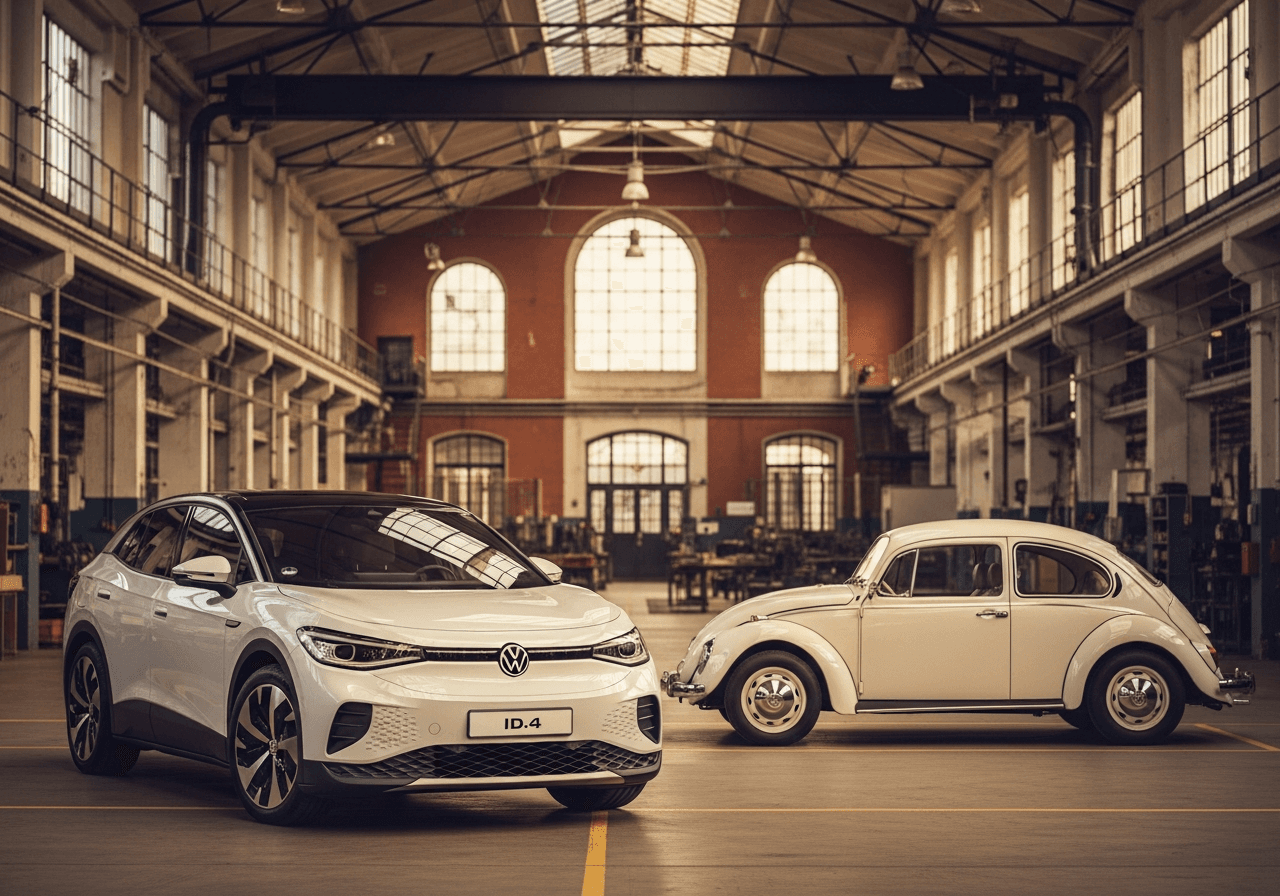
Three things matter when you look at the history of Volkswagen: the engineering brief that started it, the postwar factory that almost did not survive, and the long, profitable run of one very simple car. The rest is commentary. I have driven a Beetle, a Rabbit diesel, and most recently sat behind the wheel of a borrowed ID.4 at a bridge friend's request, and the company has changed more in the past ten years than it did in the prior fifty.
For readers who like a clean timeline, here is the order of events.
The 1934 brief: a car for the average German wage
The original specification is the most interesting part of the story, because it was unusually concrete for the era. In 1934, the German government commissioned Ferdinand Porsche to design a car that would carry two adults and three children, cruise at roughly 100 km/h (about 62 mph), return about 33 miles per gallon, and sell for under 1,000 Reichsmark. Porsche, who had already left Daimler-Benz to run his own consultancy, had been sketching something close to this brief for several years. The political context, of course, was not benign. The car was a propaganda project of the Nazi state, financed in part through a forced-savings scheme that took in money from workers and delivered very few cars before the war intervened.
Between 1935 and 1937, Porsche's team produced roughly thirty prototypes. The Wolfsburg factory, built on land seized from Count von Schulenburg, opened in 1938. By 1939 the plant had been redirected almost entirely to military production, and the small number of civilian Volkswagens delivered before the war is in the low hundreds. Most of what came out of Wolfsburg between 1939 and 1945 was the Kubelwagen and the amphibious Schwimmwagen, both built using forced labor. That is not a footnote one should skip.
1945 to 1949: the British rebuild
The Wolfsburg works were heavily bombed by Allied air raids and, by the end of the war, were operating at a fraction of capacity. Ferdinand Porsche was held by French authorities for nearly two years on war-crime allegations and never returned to lead the company.
What kept Volkswagen alive was a British Army officer, Major Ivan Hirst of the Royal Electrical and Mechanical Engineers. Hirst took over the plant in 1945 under the British occupation, secured an order for 20,000 cars to serve the occupation forces, and reorganized production around the prewar Type 1 design. There is a fair argument, made by historians at the Wolfsburg corporate archive among others, that without Hirst's pragmatic decision to keep the tooling running, the brand would have ended in 1945. He handed control to a German management team in 1949 and went home with a thank-you and not much else.
The Beetle's long arc, 1949 to 2003
What followed is well documented and worth stating in numbers, because the numbers are extraordinary.
- By February 17, 1972, total Beetle production passed 15,007,034 units, breaking the world record held since the 1920s by Ford's Model T.
- The Type 1 (the original Beetle) remained in production at the Puebla plant in Mexico until July 30, 2003. Final tally: about 21.5 million units of the original platform.
- A redesigned New Beetle, built on the Golf platform, ran from 1998 to 2010, and a second-generation Beetle from 2011 to 2019. Across all generations, total Beetle output is reported at over 23 million.
I owned a 1969 Beetle for two years in the early 1970s. Air-cooled flat-four, 1.5 liters, roughly 53 horsepower. It was loud, it leaked heat in summer and offered very little of it in winter, and the heater defroster was a polite suggestion. It also started every morning and cost almost nothing to maintain. That is the design tradeoff Porsche signed off on in 1934, and it held up for sixty-nine model years.
The Golf, the diesels, and the global brand
By the mid-1970s the air-cooled rear-engine layout was a dead end on emissions and crash standards. The 1974 Golf (Rabbit in the U.S.) was a clean break: front engine, water cooled, transverse, front-wheel drive. It is the platform Volkswagen has built on, in spirit, ever since. The diesel variants in particular built a loyal U.S. following in the late 1970s and through the 2000s, on the strength of fuel economy that domestic carmakers were not seriously competing with.
Which brings us to the part of the history that the company would prefer to skip.
Dieselgate, 2015 onward
In September 2015, the EPA announced that Volkswagen had installed defeat-device software in roughly 11 million diesel vehicles worldwide, designed to detect emissions testing and lower NOx output only during the test. On the road, the affected cars emitted up to forty times the legal limit. By June 2020, the scandal had cost the company an estimated $33.3 billion in fines, settlements, and buyback costs, including a $14.7 billion U.S. civil settlement and a $2.8 billion criminal fine. Several executives were prosecuted; the former CEO Martin Winterkorn resigned within days and faced charges in Germany.
I am not in the business of moralizing in print, but the engineering takeaway is straightforward: when a corporate target is set above what the technology can deliver, somebody, somewhere, will be tempted to fake the data. Volkswagen learned this the expensive way.
Where Volkswagen sits in 2026
The company that emerged from Dieselgate bet heavily on electrification, and the bet has paid off unevenly. In 2025, Volkswagen sold 274,417 EVs in Europe, up roughly 56 percent year over year, and outsold Tesla in the European market for the first time since 2022. The ID.4 was the strongest seller in that mix.
The U.S. picture is less encouraging. In April 2026, Volkswagen confirmed it will end ID.4 production at its Chattanooga, Tennessee plant in mid-April and shift the line back to the gasoline-powered Atlas SUV. The redesigned next-generation model, due in October 2026, will drop the numerical name and be sold as the ID.Tiguan, built only at the Emden plant in Germany. The company also agreed in late 2024 to cut 35,000 jobs in Germany by 2030 to keep its older plants open.
That is the kind of restructuring that suggests the next ten years will not look much like the prior ten.
A practical takeaway for the 60-and-up shopper
If you are weighing a Volkswagen for your next car, three notes from a retired engineer who has owned and serviced several:
- The current Golf, Jetta, Tiguan, and Atlas are perfectly competent vehicles, but they are no longer cheap-to-own in the way the Beetle and the early Rabbit diesel were. Plan for dealer service costs above what a comparable Toyota or Honda will run you.
- If you are considering a used pre-2015 TDI diesel, verify it is one of the post-settlement updated cars, and budget for the fact that resale and parts support are softer than they were a decade ago.
- If you want an EV from the brand, the present-generation ID.4 will be discounted as the model winds down in the U.S. That is genuine value if your charging situation supports it. If it does not, an electric car is not magic, and you should not let the price tag override the basic question of where you will plug it in.
Volkswagen has been a useful brand for ninety years now, including some chapters it would prefer to forget. Its best work has always been when the brief was specific, the engineering was honest, and the price reflected what the average buyer could actually afford. By those standards, the original 1934 specification still holds up.