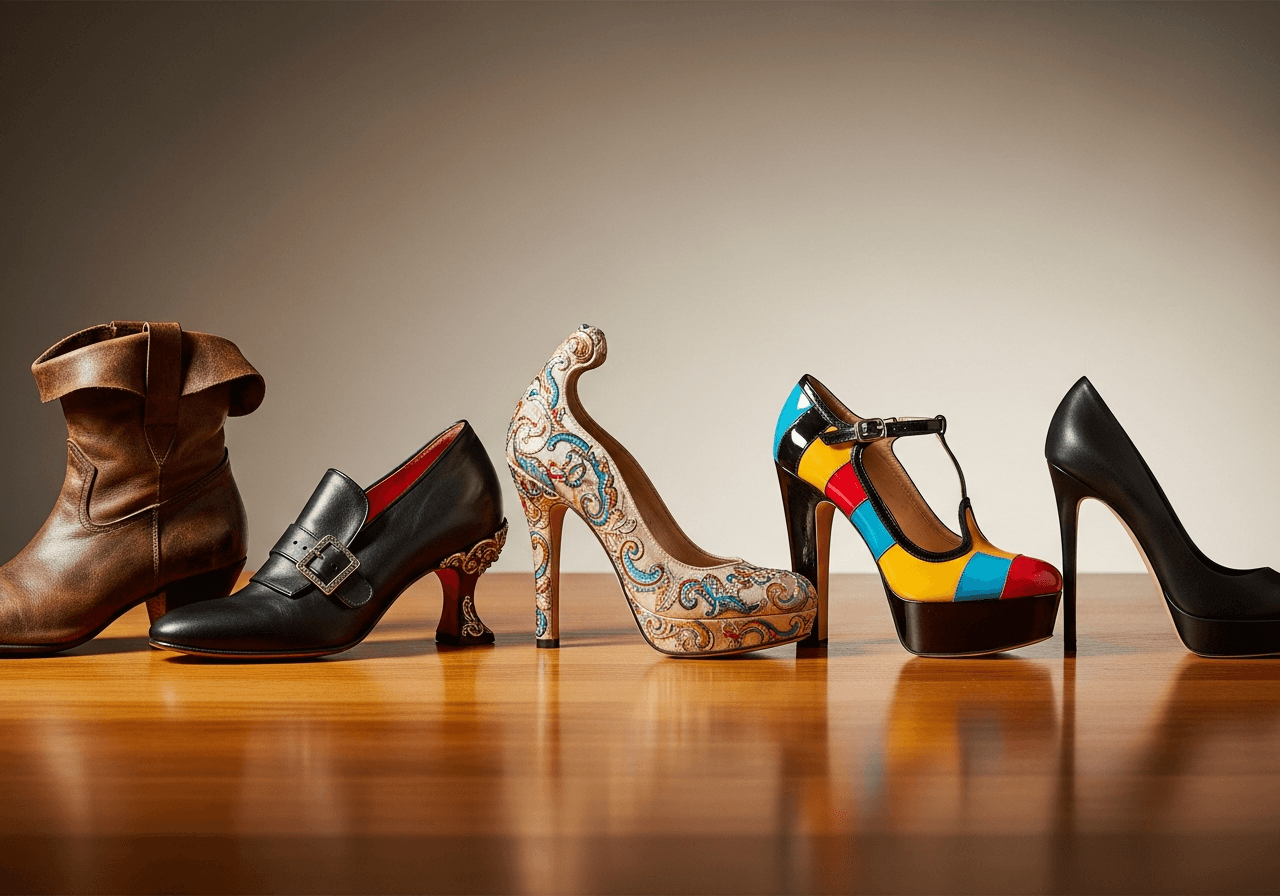
I keep a pair of low-heeled black pumps in the front hall closet, the way my mother kept a pair of white gloves in her top drawer: not because I wear them every week, but because there are still occasions in life that ask for them. A funeral. A wedding. A long lunch at the Charleston Library Society where one feels obliged to dress up for the chandeliers. After more than four decades of writing about how women furnish their lives, I have come to think of the heel as a small, complicated piece of architecture, and like any architecture, it has a history worth knowing.
A military invention, not a feminine one
The first thing to understand about the high heel is that it was designed for a man on a horse. Costume historians generally trace the form to tenth-century Persian cavalry, where a raised heel locked the rider's foot into the stirrup and freed both hands for the bow. The Bata Shoe Museum in Toronto, which is the principal scholarly authority on the subject, has documented this lineage in detail. When a Persian diplomatic mission arrived at the European courts at the end of the seventeenth century, aristocrats borrowed the silhouette as a marker of military bearing and, by extension, status.
Louis XIV, who stood about five feet four, took to the heel with enthusiasm and decreed a particular shade of red for the soles of his courtiers. The Sun King's red heel was, in effect, the original gatekept luxury good. Christian Louboutin's twentieth-century revival of the red sole was not an invention; it was a citation.
How the heel became a woman's shoe
The shift began in the early eighteenth century. As the European Enlightenment reorganized ideas about masculinity around reason, restraint, and sober tailoring, men's clothing grew quieter and their shoes grew flatter. Women's footwear, by contrast, remained ornamental, and by roughly 1740 the heel had been almost entirely surrendered to the female wardrobe. It is one of those reversals that happens slowly enough that no one quite notices until it is finished.
The nineteenth century gave us the curved Louis heel, the buttoned boot, and the first machine-made shoes from Lynn, Massachusetts. The twentieth century gave us the stiletto, generally credited to Roger Vivier in the early 1950s, working with the help of newly available steel rods that could carry a body's weight on a needle-thin point. Vivier's heels for Christian Dior, and the Italian shoemakers who followed him, defined an entire postwar idea of femininity. Marilyn Monroe's walk in Some Like It Hot would not be what it is without one heel slightly lower than the other, a piece of stagecraft she reportedly arranged herself.
Other moments worth knowing
A few footnotes that, in my experience, tend to get garbled in casual retellings:
- Chopines, the platform shoes worn in sixteenth-century Venice, could reach extraordinary heights, sometimes a foot or more. They were a marker of patrician status, and a noblewoman often required two attendants to walk in them. The persistent legend that husbands invented them to slow their wives down is largely apocryphal.
- Egyptian butchers are sometimes said to have worn raised soles to keep above the blood of the slaughter floor. The evidence for this is thinner than the story suggests, and serious shoe historians treat it with caution.
- The cowboy boot, with its angled heel, is a direct descendant of the Persian riding shoe. The function never changed: keep the foot in the stirrup.
Where the heel stands in 2026
For about a decade, fashion declared the high heel finished. The pandemic accelerated the move toward flats, sneakers, and the loafer. I watched it happen from my own closet. And yet, as of the spring 2026 collections, the heel has returned, though in an altered form. The trade press, including Who What Wear and the fall 2025 New York runway coverage in Marie Claire, has been documenting a clear preference for the high-vamp pump, the block heel, the wedge, and the square toe. Chanel's two-tone slingback is everywhere again. The pencil-thin stiletto, by contrast, has been quietly retired by most designers.
What this means in practical terms is that the heel of the moment is shorter, sturdier, and better engineered than the one many of us grew up wrestling with. That is, frankly, an improvement.
What I tell friends my age
I am no podiatrist, but I have read enough of them, and I have my own feet to consult. A few principles that have served me well, and that the foot specialists I trust tend to agree with:
- Two and a half inches is the upper limit for most occasions, and even that is generous. The fat pad under the ball of the foot thins as we age; a lower heel asks less of what is left.
- A wider heel base distributes weight. A block heel of an inch and three-quarters is far kinder than a stiletto of the same height.
- An almond or rounded toe gives bunions and hammertoes room to exist without complaint. Pointed toes that pinch are not worth the silhouette they create.
- A strap matters. A Mary Jane bar or a slingback keeps the foot from sliding forward, which is where most of the pressure damage happens.
- Wear them by occasion, not by habit. One podiatrist I read recently described heels as dessert, which I thought was the right metaphor.
A small confession
I still own a pair of three-inch black suede pumps from the late nineteen-eighties, bought on a press trip to Milan, that I cannot bring myself to give away. I have not worn them in years and I will probably never wear them again. But they sit on the shelf the way certain books sit on the shelf, as evidence of a particular self at a particular moment. The heel, more than almost any other garment, has always done that work. It marks an occasion. It records a posture. It tells you, when you find it years later in the back of the closet, exactly who you thought you were the night you bought it.
If you are buying a pair this season, take the time to walk a city block in them inside the store. Ask for half sizes. Sit down and bend your foot. Beauregard, my cocker spaniel, watches the whole exercise with the patience of a creature who has never had to choose between elegance and a comfortable arch, and I sometimes envy him for it.