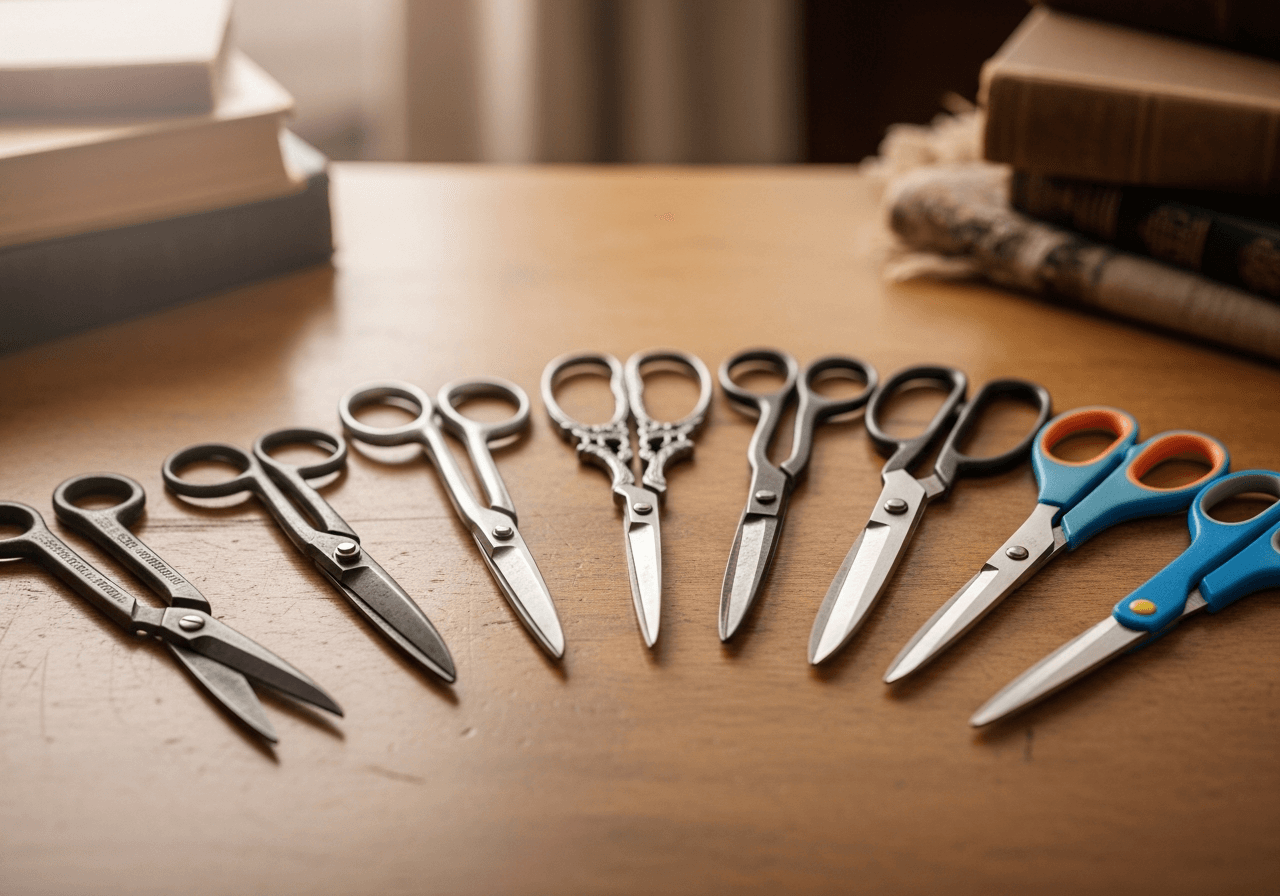
There is a small pair of scissors in my kitchen drawer that I have used to open everything from seed packets to a stubborn bag of Pittsburgh pretzels. I was sharpening them last Tuesday morning when it occurred to me that I had no idea who first thought to put two blades on a pivot. As an archivist, that sort of question tends to keep me up. So I went looking, and what I found is rather wonderful.
It turns out scissors are older than the pyramids at Giza are tall. The earliest cutting tools we would recognize as scissors date to roughly 1500 B.C., with examples in bronze surfacing from Mesopotamia and ancient Egypt. They were not the X-shaped, cross-pivoted instrument we use today. They were what specialists call spring scissors: two blades joined at the top by a single curved strip of bronze that acted as a hinge. You squeezed the blades together to cut, and the spring snapped them open again. If you have ever used a pair of grass shears or sheep shears, you have held the design's direct descendant.
The Roman Pivot, and a Long Quiet Stretch
What most people do not realize is that the cross-bladed, pivoted form we picture when we hear the word scissors arrived only around 100 A.D., when Roman craftsmen began joining two separate blades with a rivet. Even then, the spring-style and the pivoted-style lived side by side for centuries. Different trades kept what worked for them. Vintners pruning grapevines, tailors trimming cloth, and tinsmiths cutting sheet metal each had their preferred tool, and the same village smith might forge both kinds in a single week.
The history grows a little dim between Rome and the Renaissance, which is honest of it. Most invention does not happen in a flash; it accretes. A blacksmith in one century files a slightly better finger loop. A craftsman in the next adds a screw instead of a rivet so the blades can be tightened. None of them sat down and wrote about it. They were busy, the way a good plumber today is busy.
Sheffield, 1761: Robert Hinchliffe's Cast-Steel Pair
The first name in the modern history of scissors belongs to Robert Hinchliffe, a Sheffield manufacturer who, around 1761, produced what is generally credited as the first pair of scissors made from hardened, polished cast steel. Sheffield was the right place at the right time. Just a few years earlier, a clockmaker named Benjamin Huntsman, also working in Sheffield, had figured out how to melt steel in clay crucibles and pour a more uniform metal than anyone in Europe had managed before. Hinchliffe used that crucible steel and put up a sign outside his shop on Cheney Square reading fine scissor manufacturer, which I find rather endearing in its plainness.
Hinchliffe's real puzzle, according to the Hawley Collection of Sheffield knives, was the bow, the loop your finger goes through. He started with solid bows, drilled a hole, then filed the metal away to enlarge it. Tedious work, but it gave the scissors their finished form, and within a generation the design had spread through London and beyond.
A Twentieth-Century Surprise from Finland
If you opened your kitchen drawer right now, there is a fair chance the scissors with the orange handles are sitting there. Those are Fiskars, and they have a story I did not know until recently. Fiskars is a Finnish company that has been forging metal in the village of Fiskars since 1649, which makes it one of the oldest companies in the Western world. In 1967, an industrial designer named Olof Bäckström gave them the first pair of scissors with molded plastic handles, lighter and more comfortable than anything that had come before.
The orange color was, of all things, a happy accident. According to Fiskars' own company history, the prototype handles came in black, red, green, and orange, and the orange test batch was made because there was leftover orange plastic in the factory from a run of orange juicers. The staff voted, the orange won, and the company has now sold over a billion pairs. Fiskars trademarked that exact shade of orange in Finland in 2003 and in the United States in 2007. So if you ever wondered why the knockoffs are always a slightly off red or yellow, that is the legal reason.
The Folklore: Coins, Pillows, and Doors
The thing I love most about researching scissors is how thoroughly people layered superstition onto them. A few of these traditions are still very much alive:
- Never give scissors as a gift, the saying goes, lest you cut the friendship. The remedy, as my mother taught me, is to tape a coin to the package. The recipient hands the coin back, and the scissors are technically purchased rather than given. A penny will do.
- Do not pass scissors hand to hand; set them down on the table for the other person to pick up. This one survives strongly in parts of Turkey and the Middle East and turns up in tailoring shops in Europe to this day.
- Scissors under the pillow were said to cut a woman's labor pains in half, or ease a fever. I would not bet on the medicine, but the impulse is touching.
- Open scissors hung by one handle near a doorway, blades exposed, were thought to deter evil from entering, the open form making a rough cross.
There is also a much darker bit of folklore from parts of North Africa involving scissors snapped shut behind a bridegroom on horseback, said to render a marriage unconsummated. I will leave that one in the footnotes, where it belongs.
What This Means for the Drawer in Your Kitchen
For a reader who has reached the age where most of us have inherited at least one pair of scissors from a parent or aunt, here are a few practical thoughts that come out of the history:
- An old pair is often a good pair. Pre-1980 cast-steel scissors, particularly anything stamped Sheffield, Solingen, or Wiss (the New Jersey firm that ran from 1848 to the 1970s), can usually be sharpened back to fine working order by a local knife sharpener. They were built to be resharpened, not replaced.
- Match the scissors to the job. Fabric shears should never cut paper, which dulls them in a hurry. Kitchen shears should not be used to open packaging with adhesive on it. If you have arthritis, the spring-loaded styles, which are essentially a Bronze Age design with new materials, are gentler on the hand than pivoted ones.
- Mind the gift. If you are putting a pair of nice shears in a Christmas box for a daughter or grandchild, slip in a penny. It costs you nothing and respects a tradition older than the United States.
I rather like that scissors are one of those rare objects where the form has barely changed in nearly two thousand years. A Roman tinsmith, dropped into my kitchen, would recognize the tool on the counter immediately. He might not know what to make of the orange handles, but he would know what to do with them. Not many inventions can claim that kind of continuity, and I think that is worth a moment's appreciation the next time you reach for a pair.