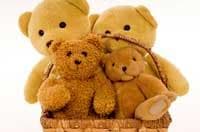
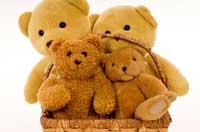
It's worth noting that one of the most beloved objects in American childhood started, of all places, with a presidential hunting trip and a newspaper cartoon. The teddy bear is now well past its 120th birthday, and the story behind it is better documented than most people assume. The Smithsonian Institution holds the original. The Theodore Roosevelt Center at Dickinson State University maintains a tidy archive of the cartoon that started it all. And both of the companies that, on opposite sides of the Atlantic, claim to have invented the teddy bear in the same year are still around in 2026.
The Mississippi Hunt, November 1902
In November 1902, President Theodore Roosevelt traveled to Smedes, Mississippi, for a black bear hunt arranged by the state's governor. Roosevelt's hunting party tracked a bear for hours, then cornered and tied it to a willow tree so the President could take the shot. He refused. According to accounts collected by the Theodore Roosevelt Association, Roosevelt thought killing a tethered animal was unsporting, and he ordered the bear put down humanely instead.
What happened next is the part most often retold. Washington Post cartoonist Clifford K. Berryman published a drawing on November 16, 1902 titled "Drawing the Line in Mississippi," showing Roosevelt with his back turned to a small, frightened bear. The cartoon worked on two levels at once, as Berryman intended: it referenced a Louisiana-Mississippi border dispute the President had been asked to mediate, and it captured the moment of refusal in the woods. Berryman softened the bear in later cartoons, drawing it smaller and rounder, and the image became something of a recurring character in his Roosevelt drawings.
Two Inventors, the Same Year
Here is where the history gets interesting. In 1902 and 1903, two unrelated toy makers — one in Brooklyn, one in southern Germany — produced soft, jointed bears that look, to a modern eye, very much like the same idea.
In Brooklyn, a Russian-born candy-shop owner named Morris Michtom and his wife Rose stitched a small plush bear and placed it in their shop window at 404 Tompkins Avenue with a sign that read "Teddy's bear." According to the National Museum of American History, Michtom wrote to the President asking permission to use his name on the toy, and Roosevelt reportedly replied that he didn't think his name would do much for a stuffed bear's marketability. Demand proved otherwise. By 1907, the Michtoms had founded the Ideal Novelty and Toy Company, which became one of the largest American toy manufacturers and remained in operation into the 1980s.
Meanwhile in Giengen an der Brenz, Germany, Margarete Steiff's nephew Richard had designed a mohair bear with movable arms and legs, catalogued as Bear 55PB. Steiff's own corporate history records that the bear was presented at the Leipzig Spring Fair in March 1903, where an American buyer placed an order for 3,000 of them. The Steiff company is still in family-related ownership today, still makes bears in Germany, and the early jointed bears now command serious prices at auction houses like Christie's and Bonhams.
The two origin stories don't contradict each other. They simply happened in parallel, in an era when the idea of a soft, friendly stuffed animal — as opposed to the stiff, fierce-faced taxidermy-style bears that came before — was clearly in the air.
From Parlor Toy to Wartime Casualty
By 1906, the word "teddy bear" was in print in Playthings magazine, the trade publication of the toy industry. Within a few years, dozens of small American firms were turning out bears, most of which did not survive the next two decades. One that did was Adolph Gund's company, founded in Norwalk, Connecticut, in 1898 (originally making other plush goods, and adding bears once the craze took hold). Gund passed to the Swedlin family in 1925 and is still in business; in 2018 it was acquired by Spin Master, the Toronto-based toy company, and continues to operate out of New Jersey.
The First World War, somewhat counterintuitively, was a strong period for American teddy bear sales — domestic factories kept running while European production faltered. The Second World War was the opposite. Materials like wool, mohair, and excelsior stuffing were redirected to military use, and American bear production largely paused. Steiff in Germany was forced to make munitions components and feed sacks during the war years.
Postwar Plush and the Shift Overseas
The bears that came back after 1945 were different. Synthetic plush replaced mohair for most of the market. Polyester fiberfill replaced excelsior. Glass eyes gave way to safety-rated plastic ones — a change driven partly by federal toy-safety regulations that gradually tightened from the 1960s onward. By the 1970s, manufacturing had moved heavily to East Asia, and the small American workshops that had defined the early industry mostly closed.
The 1980s and '90s brought two waves worth knowing about. First was the artist-bear movement, a small but devoted community of makers producing one-of-a-kind bears for adult collectors, often selling through specialty shops and shows. The Teddy Bear Artist Association still operates today. Second, in 1997, a former retail executive named Maxine Clark opened the first Build-A-Bear Workshop in St. Louis. By early 2025 the company reported nearly 600 locations worldwide, including 335 in the United States.
What an Older Reader Might Want to Know in 2026
If you have an old bear in a cedar chest somewhere, a few practical notes:
- Identification first. A small button or tag in the ear is a Steiff hallmark and has been since 1904. Early Ideal bears were rarely labeled, which makes attribution harder. The Smithsonian and several university museums have published photo guides online.
- Don't wash an antique bear. Mohair, kapok stuffing, and old glass eyes will not survive a washing machine. A soft brush and a vacuum on its lowest setting, with cheesecloth over the nozzle, is what conservators recommend.
- Insurance and appraisal. If the bear is pre-1930s and clearly identifiable, an appraisal from someone certified through the American Society of Appraisers is worth the modest fee before you list it on consignment or pass it down.
- Reproduction caveats. Steiff has produced authorized replicas of its early bears since the 1980s; these are valuable in their own right but should not be confused with originals. The button itself was redesigned several times, and the differences are documented.
The teddy bear has outlasted most of the technologies, fashions, and political controversies that surrounded its birth. The cartoon that started it ran in a paper that no longer prints in the same form. The President it was named for has been gone since 1919. And yet a child somewhere this evening will fall asleep with a bear under one arm. That kind of staying power is rare, and it is not, on reflection, an accident.