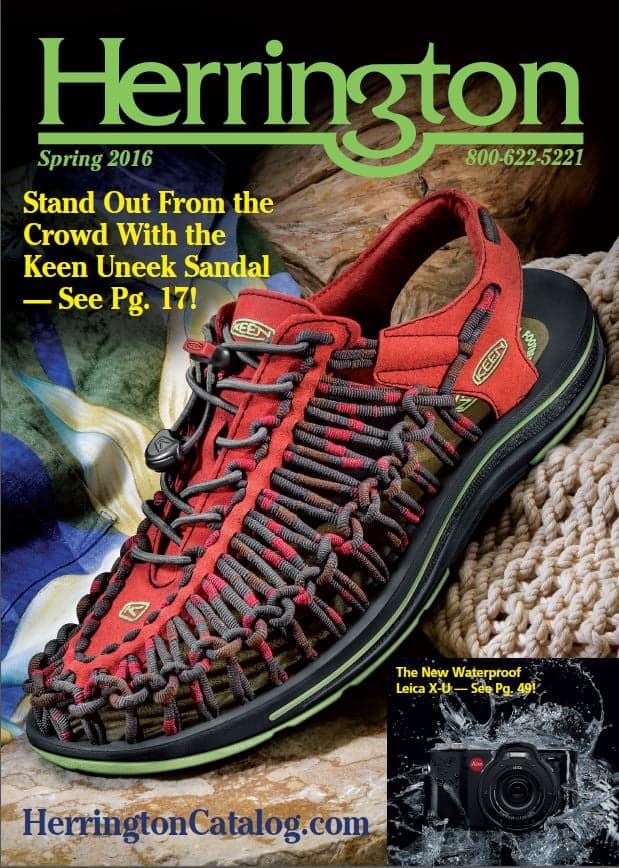
Every so often a reader asks me to chase down a catalog that seems to have simply vanished from the mailbox, and the Herrington Catalog is one that comes up more often than you might expect. It turns out the story is a tidy one, with a clear beginning in 1980 and an equally clear end in early 2018. In between, there is a small New Hampshire company that managed to put a few household-name products into American hands without most of us ever realizing it.
A short history of Herrington
The catalog was founded in 1980 by a man named Lee Herrington. According to the New Hampshire Union Leader, the business operated for more than three decades out of Londonderry, New Hampshire, and built its reputation on a particular kind of merchandise: luxury sporting goods, fine photography equipment, travel accessories, and footwear meant to last more than one season. It was, in short, a gentleman's gadget catalog, though plenty of women shopped from it too.
What most people don't realize is that Herrington was not just a reseller. The company introduced a number of items to the American market that later became household names. Among the better-documented examples:
- The Callaway Big Bertha golf club, which Herrington carried as an exclusive launch before the broader retail world caught on.
- The H.S. Trask line of men's sporting footwear.
- The Swiss MBT “barefoot technology” shoe, brought in front of American buyers through Herrington's pages.
- The original Sapphire Light, an early personal LED flashlight from the years when LEDs in your pocket still felt like a small marvel.
That is a respectable list for any catalog, let alone one that arrived in the mail rather than on a department store shelf.
The 2012 sale and the closing
In November 2012, the founder sold the company in a management buyout to a team led by Norm Beauchesne, who had served as president for many years. Lee Herrington, by then 32 years into the business, was quoted at the time saying it was “time to let others carry on the brand tradition, and to address the challenges of the retail landscape.” Anyone who has watched the print catalog industry over the last twenty years can read between those lines.
The new ownership made noises about expanded internet marketing and new product offerings, but the broader picture — postage costs, paper costs, and the slow migration of gift shopping to the screen — did not get any kinder. In late February 2018, the Herrington Catalog Company shut its doors. A complete liquidation auction was held in March of that year through Atlantic Auction Company. The Londonderry parcel where the warehouse had stood was eventually cleared for redevelopment, which the local Londonderry Times covered at the time.
So if you have been holding out hope that a new Herrington catalog will appear in the mailbox, I am sorry to be the one to tell you. As of early 2026, the company has been quiet for going on eight years, with no revival of the brand on record.
Why this catalog mattered to its readers
It is worth pausing on what made Herrington different from the dozen or so similar gadget books of its day. The merchandise leaned grown-up. The copy assumed you already knew what a rangefinder was. The products were tested for the kind of person who travels with one well-built suitcase rather than three flimsy ones. That sensibility is hard to find now, and it is what most former readers seem to miss.
For those of us who keep a small folder of beloved old catalogs — and I will admit that I do, mostly for the typography — Herrington occupies the same shelf as L.L. Bean's older signature book and the early Sharper Image. It belonged to a particular American moment when a printed catalog was something you read in an armchair, not skimmed on a phone.
If you liked Herrington, where do you turn now?
The good news is that the gadget-and-gift category did not disappear when Herrington did. A few catalogs in this space carry on in print or online, and several are listed here on Catalogs.com. Treat the following as cousins of the Herrington tradition rather than direct replacements, because no two catalogs ever quite line up.
1. Brookstone
Brookstone is the closest thing to a household name in this category. Long known for travel gadgets, well-engineered massage chairs, and the kind of clever desk accessories that make a good office gift, Brookstone has had its own corporate ups and downs but the catalog continues to circulate. It is a sensible first stop for anyone trying to fill the Herrington-shaped gap.
2. Hammacher Schlemmer
If you want a catalog with even deeper roots than Herrington had, look at Hammacher Schlemmer. Founded in 1848, it is one of the oldest continuously operating mail-order businesses in the country. The merchandise tends toward the “world's best” framing — the world's best heated jacket, the world's best umbrella — which I find rather charming in a city-archivist sort of way. The catalog still arrives in the mail and the website is maintained.
3. Edmund Scientific (Edmund Optics)
Edmund Scientific, now operating largely under the Edmund Optics name, sits one shelf over toward the science-and-curiosity side of the gadget aisle. Telescopes, microscopes, optical kits, classroom-grade lab supplies. If your interest in Herrington was the slightly nerdier merchandise — the photo accessories, the LED gear, the tools that did one job extremely well — this is a natural next stop.
4. AJ Prindle & Co.
A.J. Prindle & Co. focuses on car and travel accessories: in-car GPS, emergency kits, road-trip gear, even pet travel supplies. Herrington had a strong travel-accessory section, and Prindle is one of the better current options for that particular itch.
5. Gadgets and Gifts for Men
Catalogs.com keeps a general gadgets-for-men grouping and a broader gifts-for-men grouping that pull together smaller specialty publishers. These are useful when you have a birthday or a Father's Day list and you want to compare a few books at once rather than commit to a single brand.
A practical note for readers over sixty
For those of us who actually liked receiving a paper catalog — and there is no shame in saying so — the trick now is to request a few books from a single source so you don't end up on every mailing list in the country. Catalogs.com lets you order multiple titles from one form, which keeps things tidy. I would also suggest keeping a small notebook with the dates you ordered each catalog and any subscription you set up. It sounds fussy, but it spares you a great deal of paper-shuffling later.
And if anyone reading this happens to have an old Herrington catalog on the shelf, I would gently suggest hanging onto it. It is a small piece of American mail-order history, and those things have a way of becoming surprisingly hard to find once a generation or two has passed.