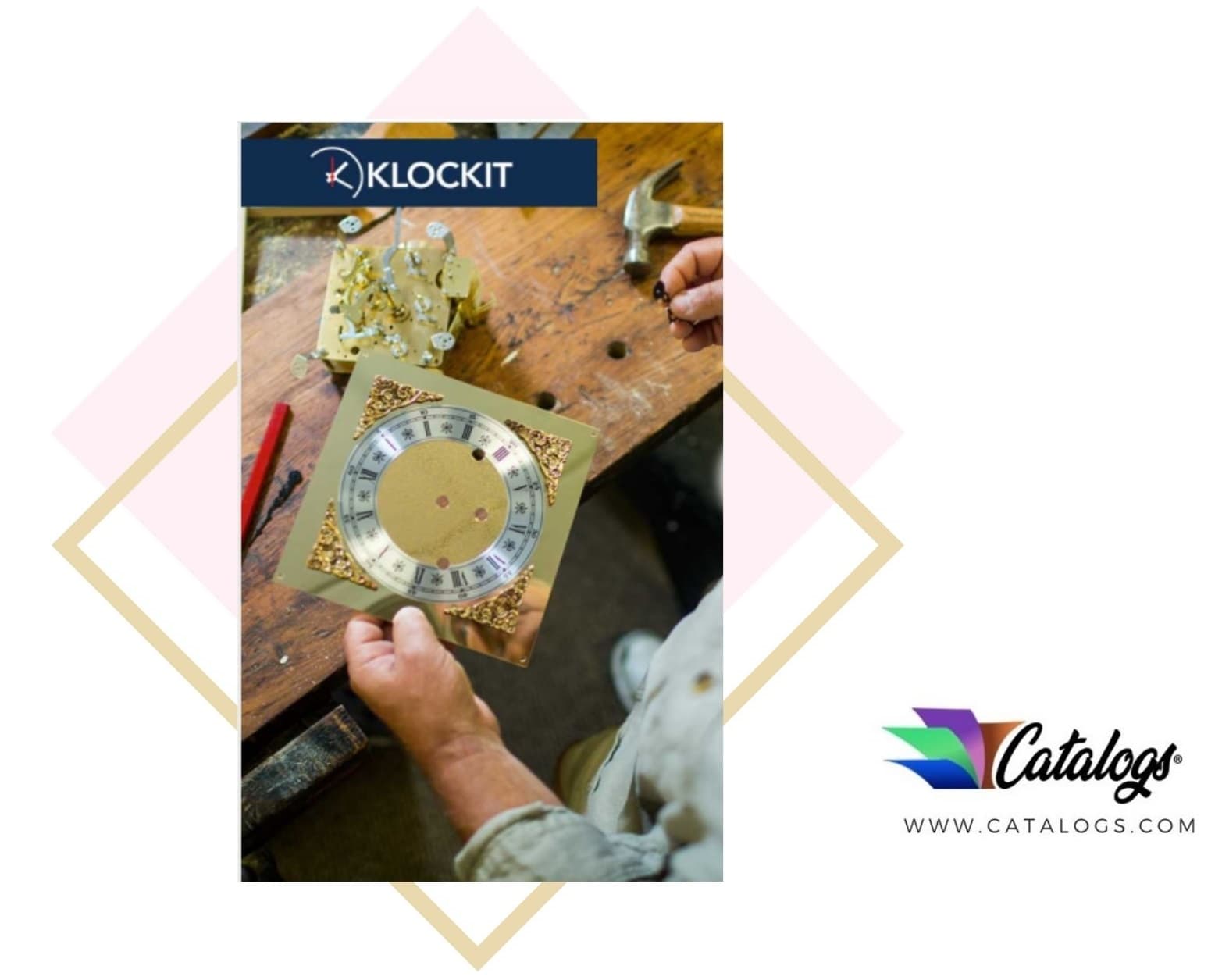
I have a Klockit catalog from the late 1980s in a bankers box in my basement, alongside a stack of Spiegel signatures I art-directed in 1979 and a Hanover House holiday book my old colleague Ed wrote almost the entire copy for. The Klockit book is a slim thing, four-color throughout, with a cover photo of a grandfather case and the kind of warm interior shot that, in our trade, we used to call a hearth setter. It still smells faintly of ink. I bring all this up because the question this article was written to answer in 2021 — how do I order a free Klockit clock parts supply catalog? — has a different answer in 2026 than it did then, and I think the change is worth understanding rather than just announcing.
The short answer for 2026
Klockit, as of this writing, no longer mails a printed catalog to your door. Their support pages have said as much for a couple of years now, and customer service will tell you the same if you call and ask. The full assortment lives at klockit.com, and what they call their “online catalog” is a digital flipbook on the website, not a paper book waiting to be addressed and stamped. If you came here expecting to fill out a form and walk to your mailbox in two weeks, I am sorry to be the bearer.
That said, the company itself is very much alive. Klockit is still based in Lake Geneva, Wisconsin, still part of the Primex family of companies (Primex has used the Klockit tradename since 1975, registered in 2000), and still selling the same Quartex movements, dials, hands, inserts, kits, and hard-to-find replacement parts that have made it the workshop standard for fifty years. The catalog is gone. The business isn’t.
How to actually get the assortment in front of you
If you want something to flip through the way you used to flip through the mailed book, here is what works:
- The online catalog at klockit.com. They host a digital edition you can page through on a tablet. It is not the same as a paper book on the kitchen table, but it is the closest thing on offer.
- Browse by department on the site itself. The navigation breaks the line into Clock Kits, Clock Inserts, Movements (Quartex and mechanical), Dials, Hands, Pendulums, Woodworking Plans, and a Sale section. If you know what you need, this is faster than any print book ever was.
- Phone in. The published number is 1-262-729-4855, Monday through Friday, 9:00 a.m. to 4:00 p.m. Eastern. If you have an item number from an older catalog, they can usually still help you place it. I’d call the morning shift; the catalog houses I worked at always had their best people answering before lunch.
If you have an old printed Klockit catalog — and there are a lot of them in basements and workshop drawers — the item numbers in those books are not all current, but a great many still are. The company has been disciplined about keeping their stock numbers stable across reissues, which is the kind of merchandising hygiene you only notice when it’s missing.
Why the printed Klockit catalog went away
I want to spend a moment on this because it’s the part most people skip past. A printed catalog isn’t just a list of things you can buy. It’s a piece of merchandise itself. The cost to design, photograph, separate, print, bind, and mail a four-color book to a house file of any size is enormous, and it has been climbing every year since around 2018. Postage rates went up. Paper went up after the pandemic and has not really come back down. The print runs that used to make a Sears Wishbook or a Spiegel Christmas book pencil out at the household level no longer make sense for a focused, specialty house like Klockit, where the customer file is intensely loyal but not enormous.
So a company in Klockit’s position has two choices. One, keep printing and mailing, and let the cost eat the margin on every clock movement they sell. Two, move the catalog online, lean on email and search, and put the saved money back into product. Klockit chose the second path, and so have most of the specialty houses I used to consult for. I am not going to tell you it’s the wrong call. I will tell you it costs the customer something real that doesn’t show up on an invoice — the pleasure of the book on the table, the way you’d see a movement next to a dial you weren’t looking for and have an idea you didn’t know you needed.
What an older Klockit hand should know
If you are a longtime Klockit customer — and many of you reading this have been ordering from them since Carter was in office — a few notes worth carrying into the new arrangement:
- Sign up for their email list. The promotional cycles, sales, and new-product announcements go out by email now, not by a four-page flyer in the mailbox. If you only check email reluctantly, ask a son, daughter, or grandchild to set up a folder that filters them in. You’ll catch the clearance windows that used to come tucked into the holiday book.
- Save your old catalogs anyway. Not for the prices — those have moved — but for the assembly diagrams and the woodworking plan illustrations. I have a 1992 Klockit grandfather plan I still reach for, and the version on the website is fine but not better.
- Use the website’s item-number lookup. If you find a part number in an old catalog or in a half-finished project that came down from an uncle’s workshop, type it into the search bar at klockit.com first. The hit rate is better than you’d expect.
- Don’t panic about the kits. The flagship clock kits — the grandfather cases, the wall regulators, the mantel kits — are mostly still in the line, and the hardware is the same. If you started a Klockit project ten years ago and it’s been sitting under a tarp in the garage, the parts you need to finish it are very probably still available.
If you really, truly want a paper catalog from somebody
I’ll be honest: the clock-parts trade has gone almost entirely digital, and the few houses still mailing print are mostly doing it as a marketing gesture rather than a functional sales tool. That’s not a knock — a marketing gesture done well is what built the industry I spent my career in. But the practical answer for a 2026 hobbyist is that the website, the phone line, and email together do the job the printed Klockit book used to do, and they do it faster.
The takeaway, if you’ll let an old catalog man have one: the printed catalog as we knew it is going the way of the four-color signature and the Pantone swatch fan. Klockit is still here, the parts are still here, and the people on the phone in Lake Geneva still know what they’re talking about. That’s the part that matters. The book in the mailbox was never the product. The clock you build with your own hands is.