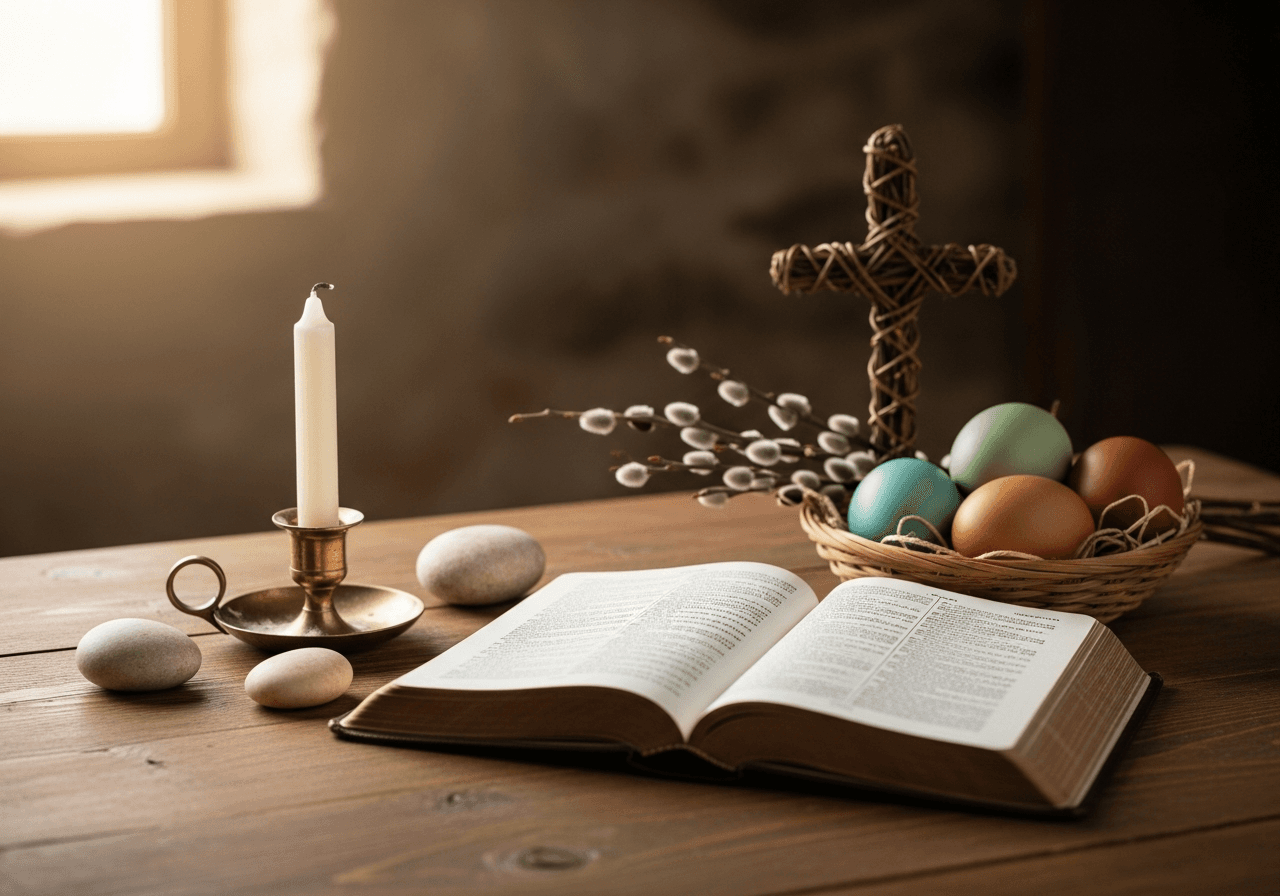
I remember when my granddaughter Lily, who is nine now and full of questions, looked up from her painted egg one Easter morning and asked me, “Grandma, why do we do all this?” She meant the eggs, the lilies on the dining room table, the ham my husband Jim had been fussing over since dawn. It struck me that I had been celebrating Easter for sixty-some years and had never given her a proper answer. So I sat down beside her, wiped my hands on my apron, and tried. What I told her was a much shorter version of what I’d like to share here.
Because the truth is, the history of Easter is older, stranger, and gentler than most of us realize.
A holiday with two long stories behind it
Easter, at its heart, is the Christian celebration of the resurrection of Jesus Christ on the third day after his crucifixion. That part most folks know. What surprises people is that the holiday also carries echoes of much older spring observances—the kind that came long before any church bells rang here in the Midwest, or anywhere else.
The Christian Easter is rooted in the Jewish Passover. According to the Gospels, Jesus traveled to Jerusalem for Passover with his disciples, and it was during that week that he was arrested, crucified on what we now call Good Friday, and rose on the third day. The Greek and Latin name for Easter is Pascha, taken straight from Pesach, the Hebrew name for Passover. Did you know that? I confess I didn’t, not really, until I started reading up to answer Lily.
The English word “Easter,” on the other hand, has a different and more debated story. The Venerable Bede, a monk writing in the 8th century, claimed that the Anglo-Saxons had once held spring feasts in honor of a goddess named Eostre, and that the month roughly corresponding to April was named for her. Modern historians still argue about how widespread her worship really was—some think Bede may have been speculating—but most agree that a spring-goddess tradition of some kind existed in northern Europe long before Christianity arrived. The name simply stuck.
Why the date moves around every year
If you’ve ever tried to plan a family gathering, you know Easter is a slippery one. My daughter Allison, who lives over in Des Moines with her husband Paul and their three children, will phone me in February asking, “Mom, what weekend is it this year?”
Here’s the simple version. Back in the fourth century, church leaders decided Easter would fall on the first Sunday after the first full moon on or after the spring equinox. That means, in most years, it lands somewhere between March 22 and April 25. In 2026, Easter Sunday falls on April 5 for Western Christians. Eastern Orthodox churches, which use a slightly different calendar, will celebrate a week later on April 12.
It’s a moveable feast, as they say. I rather like that about it. The date drifts with the moon and the lengthening days, the way an early Iowa spring drifts in—snow one Tuesday, crocuses the next.
Eggs, hares, and ham: where the traditions come from
So back to Lily and her painted egg. Where did all of this come from? It turns out almost every Easter symbol has a story, and most of them weave together the older spring traditions with later Christian meaning.
- Eggs. For centuries, Christians fasted from eggs during Lent, which meant hens kept laying and the eggs piled up. By Easter morning, families had baskets of them to decorate and share. Eggs also became a symbol of new life and the empty tomb—a closed shell that holds something living within.
- The Easter Bunny. This one always makes me smile. Historians trace the tradition back to 17th-century German Lutheran families, who told their children about the Osterhase, a hare who left colored eggs in the gardens of well-behaved little ones. German immigrants brought the custom to Pennsylvania, and from there it spread across the country. My grandmother in Davenport called him “the Easter Hare” right up until the day she passed.
- Lamb and ham. Lamb has been an Easter dish since the earliest days of the Church, drawing on the Passover lamb and the image of Christ as the “Lamb of God.” Ham came in later, especially in northern Europe and America, partly because hogs butchered in the fall would be cured and ready by spring.
- The Easter lily. White lilies, with their trumpet shape and pure color, came to symbolize resurrection and the hope of life everlasting. I always set a small one on our kitchen table the Saturday before. It costs maybe twelve dollars at the grocery, and it lasts long past the holiday.
How the celebration changed over the centuries
In the very earliest years of the Church, Easter was a quiet, deeply solemn day. The faithful gathered before sunrise, often after fasting through Holy Saturday, to remember the moment Mary Magdalene found the empty tomb. There were no chocolate bunnies in sight.
As Christianity spread through Europe, local customs blended in. Bonfires were lit on Easter Eve in parts of Germany. In Greece, families still crack red-dyed eggs together, each saying, “Christ is risen.” In Poland, baskets of bread and sausage are blessed at church on Holy Saturday. And in the American South, sunrise services have been held on hillsides since before the Civil War.
The brightly painted commercial Easter most of us grew up with—the chocolate eggs in foil, the new bonnets, the white gloves my mother insisted on for the children’s parade—largely took shape in the late 1800s and early 1900s. Isn’t it interesting how quickly something starts to feel ancient?
What it means to me, now that I’m a grandmother
I won’t pretend to be a theologian. I taught third grade for thirty-one years, not seminary. But I can tell you that the older I get, the more Easter feels like a quiet promise rather than a parade. The lilies, the ham, the painted eggs in Lily’s small hands—all of it points, in its plain way, to the same thing the early Christians believed: that even after the hardest winter, something good comes back.
Out here in Cedar Rapids, the redbuds usually bloom right around Easter week. The grass goes from brown to a tender green almost overnight. Jim and I drive up to Cedar Lake just to look. Maybe that’s why the spring goddesses lingered in folks’ imaginations for so long—because the season itself feels like a resurrection.
A few practical thoughts for the season
If you’re hosting this year, especially for grandchildren or great-grandchildren, here are a handful of things I’ve learned over the years:
- Boil and dye eggs the Saturday before. Cold dye works just fine, and small hands can manage it without scalding themselves.
- Keep the ham simple. A glaze of brown sugar, a little mustard, and pineapple rings on top will please three generations.
- Read the Easter story aloud, even briefly. The Gospel of John, chapter 20, is short and lovely. Children settle right down for it.
- Save room for a walk after dinner. The light lingers a little longer each day this time of year, and a slow loop around the block is its own small celebration.
However you observe it—in a pew, at a brunch table, or simply with a coffee on the back porch—may this Easter bring you and yours the same gentle peace it brought my Lily and me, with our painted eggs and our small, fumbling answers to big old questions. What traditions will you carry forward this year?