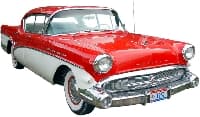
I bought my first car in 1965, a used Chevrolet Bel Air with a straight-six and a three-speed column shift. It was not a remarkable machine, but it was assembled by a company that, at the time, sold roughly half the new cars on American roads. That company was General Motors, and a great deal has changed since I handed over the cash for that Bel Air. Three things matter when you trace GM's story: how it was assembled, how it nearly came apart, and what it actually looks like today.
How a Carriage Maker Built a Car Empire
General Motors was incorporated on September 16, 1908, in Flint, Michigan, by William C. Durant. Durant was not a tinkerer in a garage. He was already running the Durant-Dort Carriage Company, one of the largest horse-drawn vehicle manufacturers in the country, and he saw which way the wind was blowing.
His method was straightforward: buy companies. Buick came first, since he already controlled it. Olds Motor Works followed in November 1908. Within a year he had added Cadillac, Oakland (the brand that would become Pontiac), and the Reliance Motor Car Company, which became GMC. He also tried to buy Ford in 1909 for around eight million dollars. The banks declined to advance the down payment, which is one of the more consequential financing decisions in American business history.
Durant moved too fast for his bankers. They removed him in 1910. He came back in 1916 with the help of Louis Chevrolet, then was pushed out a second time in 1920. Alfred P. Sloan took over in 1923 and gave the company its operating philosophy: a separate brand for every price step, from Chevrolet at the bottom to Cadillac at the top. That ladder is still recognizable today.
The Long American Century
From the 1920s through the late 1970s, GM was the largest industrial corporation in the United States and, for long stretches, the world. A few specifications worth keeping in mind:
- By 1955, GM was the first American corporation to report more than one billion dollars in net income.
- Harley Earl ran the design studio from 1927 until his retirement in 1959, and is generally credited with inventing the discipline of automotive styling. The 1927 LaSalle is the usual starting point.
- GM offered the first factory air bag in 1973, on a small run of Oldsmobile Toronado coupes, and led the industry on the catalytic converter when the 1975 model year arrived.
None of this came cheaply. The 1973 oil shock and the steady arrival of Toyota, Honda, Datsun, and later Volkswagen exposed a product line that had been engineered around cheap fuel. Vehicle downsizing, unleaded fuel, fuel injection, and front-wheel drive all came to GM in the same compressed decade. Most of these transitions were rougher than they should have been.
The Slow Erosion
I worked at Bechtel through this whole period and watched it from a distance. The pattern was familiar to any engineer: a dominant supplier with too many divisions, too much overhead, and not enough of the discipline that smaller competitors brought to the table. By 1995, GM's U.S. market share had fallen below 33 percent. By 2008, it was under 23 percent.
The 2008 financial crisis finished what foreign competition had started. On June 1, 2009, General Motors filed for Chapter 11 bankruptcy, the fourth-largest bankruptcy in U.S. history at the time. The U.S. Treasury and the Canadian and Ontario governments put up roughly fifty billion dollars in bridge financing. The company emerged 40 days later as General Motors Company, a leaner entity with four U.S. brands instead of eight. Pontiac, Saturn, Hummer, and Saab were wound down or sold. Chevrolet, Buick, GMC, and Cadillac remained, and remain today.
What GM Actually Looks Like in 2026
Here is where many older articles on this subject get out of date. The company that exists in 2026 is not the company that emerged from bankruptcy in 2009.
- Brand lineup: still Chevrolet, Buick, GMC, and Cadillac in the United States. Buick is now an SUV-only brand domestically. The Hummer name has been revived as a battery-electric sub-model under GMC.
- Electrification: GM rolled out its Ultium battery and motor platform across the four brands beginning in 2022. Cadillac is, as of mid-2025, the best-selling luxury EV brand in the United States, and Chevrolet is the second-best-selling EV brand overall. The Equinox EV sits at the bottom of the price ladder, the Cadillac Escalade IQ at the top.
- Strategic retreat: in late 2025 GM took roughly six billion dollars in EV-related charges and cut about 3,400 jobs at Factory Zero in Detroit and the Ultium battery plant in Warren, Ohio. The company has publicly recommitted to internal-combustion full-size trucks and SUVs alongside the EV lineup. The 2035 zero-tailpipe-emissions target for light-duty vehicles still appears on company materials, but the timeline is, in plain terms, less firm than it was two years ago.
- Autonomy: GM shut down its Cruise robotaxi subsidiary in December 2024 after about ten billion dollars in cumulative losses and a serious 2023 incident in San Francisco. Autonomous-vehicle work is now folded back into the parent company and aimed at improving Super Cruise, the hands-off highway driver-assistance system, rather than running a driverless taxi fleet.
What This Means for a Buyer
If you are 60 or older and shopping for a new vehicle from one of the four GM brands, three observations may save you some time.
First, the warranty math has changed. New GM EVs carry an eight-year, 100,000-mile battery warranty, which is the federally required minimum and not a generous extra. Compare it to the bumper-to-bumper coverage on the rest of the vehicle, which is shorter.
Second, the federal EV tax credit at the point of sale ended on September 30, 2025. Any sticker price comparison you make between a Chevrolet Equinox EV and its gasoline equivalent has to account for that. Dealer incentives have moved to fill some of the gap, but not all of it.
Third, GM's pivot back toward full-size trucks and SUVs means the gasoline Silverado, Sierra, Tahoe, Yukon, and Suburban are not going anywhere soon. If a V8 with a tow rating north of 8,000 pounds is what you actually need, GM is still in that business and intends to stay in it.
A Long Way From a Carriage Works
One hundred and eighteen years on, General Motors is no longer the largest carmaker in the world. Toyota holds that title, and Volkswagen Group is usually second. GM is, however, profitable, smaller than it was at its peak by design, and still the largest American-headquartered automaker by sales.
That is not a triumphant ending, and it is not meant to be one. Companies that survive a hundred and eighteen years rarely do so by staying the same. They survive by writing off the things that did not work, keeping the ones that did, and hoping the next decade rewards a different set of choices than the last one. My old Bel Air would not pass a 2026 emissions test, and I would not want it to. The company that built it is still here. Most of its competitors from 1908 are not.