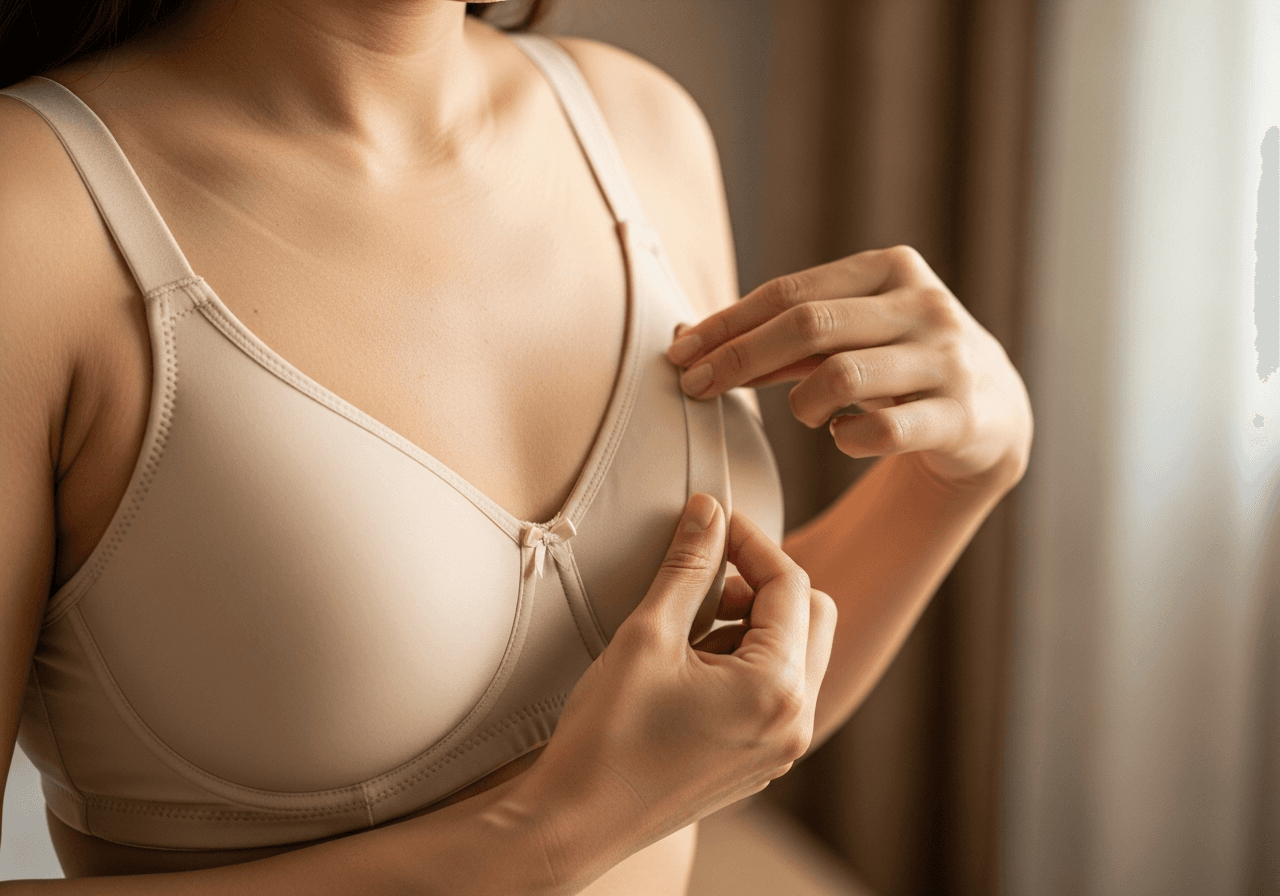
I spent thirty-five years on the bra floor at Bloomingdale's 59th Street, and I will tell you the same thing I told every gal who came in rubbing her shoulder or pulling at her sides. A bra that hurts is not a bra that fits. It is that simple, and it is that fixable.
Most of the women who came to me did not need a whole new wardrobe. They needed three or four small adjustments, and sometimes a quiet conversation about the body they have today versus the body they had at forty. So let us walk through it the way I would on the floor, with a tape measure and a mirror and no rush.
Start with the band, not the cup
The band does about eighty percent of the support work. The straps are there for placement, not lifting. If your band is riding up your back, the straps are doing too much, and that is why your shoulders ache by lunchtime.
Stand in front of a mirror in profile. The back of the band should sit level with the front, right under the shoulder blades. If it is climbing toward your neck, the band is too loose. If you can slip more than two fingers under it comfortably, same story.
Now, the part most women miss. Our ribcages change after sixty. They settle, they soften, sometimes they widen a little after menopause. The bra you wore for ten years may not be wrong about the cup, but the band may have stopped fitting. A new measurement once a year is not vanity. It is maintenance.
If the underwire pokes
An underwire is supposed to sit on the breastbone in front and follow the line where the breast tissue ends on the side. If it is digging into soft tissue, one of three things is going on.
- The cup is too small. Breast tissue is being pushed outside the wire, and the wire is now sitting on tissue instead of around it. Go up a cup before you give up on the bra.
- The wire shape is wrong for your frame. Some women have narrow roots, some have wide. A bra cut for a wide root will poke a narrow-rooted woman in the armpit every time. Look at the brand's fit notes, or ask a fitter.
- You may simply be done with underwires. And that is a perfectly fine answer at our age.
The wirefree bras coming out now are nothing like the saggy training bras from twenty years ago. Companies like Wacoal, Soma, Bali, and Warner's have wirefree styles with molded cups and side panels that lift and shape as well as anything with a wire in it. If underwires have been the source of your suffering, try a good wirefree before you assume you have to live with the poke.
For the band that creeps up
This is the most common complaint I heard, and the fix is almost always the same. The band is too loose. New bras should hook on the loosest setting, so you have two tighter settings to move to as the elastic relaxes. If you bought it already hooking on the tightest, you bought a band too big.
If the band fits everywhere except after a heavy meal or in the evening when we all swell a little, a bra extender is your friend. They are a couple of dollars at any sewing shop or online. Four hooks, four eyes, slip it on, slip it off. Nobody sees it.
One thing I want to mention. If you have arthritis in your hands or shoulders, reaching behind your back to hook a bra is no small task. Front-closure bras have come a long way. Glamorise, Leading Lady, and several others make front-hook styles that look like regular bras from the outside. There is no shame in making your morning easier.
For straps that dig or slip
Straps dig when they are doing the band's job. Tighten the band first, then ease the straps. You should be able to slide two fingers under each strap with a little resistance. Any more than that and the strap is loose. Any less and it is too tight.
Slipping straps are usually a sign that the bra is too big across the back, or that your shoulders slope a bit, which a lot of us develop with age. If shoulders are the issue, a racerback converter or strap holder pulls the straps into a Y in the back. They hook onto the existing straps. Two dollars, maybe three.
Wide straps are kinder to mature shoulders than skinny ones. A half-inch strap on a D-cup is going to leave a mark every time. Look for straps an inch wide or more, padded if you can find them.
If the cups wrinkle or gap
This is a sign the cup is too big, or the style is wrong for your shape. After sixty, many of us lose fullness on the top of the breast. A full-cup bra cut for a younger woman with rounder tissue will gap at the top and look unflattering through a blouse.
Look for styles described as balconette, demi, or plunge. These cut lower on the chest and follow the natural shape of a mature breast much better than a full cup. Wacoal's Awareness style and Bali's Comfort Revolution line have both been around long enough that you can trust them.
Two things I tell every woman
Get measured every year, and rotate three or four bras instead of wearing one favorite into the ground. Elastic relaxes a little every time you wear a bra. Resting it for a day between wears doubles its life.
And do not put a bra in the dryer. Ever. Heat is what kills elastic, and a bra that fit fine in March will be hanging off you by August if you have been drying it on high heat. Hand wash, or use a mesh bag on the gentle cycle, and lay flat to dry.
A well-fitting bra should feel like nothing. You should be able to forget you have it on. If you are thinking about your bra at three in the afternoon, something is off, and almost always, it is one of the small things I just walked through. Fix the small thing, and the rest follows.