I have been listening to recorded music in my living room since the Eisenhower administration, and the question I get from neighbors here in Sun City West has not changed much: what should I buy to make music sound right at home. The answer has. The categories have multiplied, the cabinets have shrunk, and a good portion of the engineering has moved from the speaker box into a piece of software on your phone. Let me walk through it the way I would have laid out a project at Bechtel: requirements first, components second, and a short list of pitfalls at the end.
Three things that matter before you spend a dollar
Most of the bad audio purchases I have witnessed came from skipping this step. Settle three numbers in your head before you compare brands.
- Room volume. A 12 by 14 foot den with an 8-foot ceiling is roughly 1,344 cubic feet. A great room with a vaulted ceiling can be three or four times that. The bigger the volume, the more amplifier power and speaker surface area you need to fill it without strain. Anything north of 2,500 cubic feet starts to push small bookshelf systems past their comfort zone.
- Primary source. Be honest. If 90 percent of your listening is Spotify or Apple Music through a phone, you do not need a phono stage. If you have a stack of LPs in the closet you intend to dust off, you do. If you mostly watch movies and the news, the system you want is built around the television, not the turntable.
- Hearing. I am 78. My upper range tops out somewhere around 12 kHz on a good day, and that is normal for my generation. There is no point spending extra for tweeters rated to 40 kHz when nothing above 14 kHz reaches my brain. A modest pair of speakers with a clean midrange will outperform an over-specified setup every time, for me and for most readers in this age bracket.
Once you have those three answers, the component selection mostly takes care of itself.
The component types, ranked by usefulness for a 60+ household
1. The soundbar (with a wireless subwoofer)
If I had to recommend one purchase to a neighbor who watches television in the evening and listens to music in the background, this is it. A modern soundbar paired with a wireless sub solves the dialogue-too-quiet, explosions-too-loud problem that plagues most flat-screens, and it doubles as a respectable music system over Bluetooth or Wi-Fi.
The 2026 reference point at the high end is the Samsung HW-Q990F, which Rtings, What Hi-Fi and Trusted Reviews all give five stars. Sony's Bravia Theatre Bar 9 is in the same conversation, and Bose introduced its Lifestyle Ultra Soundbar in May 2026 to favorable early notices. Sub-$500 bars from Vizio, LG and the previous-generation Samsung Q-series will still outperform your TV speakers by an order of magnitude.
2. Powered (active) speakers
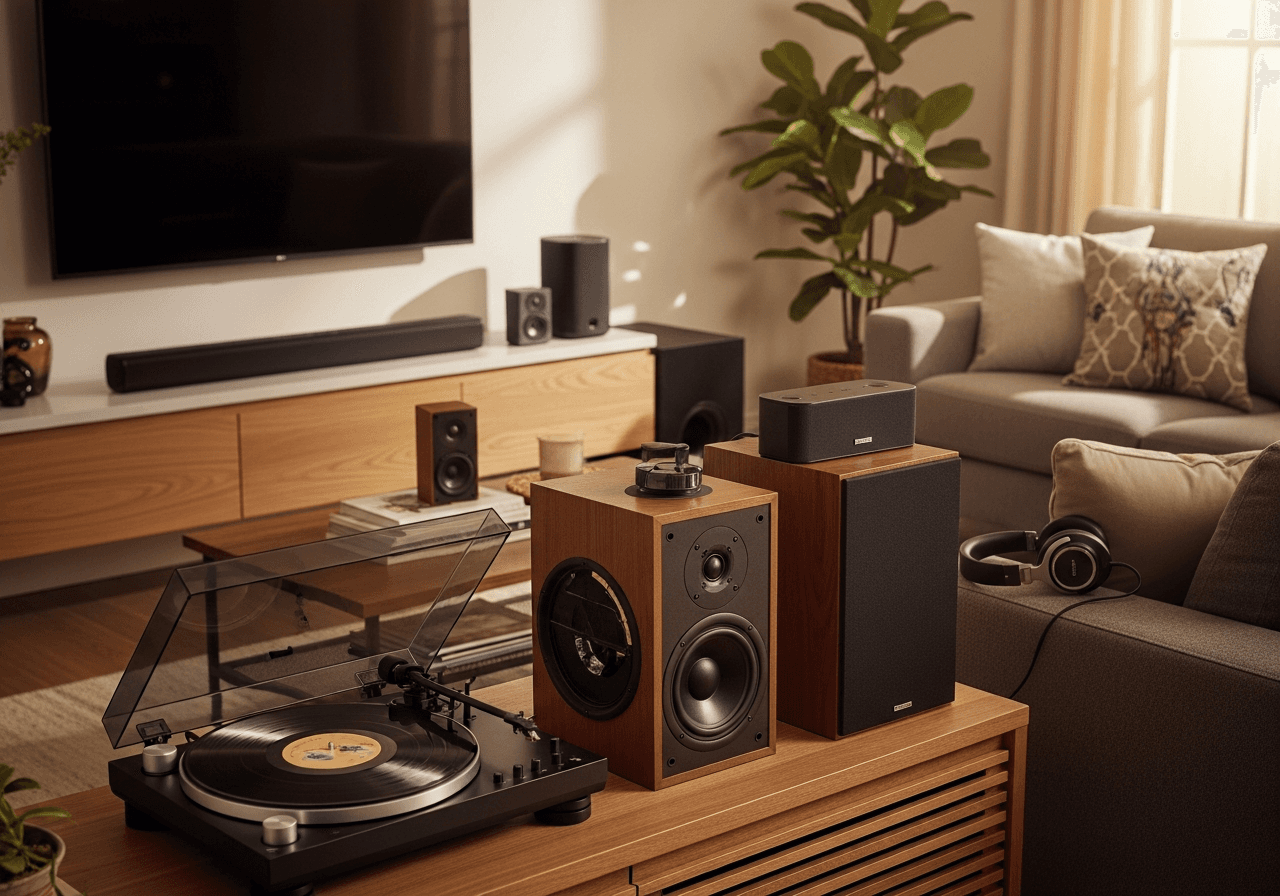
An active speaker has the amplifier built into the cabinet. You feed it a digital or analog signal and it does the rest. Two reasons this matters in retirement: fewer boxes, fewer cables. KEF, Edifier, Kanto and the long-running Audioengine line all make active pairs in the $300 to $1,500 range that pair with a phone, a turntable and a TV without needing a separate receiver. For a smaller condo or a den, this is the cleanest path I know.
3. Stereo receiver plus a pair of bookshelf speakers
The traditional setup, and still the right answer if you have legacy equipment - a CD player, a tape deck, a turntable - that needs somewhere to plug in. Yamaha's R-N series and the equivalent Marantz and Onkyo models include built-in phono inputs, network streaming and Bluetooth. A modest pair of bookshelf speakers from Wharfedale, ELAC or Klipsch will run you $300 to $700 and be the last speakers you ever buy if you treat them well. I have a pair from 1991 that still works.
4. Whole-home or multi-room systems
This is where I have to give a friendly warning. Sonos was the default recommendation for a decade. In May 2024 the company shipped a new app that broke a long list of features - missing queue, missing alarms, speakers vanishing mid-song. By February 2025 the CEO was out, the company had laid off 12 percent of staff, and the queue feature was not restored until September 2025. The hardware is still excellent; the software is still climbing back. Sonos is again a reasonable pick in 2026, but go in with eyes open.
Alternatives worth considering: Bluesound for high-resolution audio (FLAC, MQA, 24-bit) at $100 to $200 more per unit, Denon HEOS if you already own Denon or Marantz gear, and WiiM for budget buyers who want the streaming bones without the full ecosystem lock-in.
5. Headphones
Easily the highest sound-quality-per-dollar category in audio. A $200 pair of wired Sennheiser or Audio-Technica headphones will out-resolve a $2,000 speaker setup in absolute terms, with the obvious caveat that you have to wear them. For those of us with a spouse who reads in the same room, or a hearing aid that pairs over Bluetooth, this is more useful than people give it credit for. Noise-cancelling models from Bose and Sony are worth the premium if you fly more than twice a year.
6. The turntable, if it applies
Vinyl sales have grown every year since 2007. If you have a stack of records, the entry point in 2026 is straightforward: a belt-drive turntable from Audio-Technica, Pro-Ject, Rega or U-Turn, run into a receiver with a phono input or a $50 outboard phono preamp, then into your speakers. Avoid the all-in-one suitcase players with built-in speakers. They wear records out faster than they pay for themselves.
7. The amplifier and DAC question
In 2026, almost every receiver and powered speaker has a competent DAC built in, and unless you are a serious headphone listener or you have inherited a pair of speakers that need real wattage, you can skip the separates conversation. If you do go down that road, the specifications that matter are continuous power output (watts per channel into 8 ohms, all channels driven), signal-to-noise ratio (90 dB or better), and total harmonic distortion (under 0.1 percent). Anything quoted as peak wattage rather than continuous is marketing.
Three pitfalls to avoid
- Buying for a room you do not have. Atmos surround with ceiling speakers is wonderful in a dedicated theater room. In a living room with a sofa against the back wall, you will hear about a third of what you paid for.
- Subscription creep. Some of the new lifestyle systems push you toward a paid streaming tier, a paid hi-res tier, and a paid voice-assistant tier. Read the fine print before you commit. A standalone Spotify or Apple Music subscription should be the only recurring cost.
- Speaker cable nonsense. 14-gauge oxygen-free copper from a hardware store is acoustically indistinguishable from a $200-per-meter audiophile cable. Spend the difference on a better record or a better recording.
The takeaway
Starting from zero in a typical retiree home - say a 14 by 18 living room, a TV on the wall, a phone full of music, maybe a small record collection in the closet - I would buy a midrange soundbar with a wireless subwoofer for the television, a pair of active bookshelf speakers for the kitchen, and a decent pair of wired headphones for late nights. Total outlay, $700 to $1,200. That covers 95 percent of how a household actually uses music, and it leaves room in the budget for the part that matters most, which is the music itself.
The best sound system, in my experience, is the one you actually turn on.