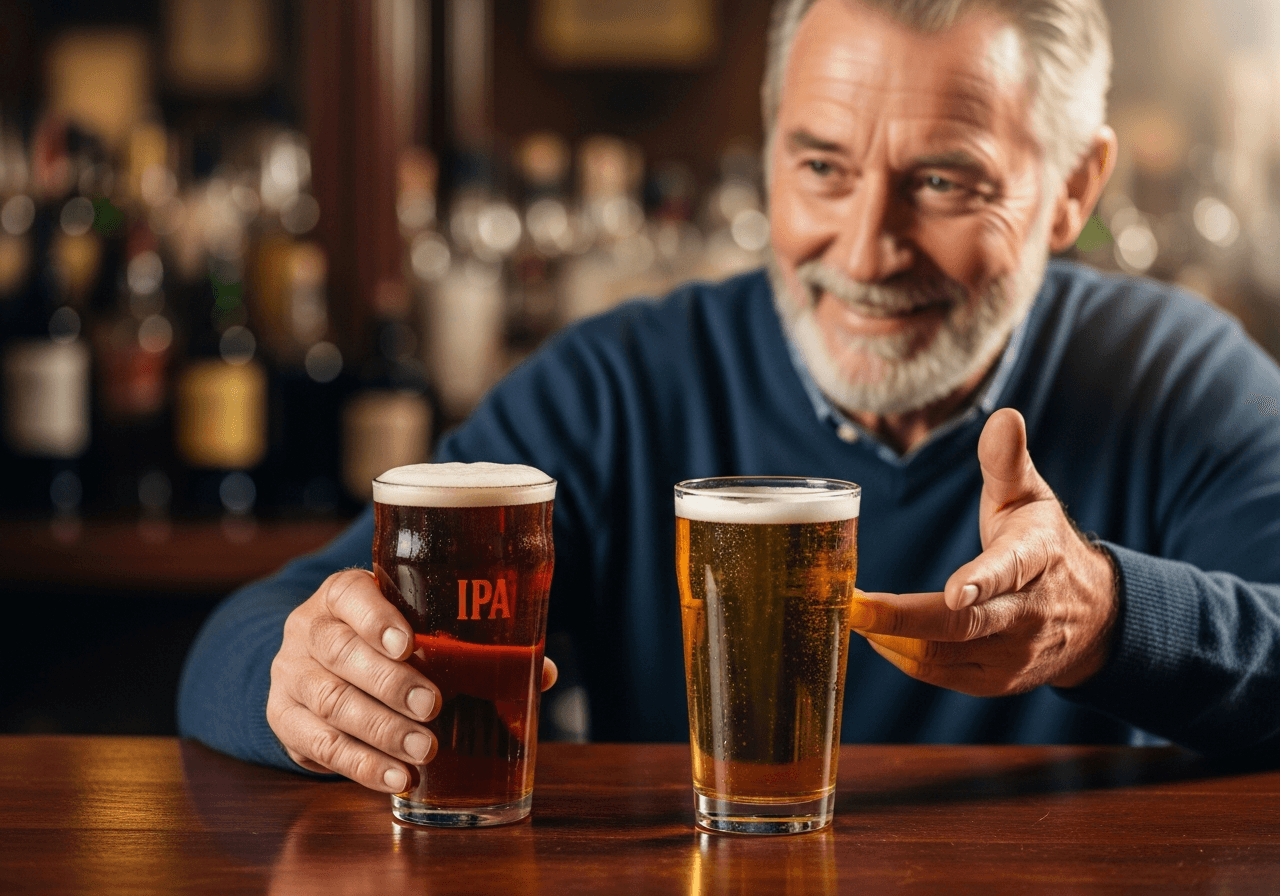
The first IPA I ever poured at McGinty's Tap was off a keg of Anchor Liberty Ale in maybe '94. The guy who ordered it took one sip, made a face like he'd licked a pinecone, and asked me to pour him a Yuengling Lager instead. That was about the size of craft beer in Kensington back then. Thirty years on, sitting in my basement in Holmesburg with Bruno snoring under the brew kettle, the IPA-versus-lager question still comes up at the Saturday class I teach at the senior center, and the answer is simpler than the beer-aisle wall makes it look.
Short version. An IPA is a kind of ale. A lager is a lager. The split happens before the hops ever go in the kettle. It's about yeast.
Ale versus lager, which is where this all starts
Every beer in the world is one of two things: an ale or a lager. The difference is the yeast and the temperature it likes.
- Ale yeast works warm, around 60 to 72 degrees, and it works on top of the wort. It's fast. A week or two and you've got beer. It also throws off fruity, spicy little flavors the brewers call esters and phenols. That's where you get the banana note in a German hefeweizen, the pear and clove in a Belgian saison, the marmalade thing in a good English bitter.
- Lager yeast works cold, around 45 to 55 degrees, and it works on the bottom. It's slow. Four, six, eight weeks of cold conditioning before it's ready. The word lager is German for "to store," and that's exactly what you're doing. Because lager yeast is shy about flavor, what you taste in the glass is the malt and the hops, clean, with not much yeast character riding shotgun.
So IPA — India Pale Ale — is an ale. Pilsner, helles, märzen, Vienna, bock, schwarzbier, your American light lagers, those are all lagers. Same grain bill possibilities, very different yeast doing very different work.
What an IPA actually is
The story you'll read on the back of a six-pack — British brewers loaded extra hops into pale ale so it'd survive the trip to India in the 1700s — is part true and part bar-room legend. Hops do preserve beer, but the style wasn't invented for the voyage. Doesn't matter much for our purposes. What matters is what it turned into.
An IPA today is a pale ale dialed up on hops. More hops in the boil for bitterness, more late in the boil for aroma, and then dry hopping — tossing hops into the fermenter where they don't get boiled, which is what gives you all that grapefruit, pine, mango, passion fruit business in the nose. A standard American IPA runs around 6 to 7.5 percent ABV and 40 to 70 IBUs. A session IPA is lower. A double or imperial IPA can hit 8 to 10 percent, and you respect it.
By 2026 the IPA has split into a few clear camps:
- West Coast IPA. Clear, dry, bitter, pine and citrus from the hops. This was the dominant American style for years, fell out of fashion when hazy IPAs took over, and over the last couple of years has come roaring back. A lot of breweries are putting out modernized West Coasts using the newer hop varieties — Strata, Nelson, Citra — and finishing them dry the way nature intended.
- Hazy IPA, or New England IPA. Cloudy, soft, juicy, low bitterness, more like drinking fruit juice that happens to be 7 percent. Tree House and Trillium kicked the door open about a decade ago. The style still sells, but the heat has come off — Brewers Association data through 2025 shows hazy growth slowing and West Coast picking up the slack.
- Cold IPA. A newer one. Brewed with lager yeast at warmer temperatures and a rice or corn adjunct, giving you a hoppy beer with a crisp, lager-like finish. Half the brewers I respect think it's the most interesting development of the decade. The other half think it's a marketing trick.
- Session, double, triple. Same family, different alcohol strengths.
What a lager actually is
Lager is where most of the beer in the world lives. Budweiser, Coors, Miller, Heineken, Stella, Modelo, Yuengling Traditional, every Japanese rice lager, every Mexican vienna, the German pilsners, the Czech pilsners, the bocks, the dunkels. All lagers. The yeast is the same family doing the same cold, slow work.
A good lager is a hard beer to make. There's nowhere to hide. The fruity esters that an ale yeast would throw to cover a flaw aren't there. If your fermentation temperature drifted, if your water chemistry's off, if your malt's stale, you taste it.
The lager corner of the craft world has been the quiet story of the last couple of years. American craft beer overall has been off — down around 4 percent in 2024 and another 5 percent in 2025, with more breweries closing than opening for the first time since 2005. But light American lagers are up. Garage Beer, the one the Kelce brothers put their name on, debuted high on the craft brand list. Tivoli's Outlaw is another. Yuengling, which a Pennsylvania kid like me would call the original American craft lager whether the Brewers Association agrees or not, just keeps rolling.
How they taste, side by side
If you put a pint of West Coast IPA and a pint of German pilsner in front of you blind, here's what you'd notice.
- Aroma. The IPA hits you in the nose with citrus, pine, tropical fruit. The pilsner is more delicate — bread crust, a little floral note from noble hops.
- Bitterness. Both have it. The IPA carries more, and it lingers. The pilsner is bitter in a clipped, clean way that disappears between sips.
- Body. The IPA usually has more weight, especially the hazy. A good pilsner is light on the palate and dry at the finish, which makes it the best food beer on the planet in my opinion.
- Alcohol. Most lagers run 4 to 5.5 percent. Most IPAs run 6 to 7.5. That gap matters when you're past 60 and on a couple of prescriptions.
Practical takeaway, especially past 60
If you're newer to craft and don't know where to start, I'd point you at a clean German or Czech pilsner first — Victory Prima Pils out of Downingtown is in every Wawa cooler for a reason — and a West Coast IPA second. Those two beers, well made, tell you what the hops and the malt can each do on their own. Once you know what bitter tastes like and what malt tastes like, the rest of the menu makes sense.
A few last things from someone who's been pouring this stuff since Reagan was in the White House. Pour your beer into a glass; the can kills the aroma you paid for. Drink the lager colder than the IPA — a pilsner at 38 to 42 degrees, an IPA at 45 to 50. Buy fresh — IPAs go downhill fast, three months from the canning date and the bright hop aroma is mostly gone. And if you're trying to drink less without giving up the ritual, the non-alcoholic side has gotten genuinely good. Athletic and Best Day put out IPAs and lagers I'd serve at the bar without an asterisk.
Bottom line: IPA is an ale, made warm and fast, leaning hard on hops. Lager is brewed cold and slow, leaning on a clean malt backbone. Room for both on a Tuesday night. Bruno doesn't care either way as long as I don't spill any on the rug.