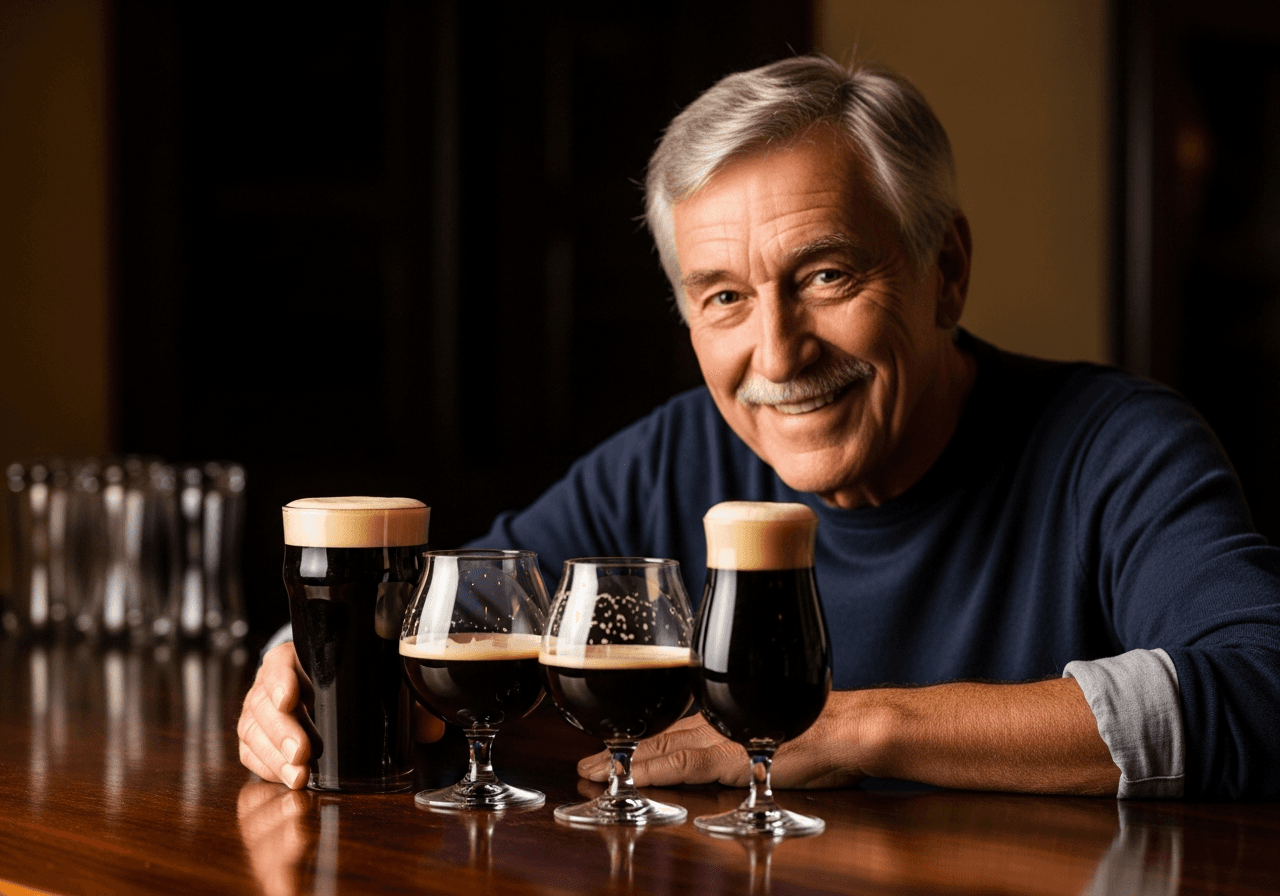
The first beer I ever pulled at McGinty's Tap was a Yuengling Porter, on a Tuesday in 1989, for a guy named Frank who drove a Septa bus and didn't say much. He drank it slow, paid in singles, and walked back out into the Kensington afternoon. I remember it because the porter was sweating on the bar before he was halfway through, and I thought, well, that's a beer that asks you to sit with it. Thirty-some years later, sitting in my basement in Holmesburg with Bruno asleep on the rug, I still think about dark beer the same way. It's a beer that asks you to sit with it.
So when folks ask me about the supposed health business around dark beer — Guinness this, antioxidants that — I try to be honest. There's some real research behind it. There's also some marketing dressed up as research. After 30 years behind a bar and a few more brewing in the basement, here's how I'd lay it out for a fella who wants the straight story.
What people mean when they say dark beer
Dark beer isn't one thing. It's a category that covers porters, stouts, dunkels, schwarzbiers, brown ales, and a handful of others. What makes them dark is roasted malt — barley that's been kilned hard enough to take on color and the flavors that come with it: chocolate, coffee, toast, sometimes a little raisin or dried cherry. That roast is also where most of the so-called health story comes from, because roasting develops compounds called melanoidins, and dark beer is generally heavier in those than your average light lager.
For the record: ABV is not what makes a beer dark. Guinness Draught is 4.2 percent. A pale tripel can hit 9. Color comes from malt, not strength.
The Folts study, and why it still gets quoted
The famous one is from John D. Folts at the University of Wisconsin, presented to the American Heart Association back in 2003. They fed dark beer and light beer to dogs with narrowed arteries and reported that the dark beer did a better job of preventing clots. It got a lot of press, especially around St. Patrick's Day, and it's the source of about 90 percent of the "Guinness is good for you" chatter you still see in 2026.
Here's the part nobody mentions: it's been more than 20 years. It was a small study, in dogs, and there hasn't been a big follow-up in humans that confirms the same effect from drinking dark beer specifically. The compounds it pointed at — flavonoids, the antioxidants in hops and roasted malt — are real. The leap from "has antioxidants" to "pour yourself a stout for your heart" is the part you want to be careful with.
What more recent research actually says
The research that's come along since is more measured. A few things to know if you're 60-plus and trying to make sense of it:
- Stouts and porters do test higher for antioxidant activity than pale lagers. That's been replicated in food-chemistry journals. The melanoidins from roasted malt, plus xanthohumol from hops, are doing real work in the glass.
- The 2025 Dietary Guidelines update softened the older "up to one or two drinks a day" language. The newer advice is closer to "consume less alcohol for better health," full stop.
- A 2024 study in JAMA found that even moderate drinkers had a slightly higher death rate than non-drinkers, mostly from cancer and cardiovascular causes. The American Heart Association's own 2025 scientific statement is plain about it: don't start drinking for your heart.
- The old "a glass a day is good for you" story is mostly outdated. The antioxidants in a stout are real. They're also in blueberries, dark chocolate, and a cup of coffee, with none of the alcohol attached.
I'm not telling anyone to put their pint down. I drink one most evenings. I am telling you that the health pitch on dark beer is thinner than the headlines made it sound.
What dark beer is actually good at
Forget the medical claims for a minute. Here's what a good dark beer genuinely does well, and why I'd reach for one over a light lager nine nights out of ten:
- It pairs. A dry Irish stout with oysters, a sweet stout with a brownie, a porter with a bowl of beef stew on a January night. Dark beer plays nicely with food in a way most pale lagers don't.
- It's filling. One pint of a 4.5 percent porter satisfies the way three light beers don't. For a man my age who's watching his weight and his sleep, that matters.
- It's a drinker's beer, not a binger's beer. Nobody pounds a stout. You sit with it. That's a feature, not a bug.
- It rewards lower temperatures than the can says. Most stouts and porters open up around 50 to 55 degrees. Fridge-cold, you miss half of what you're paying for.
A handful of dark beers worth knowing in 2026
The dark-beer landscape has shifted since I retired. The "pastry stout" thing — stouts loaded up with vanilla, lactose, and dessert flavors until they taste like liquid cake — had its moment around 2020 and is finally easing back. A lot of craft brewers are leaning toward drier, more traditional dark beers again, which suits me fine. A few that have held up:
- Guinness Draught. Still the benchmark dry Irish stout. 4.2 percent, light on the wallet for what you get.
- Yards Love Stout (Philadelphia). An English-style oatmeal stout with some history behind it. Local pride aside, it's just a good beer.
- Founders Porter (Michigan). A reliable American porter. Chocolate, coffee, no nonsense.
- Deschutes Black Butte Porter (Oregon). Been around since the late '80s and never lost a step.
- Yuengling Porter. Pennsylvania's oldest brewery still makes a porter that costs less than a fancy coffee. That's worth something.
If you're newer to dark beer, start with a dry Irish stout or an English porter before you get into the imperial stuff. The big 10-percent bourbon-barrel-aged stouts are wonderful, but they're a dessert, not a session.
Practical takeaway, especially past 60
Look — the Folts study isn't a prescription, it's a footnote. If you enjoy a dark beer, enjoy it. If you don't drink, the science doesn't give you a reason to start, and the more recent science is pretty quiet about reasons to keep going past a glass or two.
What I'd tell any guy my age: drink less than you used to, drink better than you used to, and drink it at the right temperature with somebody you like. Watch the medications — a lot of the stuff we're on past 60 doesn't mix well with beer, and that's a real concern, not a marketing one. Talk to your doctor honestly, not the way you'd talk to the bartender.
And if you do pour a pint of stout tonight, give it five minutes out of the fridge before you drink it. You paid for the flavor. Let it show up.