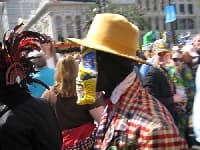
I remember when our daughter Allison came home from her sophomore year at the University of Iowa with a strand of purple, green, and gold beads slung around her neck and a grin a mile wide. She'd been to a Mardi Gras-themed mixer at the student union, and she could not stop talking about king cake. Paul, my son-in-law, hadn't even met her yet, but I think that's the moment I started paying attention to a holiday I'd only ever seen on the evening news. Out here in Cedar Rapids, we don't have parades down Bourbon Street, but the story of Mardi Gras is so much older and gentler than the late-night footage suggests.
This year, Fat Tuesday lands on February 17, 2026, which means the Carnival season is already well underway by the time most of us put away our Christmas tins. If you've ever wondered where the whole tradition came from, settle in with a cup of coffee. It turns out the history is rich, and a good deal of it has nothing to do with what you've seen on a postcard.
Where the Celebration Began
Long before the floats and the brass bands, people in the ancient world were marking the slow turn of winter into spring. Roman festivals like Saturnalia and Lupercalia gathered communities together for feasting, costumes, and a little harmless mischief. When Christianity took root across the Roman world, church leaders did something rather sensible, I think. Instead of trying to stamp out the older festivities, they folded them into the new calendar. The big party simply moved to the days right before Lent, when the faithful would give up rich foods for forty days of reflection.
That's where the name Carnival comes from. Most scholars trace it to the Latin carne levare, meaning roughly "to put away the meat." The French phrase Mardi Gras, meaning Fat Tuesday, refers to that last big day before Ash Wednesday when families would use up the eggs, milk, butter, and meat in the pantry. They couldn't very well let it spoil during Lent, could they? So they baked, they cooked, they invited the neighbors over.
Honestly, that part feels familiar to me. It's the same reason my mother used to make pancakes on what she called Shrove Tuesday when I was a girl in the 1960s. I didn't know it then, but she was carrying on a tradition that runs straight back through medieval Europe.
How Mardi Gras Crossed the Ocean
The version most Americans picture today owes a great deal to two French explorers, Pierre Le Moyne d'Iberville and his younger brother Jean-Baptiste Le Moyne de Bienville. In 1699, they came ashore at a spot about sixty miles south of where New Orleans now sits. It happened to be the eve of the holiday back home in France, and they marked the day by naming their landing point Pointe du Mardi Gras. A small gesture, but a meaningful one.
From that beginning, the celebration grew through the colonial years. Street parties, masked balls, and elegant suppers became fixtures of New Orleans life. Then came a quieter stretch. When Spain took control of the territory, the public festivities were largely shut down, and they stayed muted until 1812, when Louisiana was admitted to the Union. After that, things came alive again in earnest.
Costumed students were dancing in the streets by 1827. The first recorded New Orleans parade rolled out a decade later, in 1837. And in 1857, a group of businessmen calling themselves the Mistick Krewe of Comus organized a torchlit procession with floats and marching bands. From that night onward, the krewes, those member-run social clubs, became the backbone of the celebration. They built the floats, sewed the costumes, and tossed the beads. They still do.
What You'll See Today
Modern Mardi Gras isn't just one day. The 2026 season opened on Twelfth Night, January 6, and it runs all the way to Fat Tuesday on February 17. According to New Orleans & Company, the city's official tourism office, the parades are free to attend, which I find rather remarkable given how much work goes into them. Some of the krewes you'll hear about most often are Bacchus, Endymion, Rex, and Proteus. Each has its own personality and its own throws, the little keepsakes they fling into the crowds.
If you decide to make the trip, the last weekend leading up to Fat Tuesday is the busiest stretch. Folks I've spoken with who've visited say to book your hotel six months ahead, especially in 2026, since the holiday weekend overlaps with Valentine's Day and Presidents' Day. That's a tall order for a spur-of-the-moment trip, but it's good information to tuck away for next year.
The Colors and the Cake
Three colors run through everything: purple for justice, green for faith, and gold for power. They were chosen in 1872 by the Krewe of Rex, and they've stuck ever since. You'll see them on banners, doorways, and especially on the king cake.
King cake is the part I find most charming, probably because it reminds me of the coffee cakes I used to bake for the teachers' lounge. It's a soft, cinnamon-laced ring of brioche dough, glazed and dusted in those same three colors. Hidden inside is a tiny plastic baby, and whoever finds the baby in their slice is meant to bring the cake or host the gathering next time. The custom traces back to the 12th-century French celebration of Epiphany, when a similar cake honored the visit of the Magi to the Christ child. The plastic baby itself is a more recent flourish, popularized by a New Orleans bakery in the 1940s.
Beyond Louisiana
Louisiana is still the only state that recognizes Mardi Gras as a legal holiday. But Mobile, Alabama, has its own deep tradition, and parts of Mississippi and Texas hold celebrations of their own. Around the world, you'll find Carnival festivities in Brazil, Italy, Germany, and many places with strong Roman Catholic histories. Each country puts its own stamp on the season, but they all share that same root, the desire to gather and feast before a quieter time of year.
A Few Gentle Suggestions for the Rest of Us
If you can't make it to New Orleans, the celebration is easier to bring home than you might think.
- Bake a king cake on the Sunday before Fat Tuesday. Most grocery stores sell the colored sugars by early February, or you can mix granulated sugar with a drop of food coloring.
- Have the grandchildren over for pancakes that evening, the way my mother did. It's a nice excuse to use up a few things from the refrigerator.
- String a few beads on the mailbox or the porch railing. My neighbor here in Cedar Rapids does it every year, and it always makes me smile.
- If you have a Catholic friend or family member observing Lent, ask them what they're giving up this year. It's a kind way to start a conversation.
The history of Mardi Gras isn't really about one wild night. It's about a community marking the seasons, using up what's on hand, and gathering before a stretch of quiet. I think that's something we can all appreciate, whether we're in the French Quarter or right here in the Iowa cornfields. Wouldn't you agree?