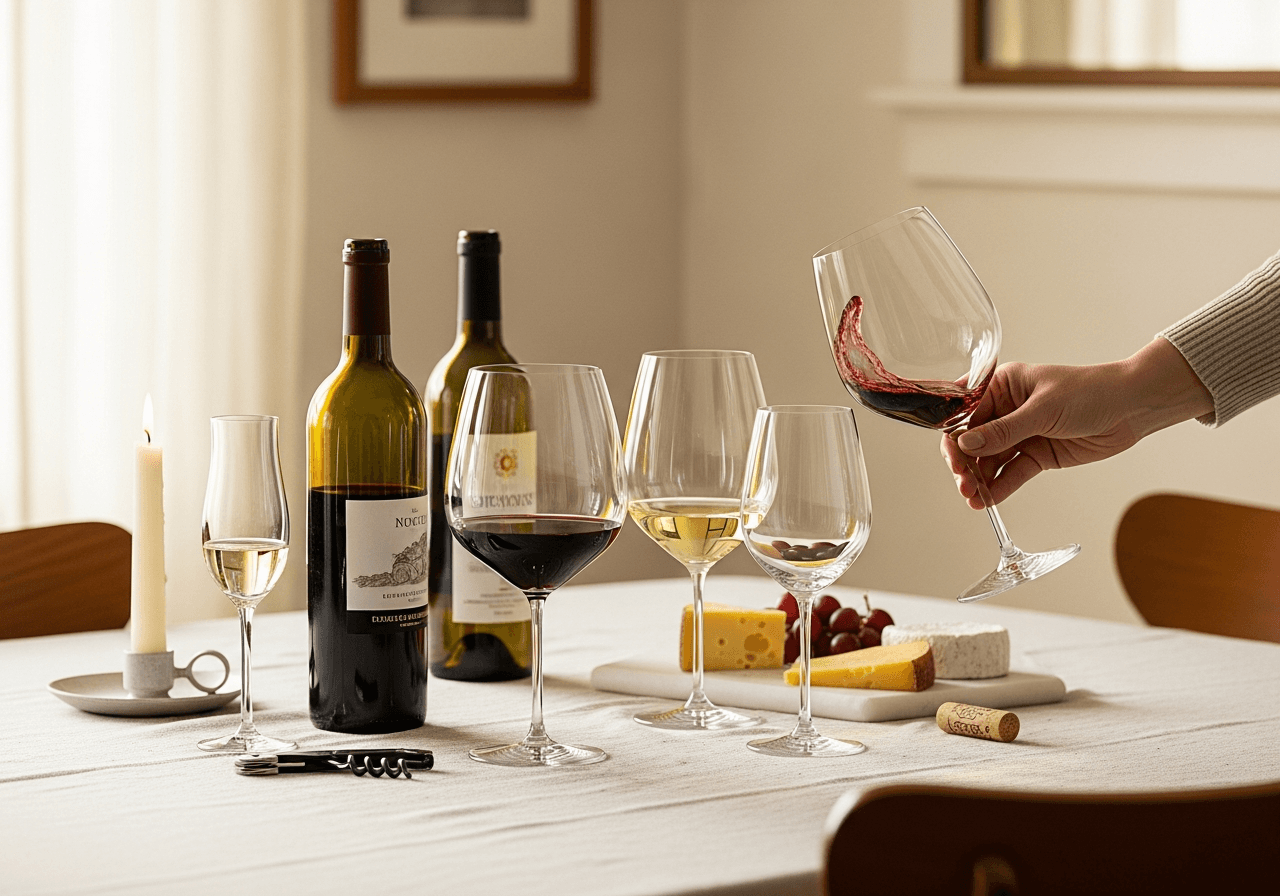
Susan keeps four kinds of stemware in the cupboard out here in the barn. That is it. We sold the rest, or gave it away, when we moved from Connecticut in 2019. For forty years I had argued with restaurant managers and importers about glassware — the right bowl for Burgundy, the right rim for a young Cabernet, the wrong tumbler for Riesling — and at the end of it I came to the same place a lot of producers come to in private: most people, most nights, are better off with fewer good glasses than a cabinet full of mediocre ones. The pour matters. The shape matters. The number of shapes does not matter nearly as much as the catalogues would like you to think.
Why the shape changes the wine
This is not marketing. A glass with a wide bowl gives a young Cotes du Rhone room to breathe and lets the perfume off the surface. A narrower bowl with a slightly tapered rim concentrates the aromatics on a delicate Pinot Noir or a Riesling so you actually smell the fruit and not the alcohol. A tall, narrow shape preserves the bubbles in a Champagne but, as I will get to, hides the wine itself from you. None of this is in dispute. The dispute is how many different bowls you need to make these things happen at home.
Hold a glass by the stem, not the bowl. Pour it about a third full. Swirl it gently. Put your nose well inside the rim, not hovering above it. Those four habits do more for the wine in front of you than buying another set ever will.
The case for one glass that does most of it
Twenty years ago I would have told you to have a Bordeaux glass, a Burgundy glass, a Riesling glass, a flute, and maybe a port glass. Today I would not. There is a clear shift, even among serious tasters, toward what people are calling the universal wine glass. Producers like Zalto and Gabriel-Glas in Austria and Riedel’s Performance line have all converged on a similar idea: one bowl, generous but not enormous, tapered at the rim, that handles most reds, most whites, and even Champagne better than a flute does.
Gabriel-Glas built its whole brand around that one shape. Zalto’s Universal is on the back bar of more good restaurants now than any varietal-specific piece. If you are starting a cupboard from scratch at sixty-five and you do not want to manage twelve sets, six of these is a very honest answer. The wine sits well. You can wash them by hand. You are not making a federal case out of opening a bottle on a Tuesday.
What that one glass should look like
- Clear glass. No cut crystal patterns, no tint. You want to see the wine.
- A bowl that holds about 18 to 22 ounces when filled to the brim. You will only ever pour a third of that. The empty space is the point.
- A rim that tapers in slightly from the widest part of the bowl. Not a tumbler shape, not a tulip, somewhere in between.
- A stem long enough to keep your hand off the bowl. Warm hands warm wine.
- A thin rim. This is the one place price genuinely shows up. A laser-cut or hand-pulled rim disappears against your lip. A thick rolled rim gets in the way of the wine.
When the old varietal-specific advice still helps
If you drink enough of one thing that you know it well, a dedicated glass is not a waste. I keep a pair of true Burgundy bowls for Pinot Noir from Volnay or the Russian River, because the wide bowl really does open them up in a way a universal does not quite manage. Susan keeps two flutes for the rare occasion when she wants the visual of bubbles climbing a column, which is a Christmas Eve thing in our house and not a serious tasting thing.
For everyone else, the old rules still apply where they apply:
- Big, structured reds — Cabernet, Napa blends, big Tuscan Sangiovese — like a bowl with vertical sides that drives the wine to the middle of the tongue.
- Lighter, more aromatic reds — Pinot Noir, Nebbiolo, Gamay — like a wider, rounder bowl with a tapered rim. A Burgundy glass is the classic.
- Crisp whites — Sauvignon Blanc, Albarino, Pinot Grigio, Chablis — like a smaller bowl. The wine stays cooler. A standard white wine glass is fine.
- Richer whites — oaked Chardonnay, white Burgundy, white Rhone blends — like something closer to a small red wine bowl, because the aromatics are doing more work.
- Rose — anything from a Provence pour to a Tavel — does well in a white wine glass. The dedicated rose glass is mostly a marketing exercise.
- Dessert wines and port — a small tulip is genuinely useful, because you are pouring an ounce or two and a big bowl swallows it.
A word on the flute
The flute is on its way out for serious Champagne drinking, and has been for several years now. The producers themselves taste in white wine glasses. A flute keeps the bubbles pretty for the table but it traps the aromatics down the column, which is the entire point of a good grower Champagne. If you have a set, fine, use them when you want the picture. If you are buying new, do not bother with a dedicated flute. A universal or a white wine glass does the wine more justice.
Stemless, crystal, dishwashers, and other practical questions
Stemless tumblers are easier on a wrist that does not love a thin stem anymore, and they break less. Susan likes them for the front porch in the afternoon. They warm the wine faster than stemmed glasses, so finish the pour. If a thin stem feels precarious — and it does for some people in their seventies, no shame in it — a short-stemmed all-purpose glass is a good middle ground.
Lead crystal is mostly out. Modern fine glassware is lead-free crystal or sturdy soda-lime glass. Both can be beautiful. Both can be thin at the rim. Do not pay extra for the word crystal alone.
About the dishwasher: most quality glasses today are dishwasher-safe on a gentle cycle, but I still wash the thin-rimmed ones by hand. Half a minute under warm water and a soft cloth, dried right away. Worth the trouble.
What I would actually buy at sixty-five
Six universal glasses for everyday. A pair of Burgundy bowls if you love Pinot. A pair of small tulips for port or a late-harvest Riesling. That is nine glasses, total. They will fit on one shelf. They will cover ninety percent of what you drink for the rest of your life. You will not stand at the cabinet trying to remember which bowl goes with the Chianti from a producer your daughter brought up from the city.
The wine is the point. The glass is in service to it. When the glass starts feeling like the point, you have drifted into furniture, not drinking, and the wine is what suffers.