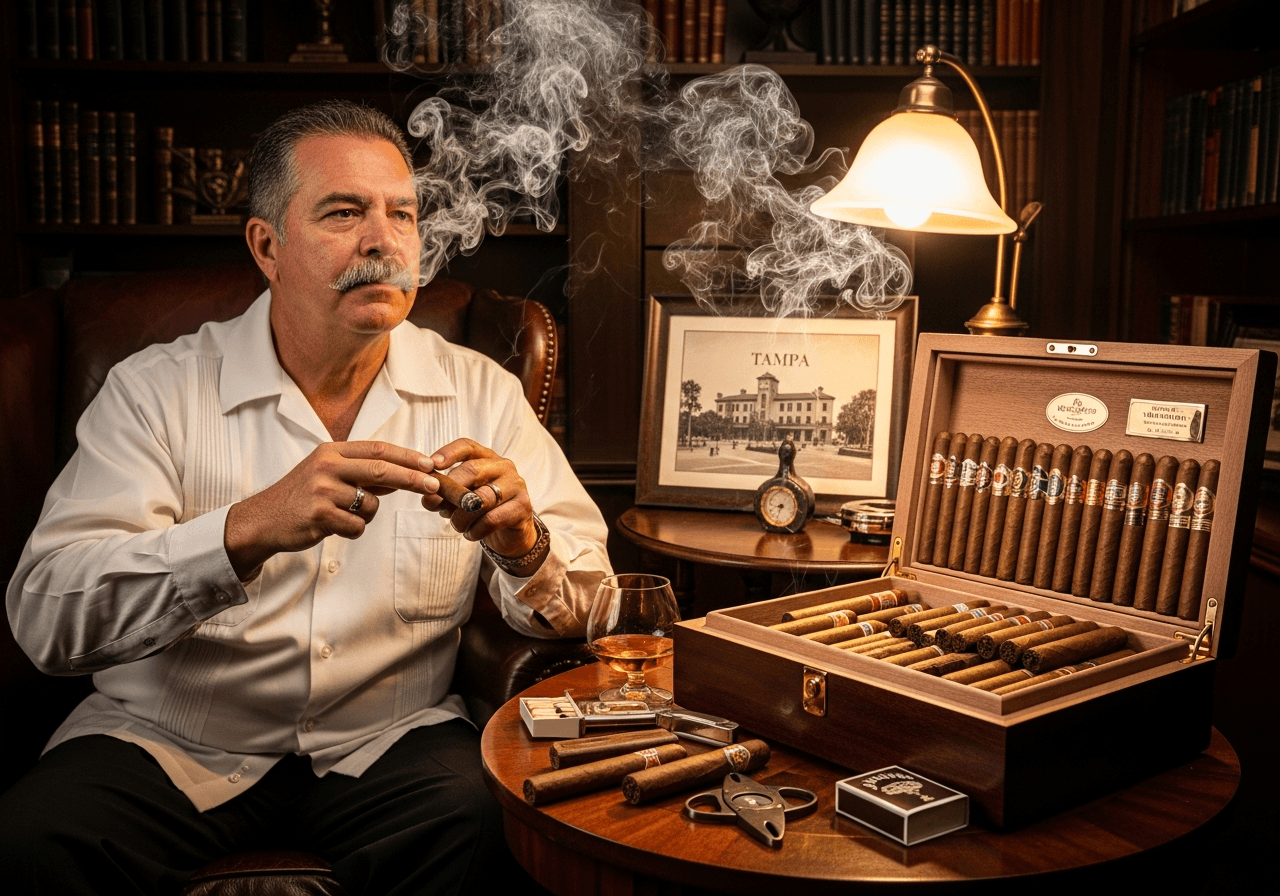
The old shop on Seventh Avenue had a back room where the regulars settled in after lunch. Some came for a cigar. A few favored a pipe. One old fella, a barber from across the street, rolled his own cigarettes with a little metal jig that had to be sixty years old. Forty-some years behind that counter taught me that tobacco isn't one thing. It's a family of small rituals, and each branch of the family has its own manners.
This piece is for the reader who already knows the smell of a tobacco shop and wants a plain rundown of what each method actually is, what it asks of you, and where it sits in 2026. I'm not here to sell anyone on lighting up. The Surgeon General has been clear for sixty years. But if you're going to do this, do it knowingly, slowly, and with some respect for the leaf.
Cigars
A premium cigar is three things put together by hand: a filler of long leaves, a binder leaf that holds the filler in shape, and a wrapper leaf chosen for color, flavor, and presentation. Connecticut shade gives you that pale, mild morning smoke. Habano and Sumatran wrappers run spicier. A Maduro, fermented dark, brings sweetness and cocoa notes. Nothing about a good cigar is fast.
Brands I trust because I sold them for decades: Padron, Arturo Fuente, Ashton, Oliva, Tatuaje, My Father. Plenty of others do honest work. A premium cigar will run you somewhere between eight and twenty-five dollars these days, which is double what it was when I opened in 1979. Inflation hit la fabrica the same as everywhere else.
One bit of news worth knowing: in January 2025, the D.C. Circuit Court of Appeals agreed that the FDA cannot regulate premium cigars under the 2016 deeming rule. That covers cigars made of long-filler tobacco, weighing more than six pounds per thousand, with only tobacco, water, and vegetable gum. It does not cover flavored cigars or machine-made cigarillos. Those are still under FDA authority, and pipe tobacco is too.
How to smoke one properly: cut just past the cap with a sharp double-blade or a punch. Toast the foot with a soft flame, then light slowly while turning the cigar in your fingers. Draw, don't suck. A premium cigar wants forty-five minutes to an hour and a half of your time. If you're rushing it, you're wasting it.
Pipes
A pipe is the most patient way to use tobacco. The shop on Seventh Avenue had a pipe corner where I'd see the same three or four men every Saturday for thirty years. They didn't smoke much, but they smoked thoughtfully.
Briar is the traditional bowl wood, cut from the root burl of the heath shrub. Meerschaum is the white mineral pipe that takes on a warm caramel color over years. Corncob is the cheap, honest option that smokes just fine — Missouri Meerschaum is still making them after a hundred and fifty years.
Pipe tobacco is a different animal from cigar tobacco. Virginias are bright and naturally sweet. Burleys are nuttier, lower on sugar, often the base of an American blend. Latakia, smoke-cured over fragrant wood, is the dark note in an English mixture. Perique, fermented in barrels in Louisiana, adds pepper and figgy depth. Cornell & Diehl in North Carolina is still hand-blending small batches, and the big consolidation news in pipe tobacco recently was Scandinavian Tobacco Group acquiring Mac Baren and Sutliff. Shelves are still stocked, but the list of independent blenders gets shorter every year.
To smoke a pipe: pack in three stages — loose at the bottom, firmer in the middle, springy at the top. A charring light, then a tamp, then the real light. Sip the smoke. If it bites your tongue, you're pulling too hard or the leaf is too damp. Slow down.
Hookahs
The hookah came west from the Middle East and South Asia, and it's been around American college towns and Mediterranean neighborhoods long enough that it's no longer exotic. The water pipe pulls smoke from a clay or ceramic head, through water in the base, and up a long hose to the smoker.
What you're smoking is usually shisha — tobacco mixed with molasses or honey and flavorings, heated by a charcoal on top of foil or a heat-management device. It is, by design, a long social sit. Two to four people sharing a hose over coffee or tea for an hour.
A word on the modern landscape: a few cities have moved against hookah lounges in the last two years. Sugar Land, Texas banned new ones in 2024. Cincinnati shortened operating hours. Seattle has had its own back-and-forth. The lounges that remain are often well-run, and many are tied to a specific cultural community. If you're trying hookah for the first time, go to an established place and let them set you up. Don't buy a cheap rig and a bag of charcoal off the internet without learning how the heat works.
Cigarettes
Cigarettes are the most common, the most studied, and the hardest to defend. Mass-produced, shredded tobacco in a paper tube, often with filter and additives. I sold them at the shop because customers asked, but the back room was for cigars and pipes.
Some people prefer to roll their own with loose tobacco and papers, which gives you control over the size and the leaf. Rolling papers come in rice, hemp, and wood pulp, in different weights. The roll-your-own folks I knew in Ybor were usually older Cuban men, and they generally smoked less than the pack-a-day crowd.
One thing every reader over sixty should know: the federal minimum age for buying any tobacco product has been twenty-one since December 2019, and the FDA finalized the enforcement rule in August 2024. That covers cigarettes, cigars, pipe tobacco, hookah tobacco, e-cigarettes, all of it. If your grandkids ask you to buy for them, the answer is no, and you can point to the law.
A few practical notes for the 60-plus reader
- Talk to your doctor. Tobacco interacts with blood thinners, blood pressure medication, and a long list of other prescriptions. Your cardiologist would rather hear about it than not.
- Cigars and pipes are not safe — they're different. The risk profile isn't the same as cigarettes, but it isn't zero. The American Cancer Society's guidance hasn't changed.
- Pick quality over quantity. One good cigar a week beats five cheap ones. One bowl of a Virginia-Perique blend on a Sunday afternoon beats a tin of drugstore aromatic.
- Store your tobacco right. Cigars want a humidor at sixty-five to seventy percent humidity, around sixty-eight degrees. Pipe tobacco keeps well in its sealed tin, then in a Mason jar once opened.
- If you want to quit, the resources are good now. 1-800-QUIT-NOW is free, and most Medicare Advantage plans cover cessation counseling. No shame in walking away from it.
I had customers who smoked one cigar a month for forty years, savoring it. I had customers who burned through stogies like cigarettes. I always preferred the first kind. Tobacco was never meant to be rushed. Whichever way you take it — by leaf, by bowl, by hose, or not at all — make the choice deliberate.