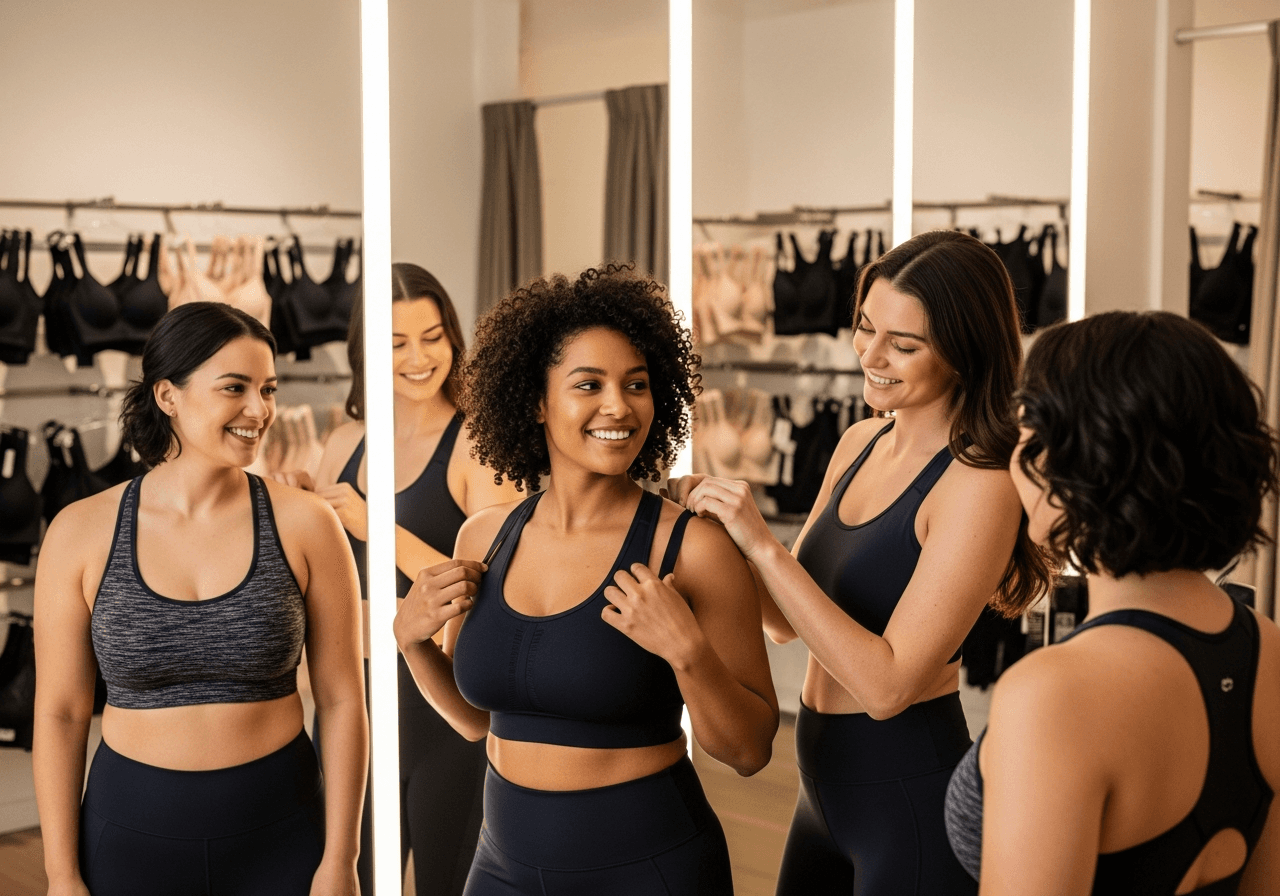
I walk Astoria Park most mornings, and on any given lap I can spot the women in the wrong sports bra. They are tugging at the band, rolling their shoulders, adjusting straps at the water fountain. Thirty-five years on the floor at Bloomingdale's taught me that a sports bra is not a fashion item. It is equipment. And like any piece of equipment, the wrong one makes the work harder and the right one disappears.
So let's go through this the way I would have walked you through it in the fitting room, with no fuss and no upselling.
Start with what you actually do
Before you think about cup or color or strap, think about the activity. A sports bra is rated for impact, and impact is the whole game.
- Low impact covers walking, gentle yoga, weight training, stationary biking, tai chi, water aerobics.
- Medium impact covers hiking, doubles tennis, dancing, elliptical, brisk power walking.
- High impact covers running, jumping rope, aerobics classes, pickleball if you really chase the ball.
Most women I fit at 60-plus live in the low-to-medium range, and that is the honest truth. If you walk the park, lift light weights, take a Silver Sneakers class, you do not need a competition-grade running bra. You need support that breathes and stays put.
Compression, encapsulation, and which one you need
There are two real styles, and the rest is marketing.
Compression bras press the breasts gently against the chest wall as one piece. Think of the classic pullover style. They are good for A and B cups doing low or medium impact. Easy on, easy off, and most of them are reasonably priced.
Encapsulation bras have two separate, shaped cups, the way an everyday bra does. They support each breast on its own. If you are a C cup or larger, this is what you want. The breasts move in three directions during exercise, not just up and down, and encapsulation handles all three. Compression alone, for a fuller bust, is a recipe for a sore back by Tuesday.
Many of the better bras now combine both. A shaped cup inside a supportive compression shell. For a D or DD doing anything brisker than a walk, that combination is your friend.
Band first. Always band first.
I will say what I said to every customer who came in worried about cup size: the band is the foundation. The band does eighty percent of the work. The straps are not holding your bust up; the band is.
To check a sports bra band:
- Put it on, settle yourself into the cups.
- Raise both arms over your head.
- If the band rides up your back, the band is too loose. Go down a size or tighten if it has hooks.
- The band should sit level, front and back, and feel snug but not pinching.
A sports bra band runs tighter than your everyday bra band by design. That is correct. It should not feel like a tourniquet, but it should feel firm.
Measuring yourself at home
You can do this in front of a mirror with a soft tape measure and no shirt on. Take your time.
- Band: wrap the tape snug under your bust, around the rib cage. Round to the nearest even number. That is your band size.
- Bust: wrap the tape loosely across the fullest part of the bust, keeping it level.
- Cup: subtract band from bust. One inch is an A, two is a B, three a C, four a D, five a DD, six a DDD.
If you have had a mastectomy, lumpectomy, reduction, or augmentation, your numbers have changed. They almost always do. Re-measure. And if one side is now noticeably different from the other, fit to the larger side and use a removable insert for the smaller one. That is the standard professional answer, and it works.
What to feel for in the fitting room
If you can try one on, do. Department stores still let you, and most online retailers have free returns now. Once it is on:
- Walk and bounce a little. Yes, in the dressing room. Jog in place for ten seconds. If anything flops or shifts noticeably, the support is wrong for your activity level.
- Look at the cup fabric. It should lay smooth. Puckering or wrinkling means the cup is too large. Spillage at the top or sides means too small.
- Check the straps. Slide a finger underneath. You should be able to fit one finger flat and no more. The strap is for guidance, not load-bearing. Wider straps spread the pressure, which matters at our age when shoulders are not as forgiving as they used to be.
- Run a hand under the arm. No seams cutting in, no scratchy edges, no chafe-prone elastic.
- Raise your arms. If the band leaves your ribcage, the bra is not going to do its job.
A note on closures, for hands that are not what they were
Arthritis is real, and back-clasping a tight sports bra is not always feasible. The good news is that front-closure sports bras have come a long way in the last few years. Magnetic clasps are out there. Zip fronts have gotten flatter and less bulky. Glamorise, Liberare, Springrose, and Enell all make front-zip or magnetic options designed for women who simply cannot reach behind their back the way they once could. No shame in that, and no reason to wrestle with a pullover that goes on like a wetsuit.
If a friend or family member is helping after surgery, front closures are a kindness to both of you.
Wide straps, breathable fabric, and the wicking question
Wide-set straps, ideally adjustable, will not dig in. A racerback can be supportive but it can also tug at the neck if you carry tension in your upper back. A U-back or convertible-strap design is gentler.
Look for moisture-wicking fabric. Polyester and nylon blends with a touch of spandex do the job. Cotton is comfortable but holds sweat, so if you tend to flush during exercise or are still navigating hot flashes after menopause, a synthetic blend will keep you drier. Many brands now offer a mesh panel at the back or under the bust to help with airflow. Worth it.
When to replace it
Sports bras wear out. The elastic gives, the band loses its grip, and suddenly the bra you trusted for two years is doing nothing. A rotation of three bras worn regularly tends to last about a year. If yours has been in service longer and feels loose even on the tightest hook, it is done. Thank it and move on.
The takeaway
You do not need a wall of bras. You need one bra that fits properly, sized to your real measurements, matched to the impact level of what you actually do. Try it on, raise your arms, check the band, and trust your body to tell you if it works. A good sports bra makes the morning walk in the park feel lighter. That is the whole point of the thing.